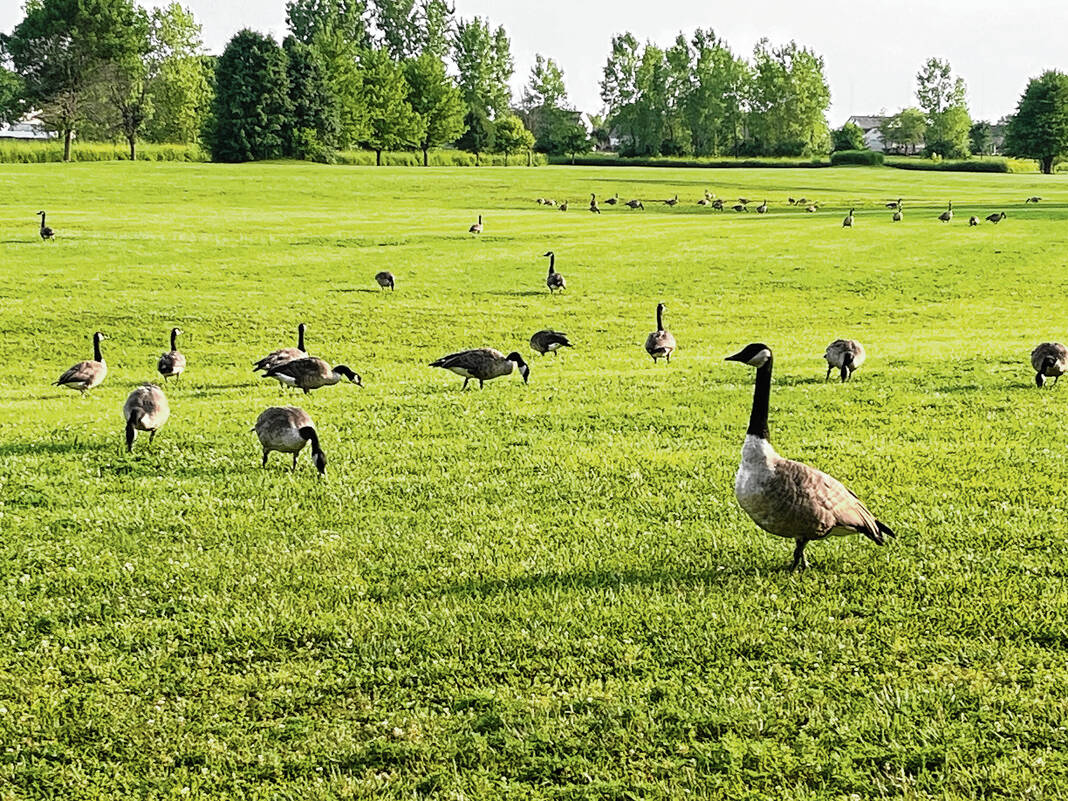
Geese are gathered in a green space in Franklin’s Blue Heron Park and Wetlands in July 2023
Leeann Doerflein | Daily Journal
By Leeann Doerflein | Daily Journal
ldoerflein@dailyjournal.net
For The Republic
JOHNSON COUNTY — There is one confirmed and nearly a dozen suspected cases of highly pathogenic avian influenza, or HPAI, reported in Johnson County over the last month.
All of the recent Avian flu cases have been reported in Franklin, according to the Indiana Department of Natural Resources.
“So far, there have been 12 geese reported to us over the past four weeks. One of these geese was collected and submitted to the lab, where they detected highly pathogenic avian influenza. It is likely that this is what is affecting the other geese,” said Eli Fleace, a fish and wildlife health biologist with DNR.
Earlier this month, DNR sent out an alert that HPAI had been detected in two southern Indiana counties and was suspected in another county.
Blue-winged teal in Greene County were found to have HPAI through surveillance conducted by the U.S. Department of Agriculture Wildlife Services and the DNR Division of Fish, Wildlife & Nature Preserves. HPAI has also been confirmed as the cause of death in black vultures in Jefferson County and is suspected as the cause of black vulture deaths in Franklin County, the release says.
The public health risk for HPAI is low. However, it is possible for humans to contract HPAI, according to the Centers for Disease Control and Prevention, or CDC. To mitigate risk, people should avoid contact with sick waterfowl and wildlife whenever possible, the CDC says.
Avian flu “can be dangerous” to cats, but dogs have so far been unaffected by the current strain of Avian flu, Fleace said. The CDC says cattle may also become sick from the virus, as well as poultry and other domesticated birds.
“It is a good idea to bring any outdoor cats indoors to reduce their risk of exposure. Dogs do not seem to be affected by the virus, though it is still better to keep pets away from wildlife when possible. If people have concerns over the health of their pet, or if their pet starts acting sick, it is best to contact their veterinarian,” Fleace said.
People should stay away from and keep pets and livestock away from wild birds showing these common symptoms of HPAI:
- Sudden death
- Neurological impairment (e.g., lack of coordination, swimming/walking in circles, tremors, twisted neck)
- Lack of energy and appetite
- Swelling of the head, neck, and eyes
- Nasal discharge, cough, sneezing, lack of coordination and diarrhea.
DNR encourages the public to report dead waterfowl or any other wildlife at on.IN.gov/sickwildlife.
DNR recommends caution when disposing of a potentially infected bird. If people find a potentially infected bird carcass on their property, they should either call a wildlife specialist to remove it or remove it themselves, taking precautions.
If getting rid of the carcass yourself, wear gloves and double-bag the carcass and put it in the trash. Then wash your hands with soap and warm water right after, Fleace said.
For people who don’t want to dispose of a carcass themselves, the DNR has a list of wildlife control operators who can remove the carcass for a fee here in.gov/dnr/fish-and-wildlife/wildlife-resources/living-with-wildlife/nuisance-wildlife-control-operators/. There are three Johnson County-based companies on the list to perform this service.
Waterfowl hunters should process birds in a well-ventilated area or outdoors and wear protective clothing such as a face mask and gloves. Meat harvested from waterfowl should be cooked to an internal temperature of 165°F before consumption, according to the U.S. Fish and Wildlife Service.
Anyone who develops the following symptoms after coming in contact with waterfowl — eye irritation or redness, fever, chills, cough, sore throat, runny or stuffy nose, sneezing, shortness of breath, fatigue, muscle or body aches, headaches, diarrhea, nausea or vomiting, or rash — should contact the Indiana Department of Health, or IDOH.
Call IDOH at 317-233-7125 during business hours. Outside of business hours, call 317-233-1325 and follow the prompts in the automated menu to speak to the epidemiologist on call.