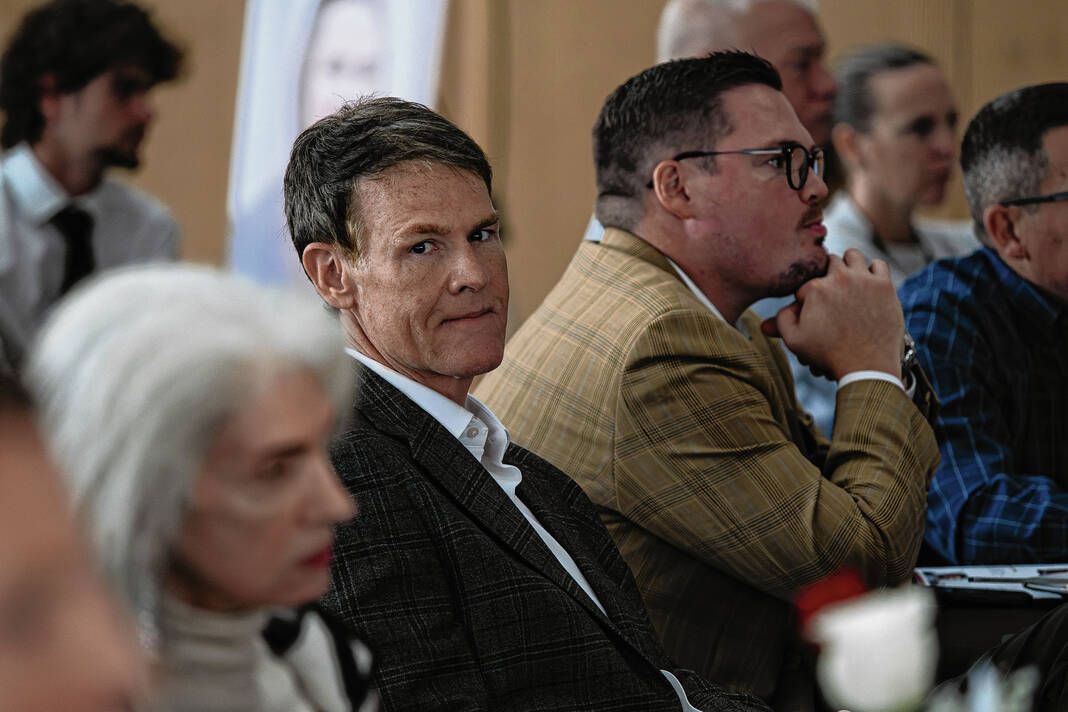
Mike Wolanin | The Republic Republican congressman Jefferson Shreve, Indiana’s Sixth District, attends the IU Columbus 2026 Economic Outlook Panel at The Commons in Columbus, Ind., Wednesday, Nov. 5, 2025.
Rep. Jefferson Shreve, R-Indiana, said he expects to be called back to Washington D.C. with his colleagues in the next week or so to end what is now the longest government shutdown in United States history.
The freshman congressman represents parts of south-central and eastern Indiana, including some of Bartholomew County. He was in Columbus Wednesday for the annual “Futurecast” Business Outlook Panel, where economic analysts from IU Bloomington and IU Columbus shared their views on what the economy may look like in 2026.
After the event, Shreve agreed to answer questions about the shutdown and lapse in SNAP benefits for families in Bartholomew County, the economic forecast for 2026, tariff policy and whether he would consider doing an open-forum town hall for constituents.
Government shutdown
Shreve said that he was “optimistic that we’ll get past this impasse in the next week, 10 days” when asked about the shutdown, which has resulted in deep concerns over food insecurity.
In Bartholomew County, which Shreve does not represent in its entirety, there are nearly 5,400 low-income residents that had SNAP assistance lapse last week. Since then, a number of community organizations have stepped up to try to fill that void.
Two rulings from federal judges in Massachusetts and Rhode Island late last week required the Trump administration to tap into billions in reserve funds Congress had designated for the program in the event of funding emergencies, The Associated Press reported.
The contingency fund the federal government said it would use has enough to cover about 65% of the normal benefits, the U.S. Department of Agriculture said in a court filing Wednesday.
But on Thursday, the federal judge in Rhode Island, U.S. District Judge John J. McConnell, issued a further ruling that required the administration to fully fund SNAP benefits for November, which was promptly appealed.
The Indiana Family and Social Services Administration indicated in a statement that November SNAP benefit distribution for Hoosiers “will be delayed by at least one week.”
In the meantime, Love Chapel set a near-all-time record last weekend for the most families served in a single day, according to Kelly Daugherty, the organization’s executive director.
“I was in the (Boys and Girls) Club in Johnson County in Franklin yesterday, and so that human services infrastructure kicks into gear at a challenging juncture like this,” Shreve said. “I’m not a spokesman for the administration, but I would say that this drives homes the exigency with which we’ve got to get past this impasse and get these programs and services fully-functional: whether it be SNAP, or our air traffic control system, TSA, our system of government, our economy needs to work. I think we are all eager to get everything fully functional again.”
Shreve said is optimism is informed “by a confluence of factors.”
“We’ve now passed the elections. Open enrollment is underway. And so I think that some of these factors that may have influenced the decision of leadership in both conferences, both chambers, is behind us,” Shreve said. “… (I’m) hopeful, but not just hopeful, optimistic, and as I read the tea lives I think it’s likely.”
2026 economic forecast
Analysts during the annual “Futurecast” Business Outlook Panel at The Commons said the economic picture of the country is a mix, with steady growth. However, one theme among the group said the continued uncertainty caused by the president’s tariff policy poses complications that are slowing business investment.
“I thought it was a generally encouraging forecast,” Shreve said. “The performance of the broader capital markets has defied most predictions, although this panel got it. Who would have thought that the S&P and the Dow would be trading at the relative highs that they are this year?”
Shreve said that IU Columbus Associate Professor Ryan Brewer’s advice to ‘buy the dip’ “underscores that we’ve got a durable economy and it will come back, even if we have a dip in 2026.”
Tariff policy
Federal trade policy was one element that the economists continually based predictions on.
Shreve said he’s heard similar concerns from constituents and business owners, calling it a “truism.”
“The markets don’t like uncertainty. And the bigger the organization, i.e. Cummins, the bigger and longer-term your supply chain events are,” Shreve said. “And so you want to know what the tariff landscape looks like. And we’ve got an administration, unlike prior administrations, that’s negotiating directly, country to country, even industry to industry. And that tariff policy uncertainty has made it a little more challenging in the near term.”
“The supply chains are rejiggering to this administration’s agenda to onshore more of our production, especially strategic production,” Shreve continued. “And so big companies, in particular, are hungry for that certainty. And I agree with that. We’ve got to nail down our trade policies.”
When asked if he thinks American business are nearing the point where they will have that clarity, Shreve said they were.
“I think if you just look at the president’s just completed Asia trade mission, we’ve (addressed) uncertainty as regards (to) the U.S.—Japanese trade relationship, we’ve made consequential headway on the U.S.—China trade relationship. Those are the big ones: so yes I do.”
Potential town hall
The congressman indicated he would be open to some form of a town hall some time in the future where constituents could come and share their input.
While Shreve has been around the district and met with constituents — including during an Americans for Prosperity-organized event in Greenfield; a chamber of commerce event in Greenwood; as well as a Greenwood Rotary Club Event — those are more controlled environments.
Some Republican lawmakers have held town halls in the past year, but several have been tense at times as constituents have voiced displeasure regarding the president’s signature legislation in the ‘Big Beautiful Bill’ and cuts made by the Department of Government Efficiency (DOGE) in particular. House Speaker Mike Johnson (R-La.) encouraged his Republican colleagues in March to skip such gatherings, claiming they are typically filled with “professional protesters.”
“People don’t agree with me and communicate that to me every day. I get that. I suppose this is a controlled environment, but anyone can come into The Commons or turn up at things I’m turning up at,” Shreve said. “I just feel like the interaction is more meaningful when I know I’m going where constituents in the district are going to be.”
Shreve noted the town halls “haven’t gone very well across the country,” but said he had been keeping an eye on a recent session held by State Senator Greg Goode of Terre Haute on redistricting.
“I paid attention to that in particular because I was trying to follow the ground rules that he established as to who could attend and speak. And I think— I haven’t spoken with him directly about it since then, I did beforehand — I think it worked. I don’t know if it was frustrating to people in the queue to get into the city hall chamber, if they felt like that they could be heard in the same way.”
Asked if he would consider something similar, the congressman said “yes.”