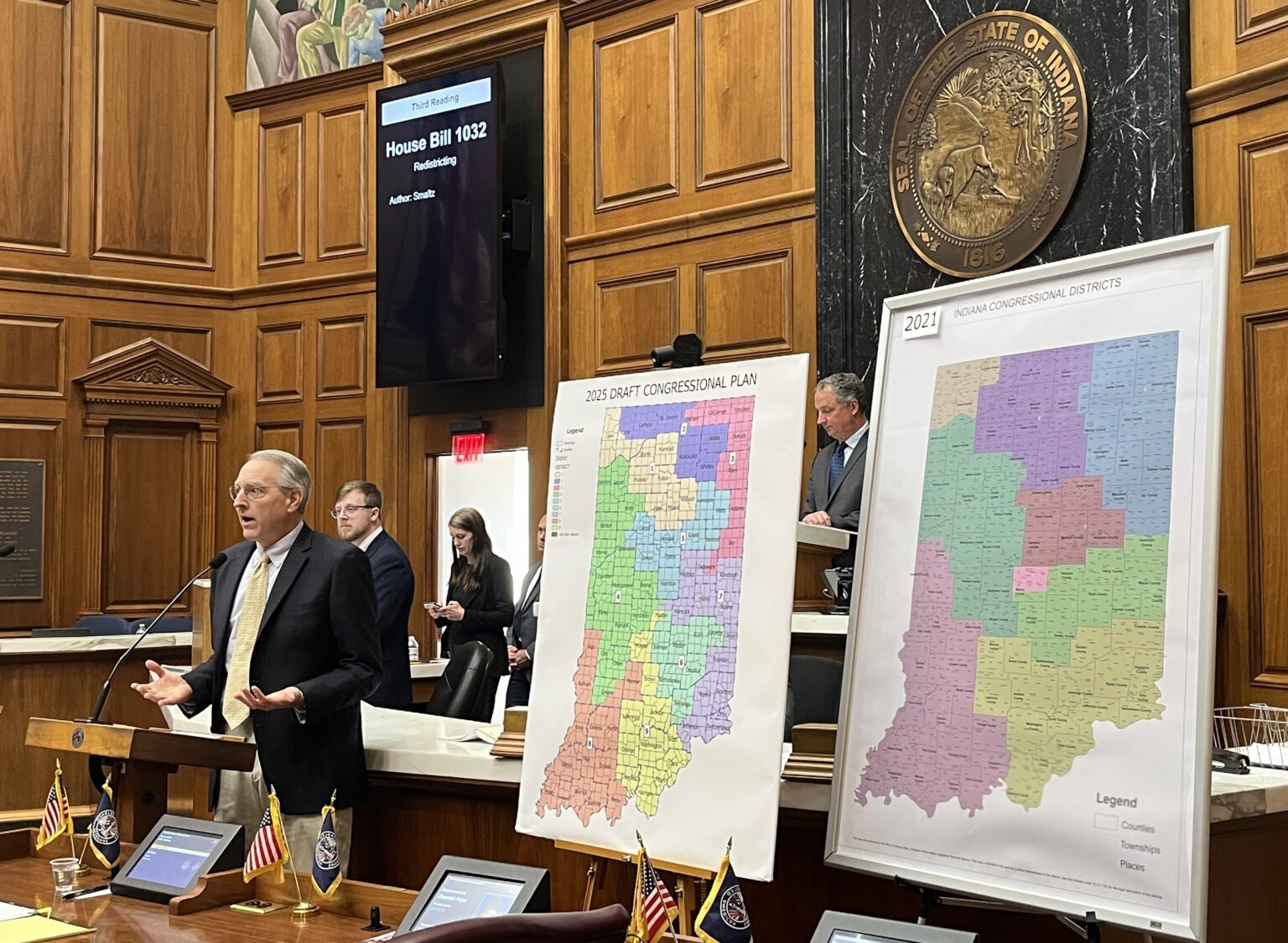
State lawmakers representing parts of Bartholomew County largely voted in favor of going along with President Donald Trump’s demands to redraw Indiana’s congressional map ahead of next year’s midterm elections.
Rep. Ryan Lauer, R-Columbus, and Rep. Jim Lucas, R-Seymour, on Friday voted in favor of the proposed map, while Rep. Jennifer Meltzer, R-Shelbyville, was one of 12 Republicans who voted against it.
The House passed the proposed map in a 57-41 vote, sending it to the Senate.



Redistricting is a process that is normally done once a decade after the census. However, Trump and his allies have pressured Republican states — including Indiana — to redraw their congressional maps to help preserve the GOP’s narrow national majority in Congress. Republicans currently hold seven of Indiana’s nine seats.
The proposed map would place all of Bartholomew County within Indiana’s 6th Congressional District, eliminating the current split between the 6th and 9th districts the county. A total of 5,964 registered Bartholomew County voters currently reside in the 9th District, according to the Bartholomew County Clerk’s Office.
Lucas, who initially opposed early redistricting, calling it “highly unusual” and “politically optically horrible,” said he ultimately changed his mind, citing concerns about the paralyzing effect a Democratic House majority would have on Trump’s agenda.
“It was a ‘solid yes’ for me,” Lucas told The Republic on Friday following the vote. “I was a ‘hard no’ at the beginning. Then after I heard what the plans were and what the White House would like to do, not just for the country, but for all Hoosiers and people in my district, that’s when I changed my mind.”
Lauer’s vote also stands in contrast from his initial position. In August, Lauer told The Republic that early redistricting would be “ill-advised” and “I’m not for changing the maps.” He also said, “I don’t see this as an extraordinary circumstance” that would warrant redrawing the map early.
After visiting the White House in August, Lauer said lawmakers had “an eye-opening conversation” about redistricting with Trump administration officials, who he said “made a strong case from a national perspective.” Last month, Lauer said he was “open” to the idea of early redistricting.
Lauer told The Republic on Friday that he “paid very close attention” to constituents from “all spectrums of our community” before ultimately voting in favor of the map designed to consolidate Republican power to what he described as “decades of political disadvantage by blue states tipping the scales.”
“It’s no secret that Indiana was thrust into this national debate … and ultimately, on every bill, you have to make a decision,” Lauer said following the vote. “At the end of the day, I believe strongly (that) we did not live in a political vacuum on this issue, and there are consequential national issues at stake. And I firmly believe Republicans must stand up now and fight for our republic.”
Senate uncertainty
The proposed map now heads to the Senate, where there has been more opposition to early redistricting. At one point last month, Senate Republican leaders said they did not believe there was enough support in the chamber to pass a new map.
The Senate is schedule to convene staring Monday to “make a final decision on any redistricting proposal sent from the House.”
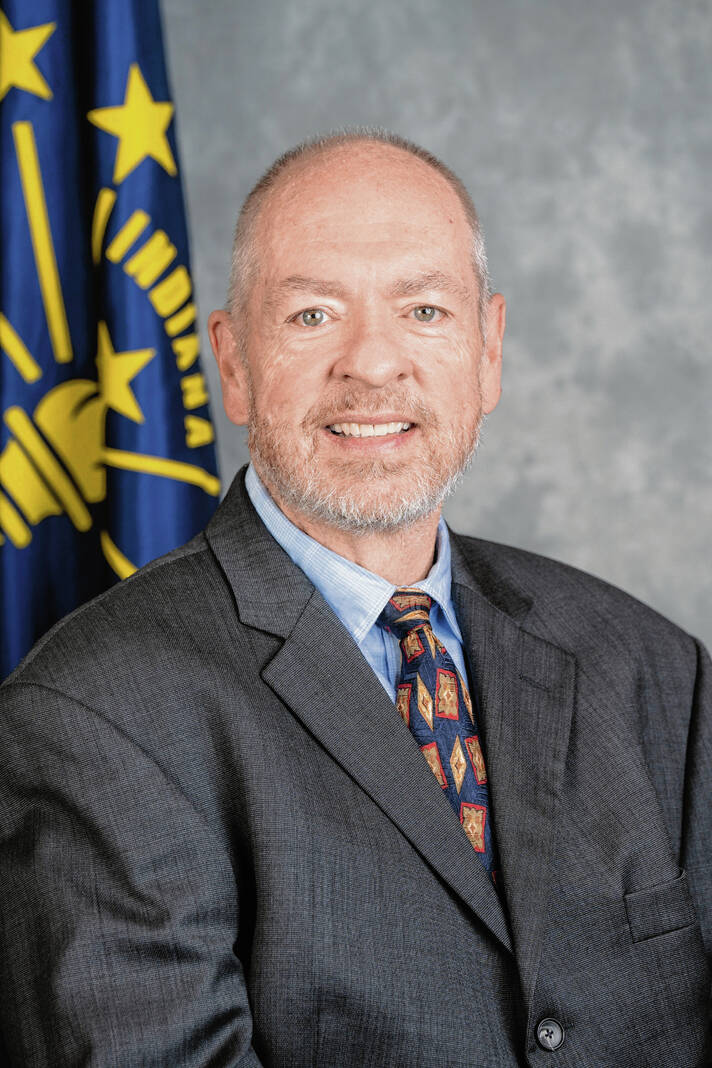
Sen. Mike Gaskill, R-Pendelton, is the redistricting bill’s Senate sponsor and chair of the Senate Committee on Elections.
The proposed congressional map was referred to the Senate Committee on Elections on Friday. Sen. Greg Walker, R-Columbus, who has been a vocal opponent of early redistricting, is ranking member of the committee.
Walker declined to comment on the redistricting bill on Friday, telling The Republic, “Holding my thoughts for now.”
However, Walker said Gaskill can preside over a committee hearing in which his bill is being considered, though “he can also give the gavel to whomever he wishes.”
In August, Walker said early redistricting is a “ridiculous idea” that would backfire against Republicans.
Walker has since turned down two invitations to visit the White House aimed at changing his mind. The first invitation was to travel with other Indiana Republicans in August.
Walker also said a White House official contacted him on Nov. 17 and invited him to visit the Oval Office on Nov. 19 — the same day that he ended up being the victim of a swatting incident.
Walker and several other Senate Republicans were targeted in swatting incidents after Indiana Senate leaders said they were rejecting Trump’s push for congressional redistricting.
Swatting involves making false reports of criminal incidents in an attempt attempting to create a dangerous SWAT response to the residence.
“How does (Trump) have the time to mess with a nobody like me with all of the important matters that are to take his attention as the leader of the executive branch in this nation?” Walker told The Republic in an earlier interview. “There is no way that he should have time to have a conversation with me about Indiana mapmaking when that’s not his business for starters. But secondly, doesn’t he have anything better to do? I can make a big list of things that are more important for him to focus on.”
“I’ll guarantee you this — my opinion will not change,” Walker added. “And having been swatted didn’t convince me that the … right thing to do is to redistrict midterm. So what tactics are you going to use? There’s no leverage to change my mind. I know right from wrong. I was taught as a child the difference between right and wrong, and this is just wrong on so many levels.”
Currently, it is unclear whether there will be enough support in the Senate to approve the proposed map.