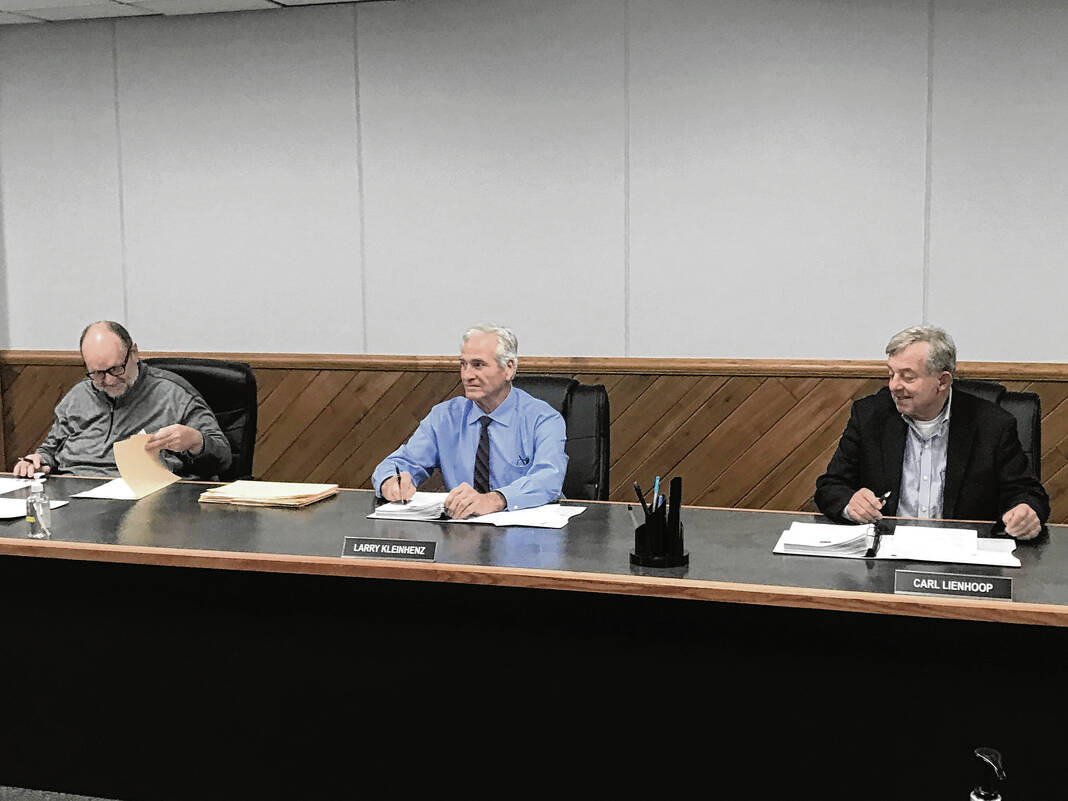
Republic file photo | The Republic Bartholomew County Commissioners Tony London, left-right, Larry Kleinhenz and Carl Lienhoop are shown during a recent meeting.
By Brad Davis
bdavis@therepublic.com
Bartholomew County will not receive any money next year through a program that provides state matching funds to improve and maintain local roads after the program was tweaked during the last legislative session.
The Bartholomew County Commissioners on Nov. 25 received notice from the Indiana Department of Transportation (INDOT) that after a review of applications from local governments across the state, the county will be receiving no Community Crossings Matching Grant (CCMG) funds in 2026, a stark change from previous years and something that could have an impact on the quality of local roads.
The letter sent to the commissioners did not provide a specific reason as to why no funds were awarded. The city of Columbus, on the other hand, applied for, and received the full $1 million through the program for 2026.
INDOT has awarded an annual average of $260 million of Community Crossings Matching Grant (CCMG) funding since the program began in 2016. Bartholomew County has been awarded $10.4 million since that time, receiving the maximum amount of $1.5 million the past two years.
The program requires that the county provide dollar-for-dollar local matching funds for the award amount because of its population size, meaning that county engineering has had access to up to $3 million in funding annually for road projects through the program as of this year.
For the first eight years of the program, the maximum award was $1 million. CCMG money comes from Indiana’s state road-funding revenue via a sales tax on gas.
But last legislative session’s House Enrolled Act (HEA) 1461 changed CCMG, significantly decreasing the funding local governments have at their disposal and separating out how the funds will be distributed via matching grants, as well as a direct distribution component.
Rather than an average of $260 million in matching grant funds, just $100 million is now awarded. And half of the funding must go to counties and towns with a population less than 50,000, which excludes Bartholomew County.
HEA 1461 allocated $20 million toward financing a railroad crossing upgrade project from 2026 to 2030. In addition, starting in 2027 and each following year, $50 million will be transferred to Indianapolis for use on secondary streets if the state capital matches the funds.
Money that is leftover will be allocated to a new, separate, direct distribution fund, that in turn is directed to counties and cities with populations over 5,000 depending on lane mileage.
But that funding is only available to government units that have adopted a wheel and excise surtax. The Bartholomew County Council has not done so and is gathering more information from consultants to get more of a precise idea of how funding would be different, with and without a wheel tax.
The legislation also reduced the annual cap of CCMG funding from $1.5 million back to the original $1 million.
The commissioners indicated they knew the county would receive less CCMG funding than past years, but were miffed to learn that no CCMG money would be provided, thinking the county would at least receive $500,000.
“The state of Indiana sells a little over 8 million gallons of gas a day in the state of Indiana, and they bring in close to $2 billion a year in different gas taxes,” said Commissioner Tony London, R-District 3. “And now we are going to get zero from the sales tax (on gasoline)?”
If the county council doesn’t appropriate any additional money to improve and maintain local roads, County Engineer Danny Hollander estimated they will be able to do work on about 10 miles of road in 2026, one-third the amount of previous years.
“The bottom line is: our roads are going to suck,” London said.
London said he spoke with commissioners from other counties that also received no CCMG funds in 2026 and intends to call INDOT to learn more about the process, including the names of those who contribute to the decision-making of awards, what criteria they used, and any meeting minutes that would reflect that.
“I have lots and lots of problems with it,” London said. “One of my biggest problems with it is an unelected body deciding what municipalities get tax dollars.”
Commissioner Larry Kleinhenz, R-District 1— as he has mentioned continually in recent months— wondered if the county would simply be able to opt out of a sales tax on gasoline, especially if tax payers aren’t receiving any of it back in CCMG funds.
The commissioners have been vocal about their opposition to a potential wheel tax, and they reiterated that on Monday, even though they won’t ultimately make the final decision.
It’s unclear whether the county council’s decision not to adopt a wheel tax as of now played into INDOT’s award decision. Bartholomew County is one of just 36 Indiana counties to not implement a wheel tax.
“We don’t need a wheel tax. We don’t need an additional tax to take care of our roads if everybody plays by the same rules,” London said. “The idea of forcing us to institute a tax to get some of the other taxes we should be rightfully entitled to is absolutely mine-boggling. Tax, tax, tax.”