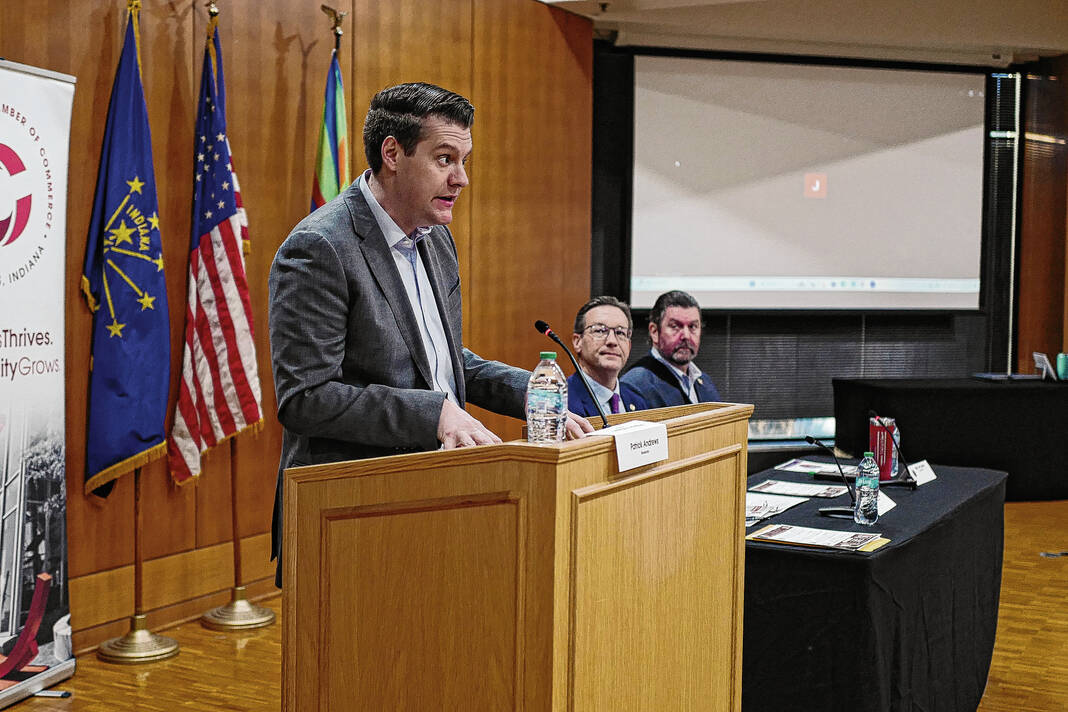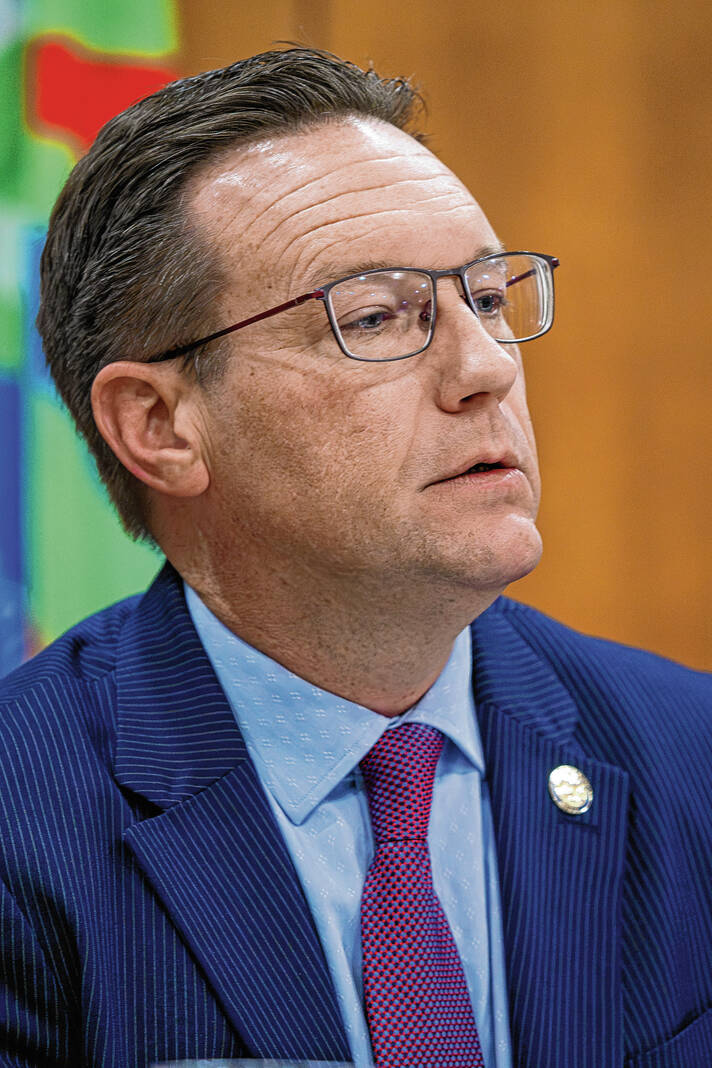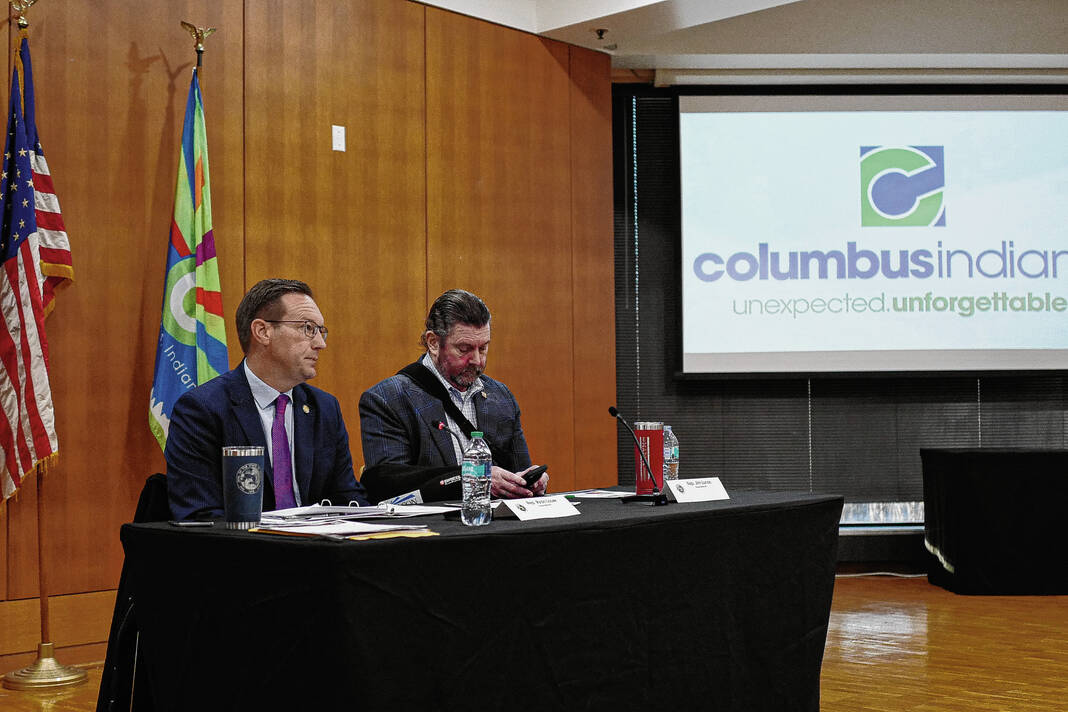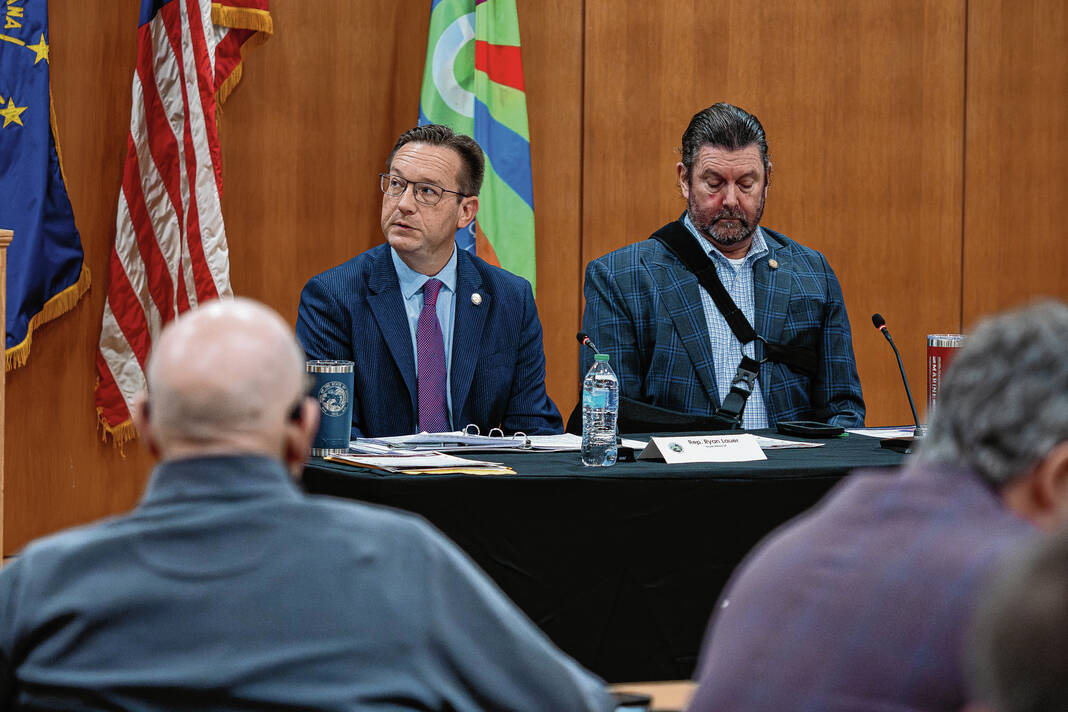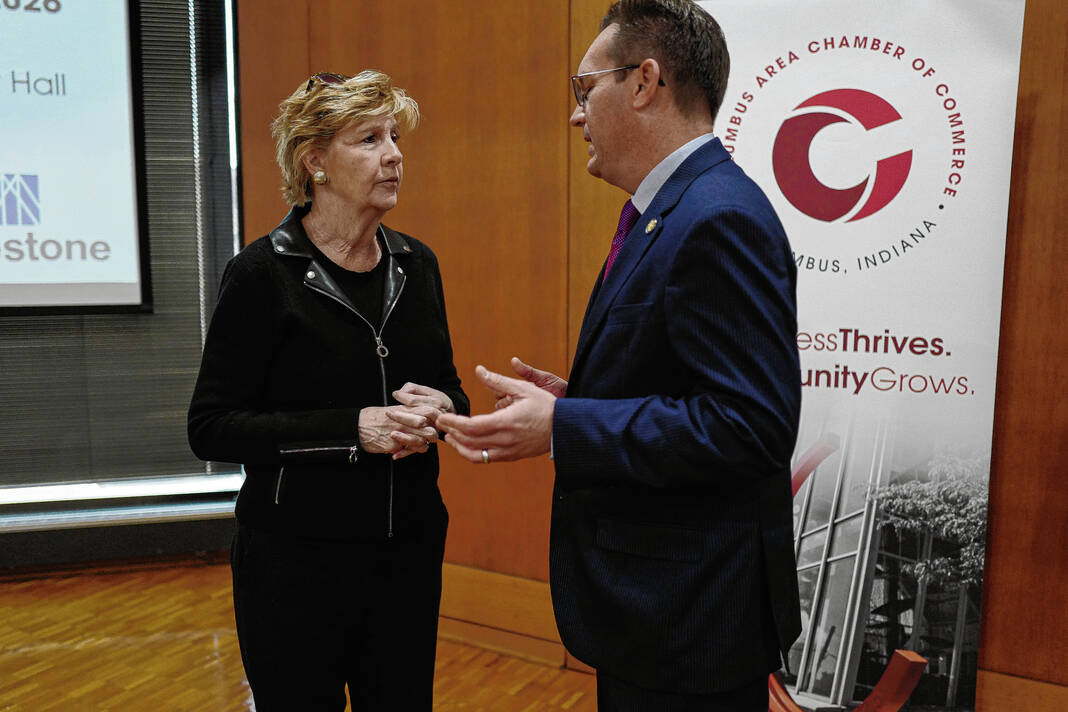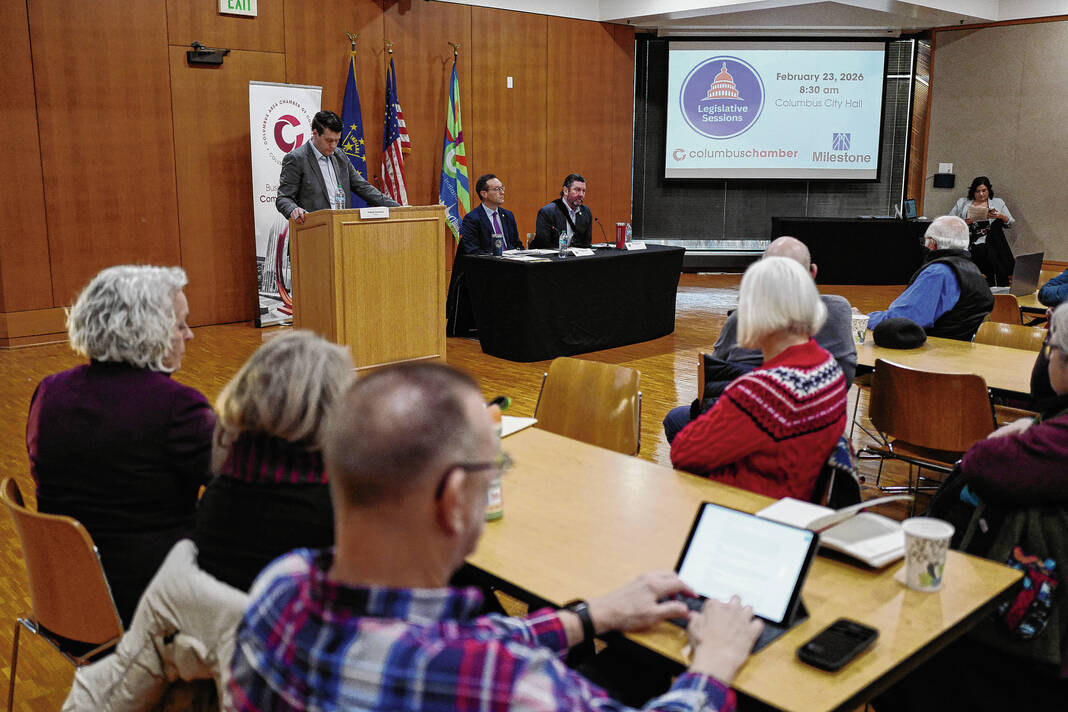
Mike Wolanin | The Republic Patrick Andrews, at podium, moderates a legislative forum with State Reps. Ryan Lauer and Jim Lucas in the Cal Brand Meeting Room inside Columbus City Hall in Columbus, Ind., Monday, Jan. 12, 2026.
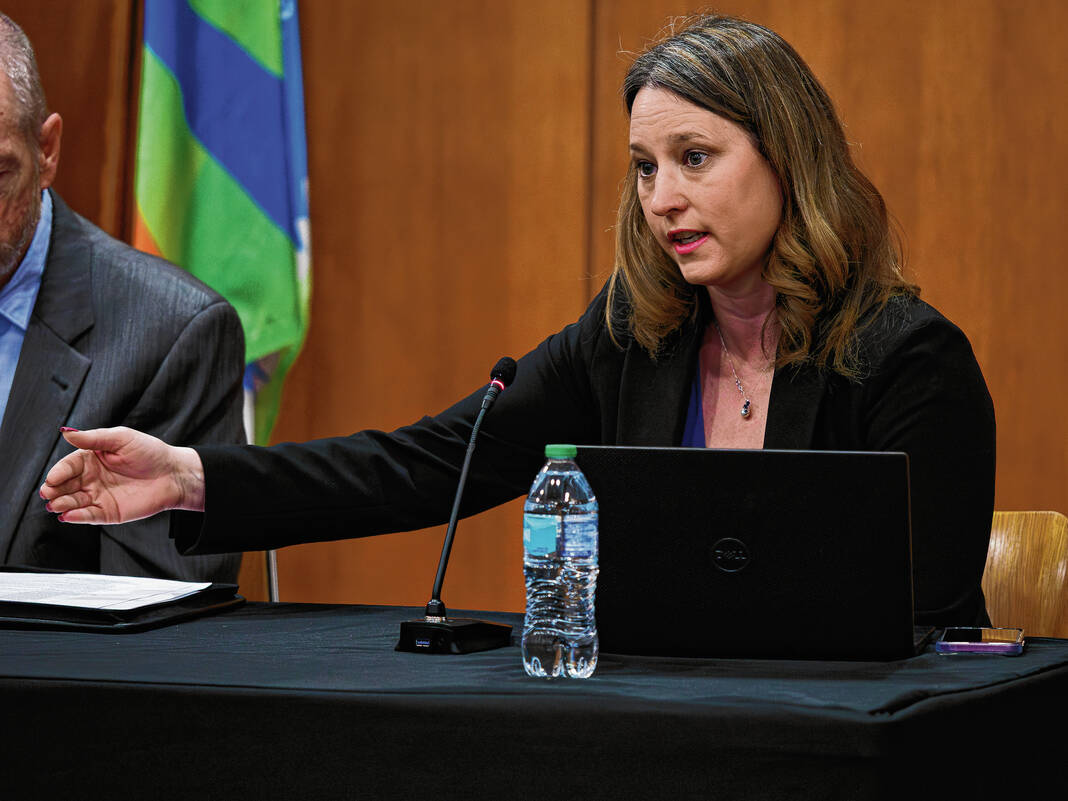
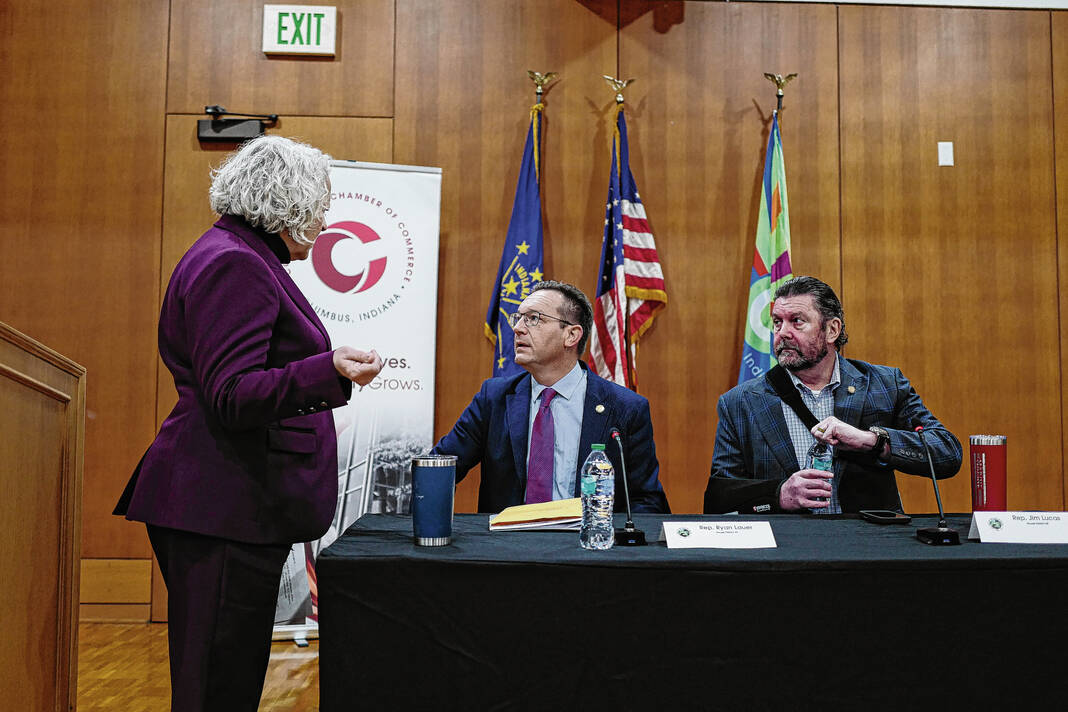
State legislators representing parts of Columbus and Bartholomew County took part in a forum organized by the local chamber on Monday, discussing the current legislative session, bills they are championing and taking questions from constituents.
The Columbus Area Chamber of Commerce hosted its first in what will be a series of legislative forums with local representatives of the Indiana General Assembly.
Topics included child care, housing and redistricting, as well as property tax changes and their impact on how local governments are funded.
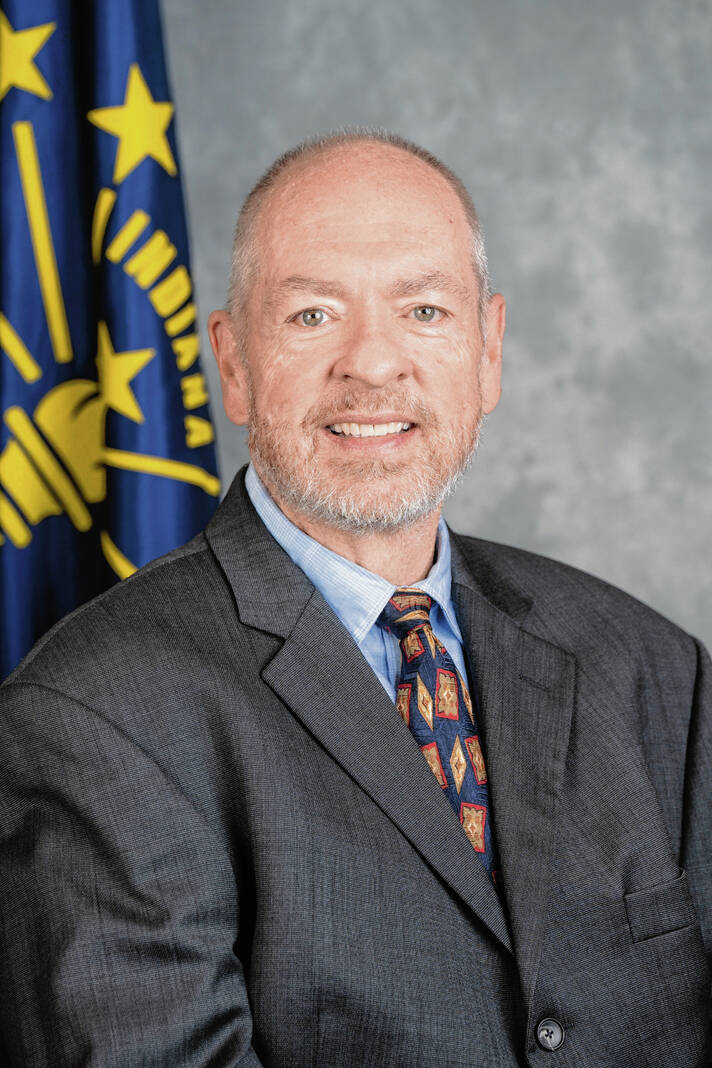
Rep. Ryan Lauer, R-Columbus, and Rep. Jim Lucas, R-Seymour, joined in person, while Sen. Greg Walker, R-Columbus and Rep. Jennifer Meltzer, R-Shelbyville, joined virtually.
Questions to the legislators were based on a survey that went out to chamber membership. Out of the 200 responses, the highest priorities were K-12 education, health care affordability, child care, infrastructure and economic development policy.
State legislators were called into special session by Gov. Mike Braun in December to take up the redistricting plan pushed by President Donald Trump to redraw congressional maps mid-decade in favor of Republicans. Leadership in both houses chose to make that special session part of the regular session, so there are two fewer weeks than otherwise would be the case for legislative business this session.
Some bills are only now going through the committee process, so it’s unclear how many of the bills the local delegation is part of will even be up for a vote before the session adjourns in March.
“When we took two weeks in December, it didn’t really give us two full weeks of work,” Walker explained. “Because many of the items that we were preparing for January introduction were already behind, because of the attention drawn away from Indiana matters for the purpose of redistricting the state midterm. So we’re double behind.”
Legislative priorities
The legislators said that child care is going to be one focus of the session. Lauer and Walker said that there may also be some changes related to last session’s Senate Enrolled ACT (SEA) 1, the sweeping local government finance reform package that carries profound implications for local governments.
The bill included changes to assessed value and levy collections, the expansion of local income taxes (LIT) and provisions related to the enactment of a wheel tax.
State Republicans touted SEA 1 as “property tax relief” and a “great win” for Hoosiers, while Democrats described it is “bait and switch” that will leave local governments with few options but to either raise income taxes or cut essential services to offset the revenue loss.
Locally, Bartholomew County Council members have discussed measures they will have to consider as a result of the legislation— including a wheel tax and potential LITs— to make up for lost revenue.
Columbus Mayor Mary Ferdon called overhauling property taxes and income taxes at the same time “a double whammy,” noting the city already saw a $450,000 drop in property tax revenue in the 2026 budget as a result of SEA and that will continue to climb over the next couple of years.
“We’re seeing a decrease in our 2026 budget and it will continue to increase. We’re also hit hard — as is Seymour — with business personal property tax, we’re going to be losing that as we go forward,” Ferdon said. “And the reason I’m saying that is because the income tax overhaul will affect the city too. And we know that the way it was currently written last year, we will lose significant income tax going forward if changes aren’t made.”
Ferdon mention HB 1284, which proposes further changes to LIT rules in Indiana. The bill adjusts the structure and caps of LITs and removes the automatic annual expiration of LIT rates imposed by SEA 1.
“We’re not asking for new income taxes, we’re just asking for them to be reallocated so that the city remains whole,” Ferdon said. “… We have a priority on economic development and public safety… if we don’t see some changes cities will get harmed and it will continue to grow.”
Walker said that “I think we’re going to look for ways to try to allow more flexibility on how funds are allocated,” adding that legislators may look to “create pathways for covering that missing revenue with local income tax choices,” although the bill isn’t “in a form that’s workable yet.”
Lauer agreed “we could use some adjustments” and that “there is absolutely tension between the cities and the regulatory structure of taxation,” but emphasized that provisions in SEA 1 are part of a “multi-year plan.”
“One of the goals of SB1 is to put more voting at the local level so that the city councils, the county councils, or township government, if they’re adjusting their rates, raising or lowering taxes, that those are actions that are done on an annual basis so that taxpayers know what your local government is doing and how they’re doing it,” Lauer said. “We need to be looking very closely at how this is affecting our cities and counties, and it’s really a balancing act to try to find spot where we get real property tax relief for homeowners, for seniors, and I think we’re there with this.”
Local chamber members said child care is in crisis in the state, including Bartholomew County.
The state in October announced cuts to child care and early learning initiatives, including significant reductions to Child Care Development Fund (CCDF) vouchers and the On My Way Pre-K program, which provide child-care assistance to low-income families.
Local officials estimate that the local providers will collectively see a $31,836 weekly reduction in revenue — about $1.66 million annually — due to the lower reimbursement rates.
Due to the new rates and declining enrollment because no new vouchers are being awarded, Children Inc. announced it would have to lay off 15 teachers and close six classrooms, said Children Inc. Executive Director Jill Harden in October. Additionally, local officials said another child care site that they declined to name will be closing altogether due to the cuts.
Lauer said “we are consistently needing more places of child care, child care centers and informal ones,” mentioning HB 1152, which prohibits a home owner’s association (HOA) from banning a person from providing child care in a single-family home.
Lucas talked about HB 1020, a bill he authored that would establish an access to a birth control program administered by the Indiana Department of Health to increase access to birth control among low-income Hoosiers.
“The purpose for that, since 2017, Medicaid in Indiana has averaged paying for 54% of the births in this state,” Lucas said. “… That is unsustainable. We cannot continue to maintain that when you have a generation of children born into poverty. I want to try and stem that and trying to help that recede, go backwards, and help those people out, but we have to start teaching people to be responsible for themselves. And that’s a general statement.”
Indiana’s Medicaid-paid birth share has generally hovered around 40% since 2017, according to state data.
“We see this playing out with the need and the demand for child care,” Lucas continued. “I’m more on the side that we should be regulated and allow more people to offer child care without having to meet so many stringent requirements that it becomes cost prohibitive to open a day care center. And trust in the parents that (if) they’re sending their kids to that day care center, to check them out and make sure they meet their standards, not government standards.”
The following are some bills of note authored or co-authored by local legislators:
- HB 1055 (authored by Meltzer): Would allow any city or town in Indiana to pass an ordinance that moves municipal elections to even-numbered years. This could impact Columbus because the city’s municipal elections are held on odd-numbered years. Voter turnout is always higher during even-numbered year elections.
- HB 1315 (authored by Lauer): Would reorganize townships, with cities or counties taking over their services if the townships meet certain criteria like doing more administrative work than providing relief and not having a fire department.
- SB 53 (authored by Walker): Would bar the Indiana General Assembly from redrawing legislative or congressional district maps outside of the first regular session immediately following the U.S. Census.