Bartholomew Consolidated School Corp. is extending the deadline for when community members can provide their input on renewing 2020’s operating referendum by a week.
BCSC is in the process of seeing what people think about renewing 2020’s operating referendum at a lower tax rate, which district officials say will enable them to keep up retention of high-quality staff and school safety.
Challenges caused by this week’s snowstorm and some residents difficulty in reaching their mailboxes led the district to extend the survey deadline from Feb. 2 to Feb. 9.
Community members that have yet to complete the survey are able to do so via a paper copy sent in the mail or an electronic copy sent to BCSC families.
If a person lives with the district’s boundaries, but haven’t received a survey, they are encouraged to fill out this Google Form and a member of BCSC administration will be in touch to provide copies.
They survey is to gauge interest in renewing the operating referendum, which will inform the administration’s recommendation to the school board about moving forward. BCSC did not survey the public in the lead-up to the 2020 referendum vote.
Survey results will be presented to the school board in March, and they will consider moving forward with the referendum renewal in May or June.
Recent changes by state lawmakers restrict referendums to only even-numbered general elections. That means the referendum could be on ballots in November 2026 or November 2028, but school board members must first pass a resolution stating the board is in support of pursuing a referendum renewal and approving the question that would be on the ballot.
Indiana allows districts to place a renewal referendum on the ballot before the original levy expires, which can be voted on within the last two years of a referendum period. With the change to even-numbered general elections, voter turnout will be significantly higher as is usually the case in comparison to a primary.
Just over 61% of Bartholomew County voters in June 2020 approved a property tax referendum for BCSC, with the resulting funds going towards recruitment and retaining staff and safety and security.
The 2020 referendum allowed the district to impose an additional property tax rate not exceeding $0.1560 on each $100 of assessed value, which were collected beginning in 2021 and will be through 2028.
The impact of the referendum has already borne out quantitatively, with the district improving graduation rates, state assessment scores of young readers and teacher retention numbers.
The referendum is expected to bring in about $10.5 million in 2026, with $9.3 million of that going towards teachers salaries and $750,000 for security personnel in the district’s new school security officers (SSOs). The remaining $500,000 is earmarked for buses, among other items, according to Brett Boezeman, assistant superintendent for finance and operations.
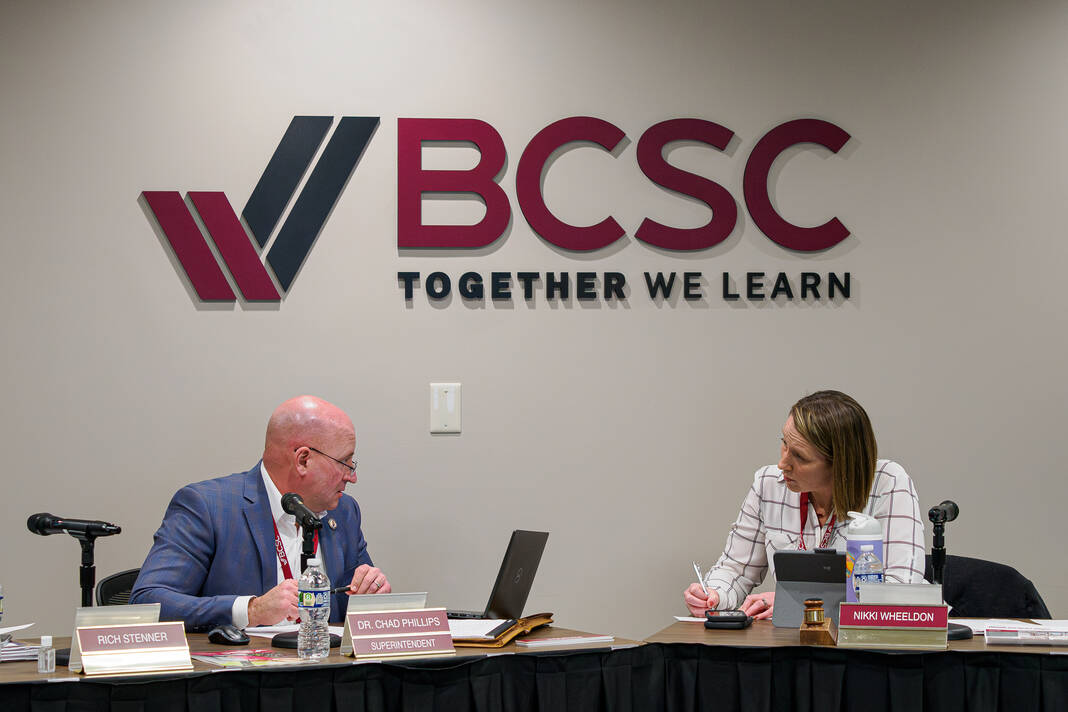
Superintendent Chad Phillips summed it up by saying the district believes it can provide the same impact with a tax levy of about 10% less.
BCSC outlines six goals for the current operating referendum, and keeps track of annual targets. Those can be found at bcscschools.org/referendum-2020 under “Referendum Performance Goals and Targets.”
Those goals include teacher retention, student mental health, safety and wellness, updating the bus fleet, adding bus drivers and expanding STEM lab student experiences.
The survey is comprised of three sections, including one with basic demographic information; another to check support for renewing the referendum at a lower levy; and the third to see the community’s willingness to invest in other areas.
If the board were to move forward with the renewal and it was ultimately approved by voters, it would replace the existing referendum. If the renewal was denied by voters in November 2026, the school board and district could still pursue a renewal once more in November 2028.
The district has enlisted Wisconsin-based School Perceptions, a third party research organization, to help with the survey.
The potential attempt at renewal comes against the backdrop of last legislative sessions’ Senate Enrolled Act (SEA) 1, which will ultimately result in lower operating revenue for public schools in Indiana into the future and increases how much of that funding must be shared with charter schools.