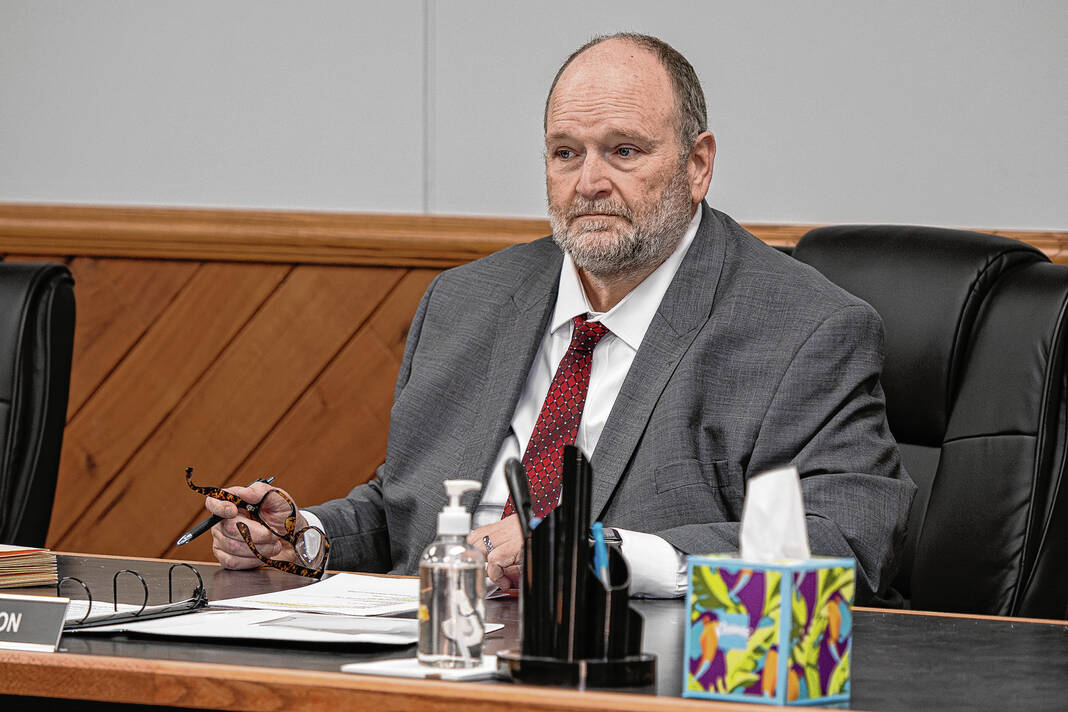
Mike Wolanin | The Republic Bartholomew County Commissioner Tony London takes a break while looking over agenda items before a county commissioners meeting in the Bartholomew County Governmental Office Building in Columbus, Ind., Monday, Jan. 12, 2026.
Bartholomew County Council members agreed to transfer $1.5 million for road improvements to fill a gap created after the county received no dollars through a state program that was tweaked during the previous legislative session.
Council members agreed to a request from the Bartholomew County commissioners to transfer $1.5 million from the county’s general fund to pay for a road paving project for this year.
The county for the last two years received $1.5 million annually from the state Community Crossings Matching Grant (CCMG) program, which would be paired with $1 million from county highway funds and $500,000 in County Economic Development Income Tax (CEDIT) to go towards improving and maintaining local roads.
There were big-time changes to the CCMG program during the legislative session in 2025, shrinking the annual amount of funding given out and reducing the annual cap of funds distributed to a local unit of government each year.
House Enrolled Act (HEA) 1461 also changed how the funds are distributed via matching grants, as well as a director distribution component.
The commissioners in November received notice from the Indiana Department of Transportation (INDOT) that after a review of applications from local governments across the state, the county will be receiving no CCMG funds, a stark change from previous years.
The letter sent to the commissioners did not provide a specific reason as to why no funds were awarded. The city of Columbus, on the other hand, applied for, and received the full $1 million through the program for 2026.
INDOT has awarded an annual average of $260 million of Community Crossings Matching Grant (CCMG) funding since the program began in 2016. Bartholomew County has been awarded $10.4 million since that time, receiving the maximum amount of $1.5 million the past two years.
For the first eight years of the program, the maximum award was $1 million. CCMG money comes from Indiana’s state road-funding revenue via a sales tax on gas.
Rather than an average of $260 million in matching grant funds, just $100 million is now awarded. And half of the funding must go to counties and towns with a population less than 50,000, which excludes Bartholomew County.
HEA 1461 allocated $20 million toward financing a railroad crossing upgrade project from 2026 to 2030. In addition, starting in 2027 and each following year, $50 million will be transferred to Indianapolis for use on secondary streets if the state capital matches the funds.
Money that is leftover will be allocated to a new, separate, direct distribution fund, that in turn is directed to counties and cities with populations over 5,000 depending on lane mileage starting in fiscal year 2028.
But that funding is only available to government units that have adopted a wheel and excise surtax.
The Bartholomew County Council has been hesitant to adopt the tax, and has been gathering more information from consultants to get more of a precise idea of how funding would be different, with and without a wheel tax.
They have until September to make a decision if the county wants access to the direct distribution component during the first time around in fiscal year 2028.
The city is able to impose a wheel tax as well if it wishes access to the direct distribution component. Council members said previously they plan to coordinate with the city in that respect.
When the county received no dollars through the CCMG program in December, the commissioners weren’t happy about it.
Commissioners Tony London, R-District 3, told council members on Monday that they are making the request now because the price of petroleum is down, presenting a potential cost-savings opportunity for road projects. Oil is used in asphalt pavement.
“We’re looking at the ability to do more than we would normally do at current petroleum prices if we wait ‘til summer,” London said
London mentioned that the drop in petroleum prices is reflected in the city’s recently bid out CCMG project, which was budgeted at $2 million but came in at $1.3 million.
That $3 million dollars would typically involve improvements to 27 miles of roads, but with cheaper petroleum prices, it could pay for upwards of 35 miles of road improvements this year, London told the council.
The $1.5 million transfer will again be combined with $1 million in county highway funding and $500,000 in CEDIT.
The chairman of the commissioners also said that projects using CCMG funding require that the entire project is awarded to one vendor, so there may be another cost-savings by dividing up the road paving project by area, with different sections going to the lowest bidder.
The commissioners had asked for the money during budget deliberations in August of 2025, but the council wanted to wait and see how much, if any, the state would provide through the CCMG program.
London vowed when the state awarded no dollars to the county through CCMG he would keep calling INDOT until he received an answer as to why.
“The number of inquiries so far is 12,” London told the council. “The number of returned phone calls (from INDOT) is zero.”