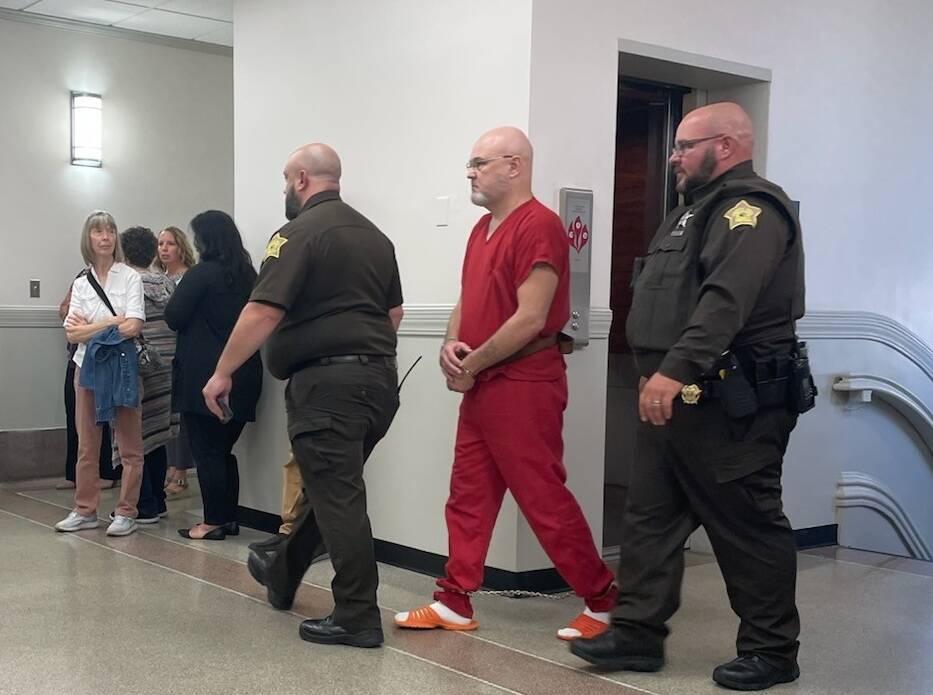
Julie McClure | The Republic
Jason Hubbell is escorted by Bartholomew County Sheriff deputies to the courtroom for a pre-trial hearing in his murder case on Thursday, Oct. 2, 2025.
The Bartholomew County Prosecutor’s Office faces a deadline this week to submit its brief to the Indiana Court of Appeals as it challenges a local judge’s decision overturning the murder conviction in the Sharon Myers murder case.
In October, local prosecutors appealed a ruling by Bartholomew Circuit Court Judge Kelly Benjamin that overturned Jason Hubbell’s conviction and granted him a new trial. The Indiana Court of Appeals has given prosecutors until Friday to file a brief outlining the basis for its appeal.
Hubble has spent more than 25 years in prison after being convicted by Bartholomew Circuit Court jury in 1999 for the murder and criminal confinement of Myers, an Arvin Industries employee who was abducted from the company’s Gladstone plant in Columbus in 1997. Her body was found six months later in the Atterbury Fish and Wildlife Area north of Columbus.
According to court records, Hubbell was a former Arvin employee whose benefits were handled by Myers. During the trial, a witness testified Hubbell was having difficulty getting insurance benefits and that Myers was treating him coldly.
In September, Benjamin overturned the conviction, finding that Hubbell’s attorneys had met the burden of showing he is entitled to post-conviction relief. Benjamin found that prosecutors at the time had withheld favorable and material exculpatory evidence from the defense, including information linking death row inmate Michael Dean Overstreet to Myers’ murder.
Local prosecutors, for their part, had argued that the withheld information did not meet the legal threshold required to overturn a conviction, and that their disclosure would have been unlikely to have led to a different result at trial.
Overstreet was convicted for the 1997 killing of Kelly Eckart in Johnson County. In 2014, a South Bend judge ruled Overstreet was not mentally competent to be executed but would remain on death row until the state could prove he was competent.
Hubbell, who is being represented by his own attorneys and the Exoneration Justice Clinic at Notre Dame Law School, has maintained his innocence for decades.