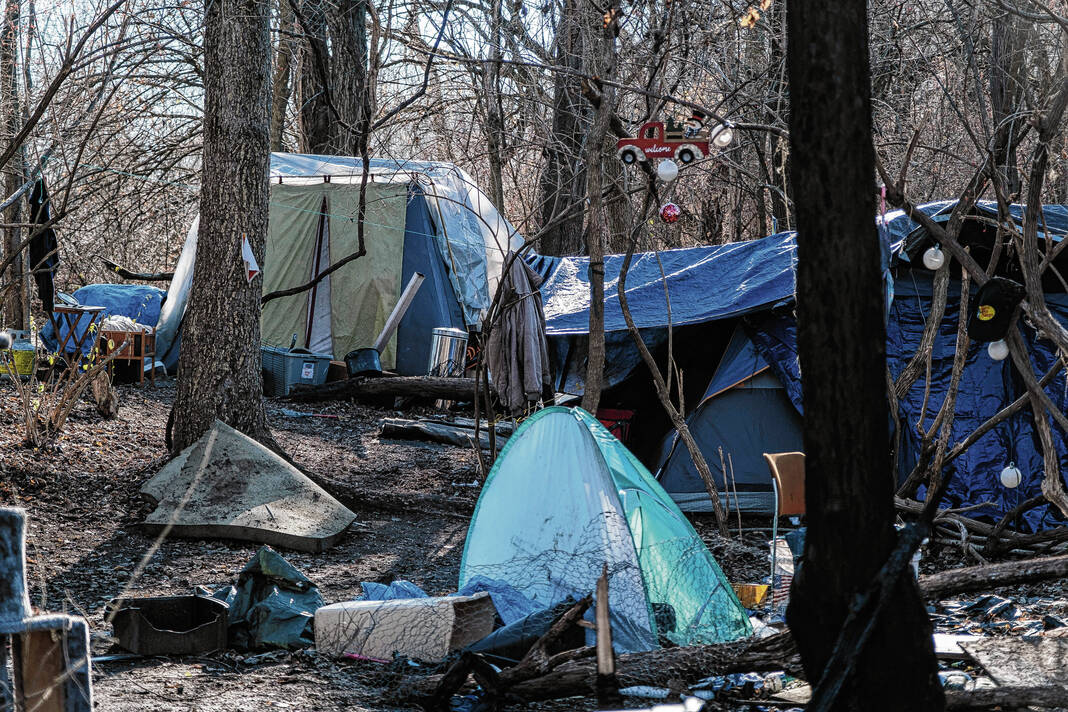
Mike Wolanin | The Republic A view of the homeless camp off the People Trail behind the old REMC building off Second Street in Columbus, Ind., Thursday, Dec. 14, 2023.
Local leaders have raised concerns that a bill banning sleeping on public property could make it more difficult to reduce homelessness in Bartholomew County, erode trust in law enforcement and result in “substantial costs” for taxpayers.
The measure, Senate Bill 285, would prohibit camping, sleeping or long-term sheltering on property owned by the state or local governments. Violators could face a Class C misdemeanor, which is punishable by up to 60 days in jail and up to a $500 fine.
The bill has drawn sharp criticism from those who see it as criminalizing homelessness, while proponents argue it will help connect people on the streets to essential services. Amid the controversy, the Senate voted 28-22 on Thursday to send the bill to Gov. Mike Braun’s desk. The House previously voted 53-44 to pass the bill two days earlier.
Local officials fear the bill would erode trust that outreach workers and law enforcement have built with homeless residents, making it harder to rehouse people through a community-wide initiative by United Way of Bartholomew County, the city of Columbus and other service providers.
“We can’t help people get rehoused until there is an establishment of trust,” United Way of Bartholomew County President Mark Stewart told The Republic. “That almost always takes multiple contacts with a person to start to build that trust. You can’t just walk up to someone and say, ‘Hey, I want to help you get rehoused.’ …If officers are in a position where they have to start arresting people or citing people, that does not build trust. We’ve had a very productive partnership with the police department and with code enforcement.”
“I’m not sure why we need to make it a criminal matter,” Stewart added. “We have, here locally, we’ve done well with getting people rehoused,” Stewart added. “…The folks that we’re rehousing, they have a multitude of hurdles to overcome in order to get rehoused, and if they end up with another mark on their record and a fine, that’s another hurdle that has to be overcome as we try to get that person back into mainstream housing and back into the mainstream economy with employment.”
Bartholomew County Sheriff Chris Lane raised concerns that the bill would criminalize homelessness without addressing its causes, strain jail resources and would likely end up costing local taxpayers who would have to foot the bill for additional staff and services.
“We’re a county jail, we’re not a mental health hospital,” Lane said. “I think the state pushes a lot of this stuff down on local government to have to try to figure out how to fix things. Arresting our way out of homelessness, I can’t see how that’s going to be beneficial to anybody.”
Lane also expressed concerns about how much it would cost local taxpayers, with his department potentially needing to increase mental health services, provide more medical services, hire additional staff and find a way to store people’s belongings. At the same time, the bill could place an additional burden on the county’s justice system, he said.
“Where are they going to get the money to pay the fines?” Lane said. “(They) probably won’t (pay them). If they were arrested, say they come to jail, they (will) get out of jail. Obviously, we can hold them for only so long. And then are they going to show back up for court? If they don’t show up for court, then there are warrants that could be issued for failure to appear. And then here that individual will be coming back to the jail and maybe even for a longer stint.”
“I’m not at all a fan of adding this criminal misdemeanor, because I think it’s just going to … put somebody in a system, have a criminal charge,” Lane added. “Maybe it’ll give them more resources with that, but it’s going to cost the taxpayer. And incarceration is not cheap. It’s not. I would rather see that money used other places to help these individuals than have them in my jail.”
Lawmakers divided
The bill has divided state lawmakers who represent parts of Bartholomew County.
Rep. Jim Lucas, R-Seymour, and Sen. Greg Walker, R-Columbus, voted in favor of the bill, while Rep. Ryan Lauer, R-Columbus, and Rep. Jennifer Meltzer, R-Shelbyville, voted against it.
Lucas described the legislation as “probably the most misunderstood bill” being considered this session. The Republican from Seymour said the bill seeks to give local authorities “tools” to help homeless people.
“What is the best way to help them get the resources that they can use, and this is it,” Lucas told The Republic. “With the court system, they have access to drug counseling, mental health counseling. That’s what they are set up for. And arresting them is discretionary, just like it is today with any other charge on the books. …It’s up to (law enforcement officials). It’s up to the local court system. …The only thing this bill does, it gives tools to the local authorities to help them get these people the help that they need if they want it, and there are safeguards put in place if a county’s not equipped to deal with it.”
“If there’s any way at all to get these people access to mental health treatment, drug and alcohol treatment, that’s what this bill is designed to do — not just arrest the homeless,” Lucas added. “I know that’s a catchy headline, and it gets attention.”
Walker said “it was a tough vote” and acknowledged that lawmakers still have work to do to address homelessness. He also pointed to the public health risks that homeless encampments can pose, citing crime, drug use and unsafe living conditions.
“The bill language is written such as to provide every chance on the part of law enforcement, on the part of prosecutors, on the part of judges and on the part of the homeless to avoid any criminal charges being brought,” Walker said. “But without the language that creates a criminal statute, it ties the hands of predominantly urban areas. That’s where these encampments are going to be an issue for the most part. …It ties the hands of city police to even engage and offer a ride to an available bed or a daytime resting station or some of the opportunities and services being provided in both Bartholomew and Johnson (counties).”
“I know that this is not a standalone bill that solves the problem,” Walker added. “It creates the engagement, and it’s still incumbent upon us as lawmakers to look at what we can do on a statewide basis and what locals can do and have done already in many cases to engage on the local county level, city level. …If there is any increase, any increase at all, in criminalization among the homeless population, I’ll be the first to work to get this undone.”
Lauer said he voted against the bill after consulting with law enforcement officials in Bartholomew County and elsewhere in Indiana and receiving feedback from constituents who questioned the necessity of the law.
“This bill focuses on setting up tents and living on public property, the current laws on the books, I think, are sufficient to address those situations,” Lauer said. “…I’m confident, in our community, that our city officials, our law enforcement, our mental health community work very well together to address these issues under the current laws, and I’m confident that we didn’t necessarily need to add a new law.”
How the bill works
While the bill would establish a criminal penalty for camping on public property, prosecution would not be immediate and lawmakers included some defenses that would shield people from charges under certain circumstances.
Before any charge is brought, a law enforcement officer must first assess whether the person is “gravely disabled” and should be placed on an involuntary hold. The bill would expand the definition of “gravely disabled” to include people without regular shelter who are living outdoors in dangerous weather and refuse transportation to a shelter or mental health provider with available beds.
However, those who don’t qualify for emergency detention would not be charged right away. Instead, first-time violators would receive a warning, along with information about available shelters and services. Anyone who remains within 300 feet of where the infraction occurred after 48 hours could face charges.
Lawmakers added several defenses from prosecution, including one that applies when no shelter or treatment beds are available within five miles of where the violation took place. Another defense covers people who were released from a facility within the previous six months after being found mentally ill and either gravely disabled or dangerous.
Homelessness initiative
Locally, Bartholomew County has made progress in reducing homelessness through a community-wide initiative launched in 2023, officials said.
So far, the effort — which is a partnership between United Way of Bartholomew County, the city of Columbus and other service providers — has rehoused 144 homeless people and prevented another 199 from becoming homeless.
The initiative has included building relationships with property owners willing to rent to tenants who might otherwise be excluded. Some landlords have agreed to lease units to residents working with housing coaches.
United Way has hired a case worker to do outreach with the homeless community, officials said previously. Additionally, the city of Columbus created a Homeless Task Force that includes representatives from parks and recreation, police, community development and code enforcement.
However, the work has recently grown more difficult as the number of homeless residents has declined, Stewart said.
“A lot of the people who are still homeless are facing more significant barriers with regard to mental health and substance misuse,” Stewart said. “A lot of the folks who are currently homeless now are really what we would call ‘chronically homeless,’ and that’s a very difficult group to serve.”
“Serving people who are homeless and getting them rehoused is really complex,” Stewart added. “There’s a number of different factors at play. Often, the issue of homelessness sits at the intersection of deep poverty, lack of affordable housing, substance misuse and mental health.”
At the same time, the number of people staying at Brighter Days, an emergency housing shelter run by Love Chapel at 421 S. Mapleton St., remains higher than two years ago.
Last year, the shelter served an average of 41 people per night, up from an average of 29 people per night in 2024, said Love Chapel Executive Director Kelly Daugherty. So far this year, around 40 people per night have been staying at the shelter.
However, not all homeless individuals choose to stay at Brighter Days. Daugherty said previously that there are several reasons why people may choose not to stay at Brighter Days, including people who do not want to part with pets, drugs, alcohol or weapons, none of which are allowed at the shelter.
“We’ve made some progress,” Daugherty said, referring to the homeless initiative. “There’s no way to solve homelessness. It’s never going to be totally solved, but I do think that Columbus as a whole and the United Way’s initiative for the city have made a big difference. For a long time, we felt like we were the only ones out there trying to take care of services for the homeless, and now we feel like there’s a good group effort in it.”