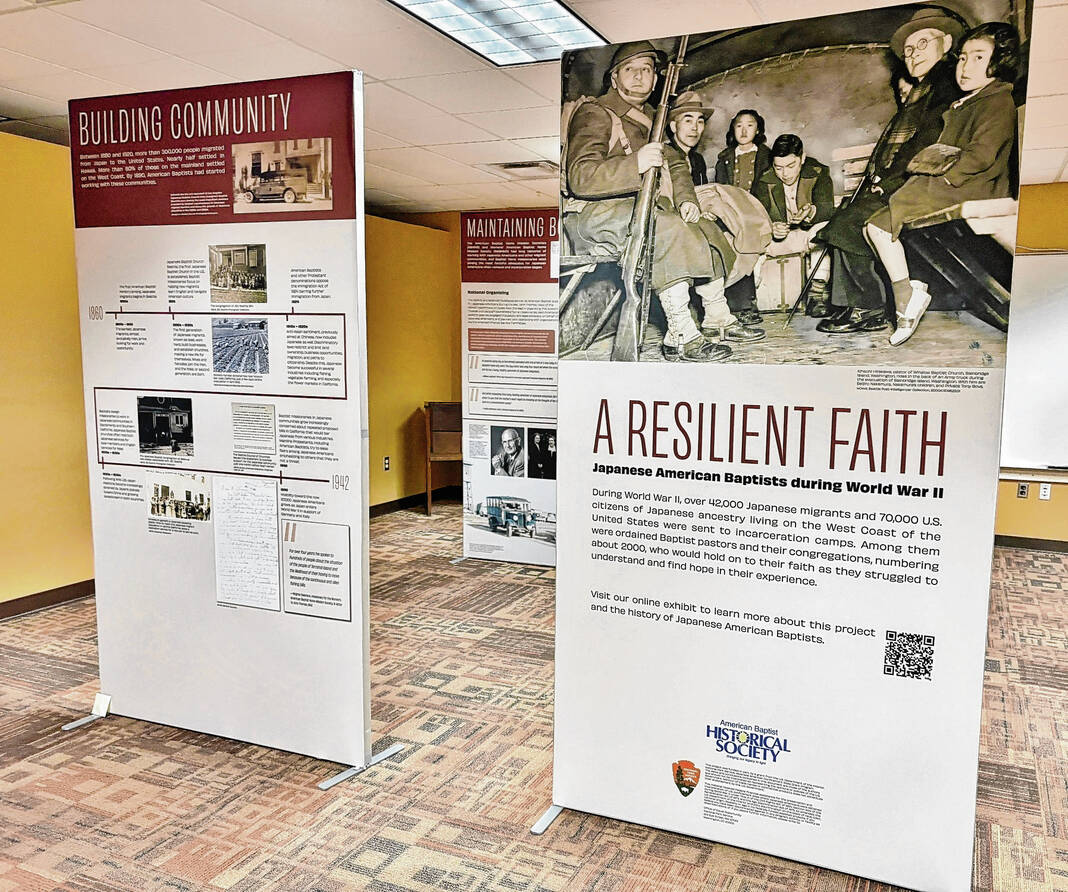
Oversized panels are set up inside the B.F. Hamilton Library on Franklin College’s campus, part of the exhibit “A Resilient Faith: Japanese American Baptists During World War II.” The exhibit, which examines the internment of Japanese Americans, opens March 2.
RYAN TRARES | DAILY JOURNAL
By Ryan Trares
Daily Journal, Franklin
For The Republic
FRANKLIN — The images are haunting and infuriating at the same time.
A mother holds her tiny baby, marked with tags as they are forced to leave their homes. Scared children and worried adults ride in the back of a truck, accompanied by an armed soldier. A mugshot of a pastor, whose only crime was being of Japanese descent.
The forcible removal of Japanese American families during World War II is a stain on American history. But the perseverance of Japanese Americans stands out.
A new exhibit coming to Franklin College examines this chapter in American history, filtering it through a lens of faith and a close connection to the college. “A Resilient Faith: Japanese American Baptists During World War II” illuminates stories of faith, perseverance and community among the 70,000 U.S. citizens of Japanese descent and 42,000 Japanese migrants who were forcibly confined during the war.
Using historical materials and personal narratives, the exhibit offers visitors an opportunity to reflect on a pivotal chapter in American history and its lasting impact.
“It’s about the stories, and sharing those stories that humanize the experience, and I think that’s what’s important here — understanding the human side of history too,” said Jessica Mahoney, director of library services and assessment for the college.
Franklin College organizers have also woven the school’s own history into the exhibit, from the life and work of Thomasine Allen, a graduate of the school and a noted missionary to Japan, and items from the archive of the American Baptist Churches of Indiana and Kentucky.
“It’s a great opportunity to show the value of preserving historical narratives,” Mahoney said. “There’s also a lot of opportunity for us to understand or envision ways that narratives are still historical but still current.”
“A Resilient Faith” is a traveling exhibit created by the American Baptist Historical Society. Using funding in part from the National Park Service Japanese American Confinement Sites Grant Program, the organization worked to digitize records related to the Japanese American relocation, providing educational resources for scholars, congregations, and members of the public.
The focus is on the approximately 2,000 Baptist pastors and their congregations, who leaned on their faith during the difficult period of time.
“Religion played a key role in the effort to preserve elements of normal life within the camps. Japanese American congregations — Buddhist, Catholic and Protestant — worked to continue holding services and organizing community events as they had before incarceration,” reads part of the exhibit.
That history presented several connections and parallels to Franklin College. The school was founded by Baptists in 1834 and remains in relationship with the American Baptist Churches USA and with local American Baptist congregations.
And of course, there’s the college’s history with Allen. The 1911 Franklin College graduate who left the U.S. in 1938 to be an American Baptist missionary in Tokyo, Sendai, Morioka and Kuji, Japan. She was detained in the internment camps of Sendai and Tokyo during World War II — mirroring the plight of Japanese-Americans in the U.S.
Upon returning to the States through an exchange of prisoners, Allen worked for two years at the Tule Lake Relocation Center in California, where Japanese Americans were incarcerated during the war. Later, she returned to Japan, where she laid the groundwork for the eventual sister-city relationship between Kuji and Franklin, which remains strong today.
“To know that her story connects Franklin College and Franklin, Indiana, to the city of Kuji and has created this cultural exchange, that’s opened some doors and awareness to culture and faith,” Mahoney said.
In 2024, three Franklin College students spearheaded a project collecting writings, photographs and more connected to Allen and creating the Thomasine Allen Online Collection. Through the project, Franklin College started down the path towards hosting “A Resilient Faith.”
While working on the project, they reached out to the American Baptist Historical Society for additional papers related to Allen. They talked about sharing resources and working together on projects.
“As we finished up our Thomasine Allen project, sharing all of that with the historical society, it became a matter of whether we wanted to have the exhibit on our campus,” Mahoney said. “It was a matter of making the right connections and finding a plan to make it work here.”
The exhibit — housed on the third floor of the B.F. Hamilton Library on campus — consists of a series of towering displays telling the story of Japanese American internment. Visitors start by learning about the migration of people from Japan to the United States — more than 300,000 of them between 1880 and 1920 — as well as the work the American Baptist Church did with them.
A picture emerges of a thriving immigrant community, coupled with a rising tide of anti-Asian sentiment, particularly aimed at Japanese Americans as World War II started.
Subsequent panels tell the story of forced interment after the bombing of Pearl Harbor and the signing of Executive Order 9066 in 1942, which forced the removal of 112,000 people of Japanese descent from California, Oregan and Washington. Entire families had to relocate, bringing along what they could carry.
“The women packed through the night, but when the trucks came the next morning, some were not done … but we had to take them, ready or not. In some cases, we had to pull them from their houses, crying and rush them off …” reads a quote from Virginia Swanson Yamamoto included in the exhibit.
Subsequent portions of the exhibit show how Japanese Americans tried to maintain a normal life, even behind barbed wire, including schooling young people, forming a basketball team and continuing their Boy Scout activities. A group of Protestant churches, including American Baptists, banded together to offer religious and pastoral care.
And outside the fences, American Baptist organizations advocated for those who had been interred and performed missionary work within the camps.
“Direct ‘on-the-ground’ support to incarcerated Baptists came through local home missions organizations and individual home missionaries, who found multiple ways to continue to serve,” the exhibit reads.
“A Resilient Faith” will be free to visit and open to the community during limited hours at Hamilton Library through April 24. The exhibition will also be incorporated into courses at the college, with 12 different classes visiting it as part of a tailored experience, Mahoney said.
“We’ve created lesson plans for each of those classes and a guide specific for what they’re taking,” she said. “We have courses from teaching social studies to elementary students to religion to history and creative writing. We’re finding ways to tie those threads together.”
To accompany it, Franklin College is offering a special public lecture by Mitch Homma on March 19, funded by Jim and Sandy Napolitan, longtime supporters who are active with the college. Jim Napolitan serves on the school’s board of trustees.
Homma is a third-generation sansei, or a person born in the United States or Canada whose grandparents were immigrants from Japan. He had nine family members spanning three generations incarcerated at Amache, an internment camp in Colorado.
His lecture is titled, “Faith-Based Perspectives: Japanese American Confinement During WWII & the Role of American Baptists.”
“It is very interesting because Mitch says that his grandparents knew Thomasine (Allen). So there’s that big connection there,” Mahoney said.
AT A GLANCE
“A Resilient Faith: Japanese American Baptists During World War II”
What: A traveling exhibit from the American Baptist Historical Society exploring the experiences of Japanese-American Baptists during World War II, highlighting stories of faith, perseverance and community amid the forced confinement of Japanese-Americans.
When: March 2 to April 24
Where: B.F. Hamilton Library, Franklin College campus
Hours: The exhibit will be free and open to the public 2–4 p.m. Tuesdays, 10 a.m.-noon Wednesdays and 11 a.m.-1 p.m. Fridays.
Lecture: A free, public lecture will accompany the exhibit at 7 p.m. March 19, in the Branigin Room at the college. The program will feature Mitch Homma, a third-generation sansei, presenting “Faith-Based Perspectives: Japanese American Confinement During WWII & the Role of American Baptists.”
Attendees will have the opportunity to view the exhibit before and after the lecture, from 6–7 p.m. and following the program until 9 p.m.
Registration for the lecture is strongly encouraged and available at bit.ly/Resilient_Faith.