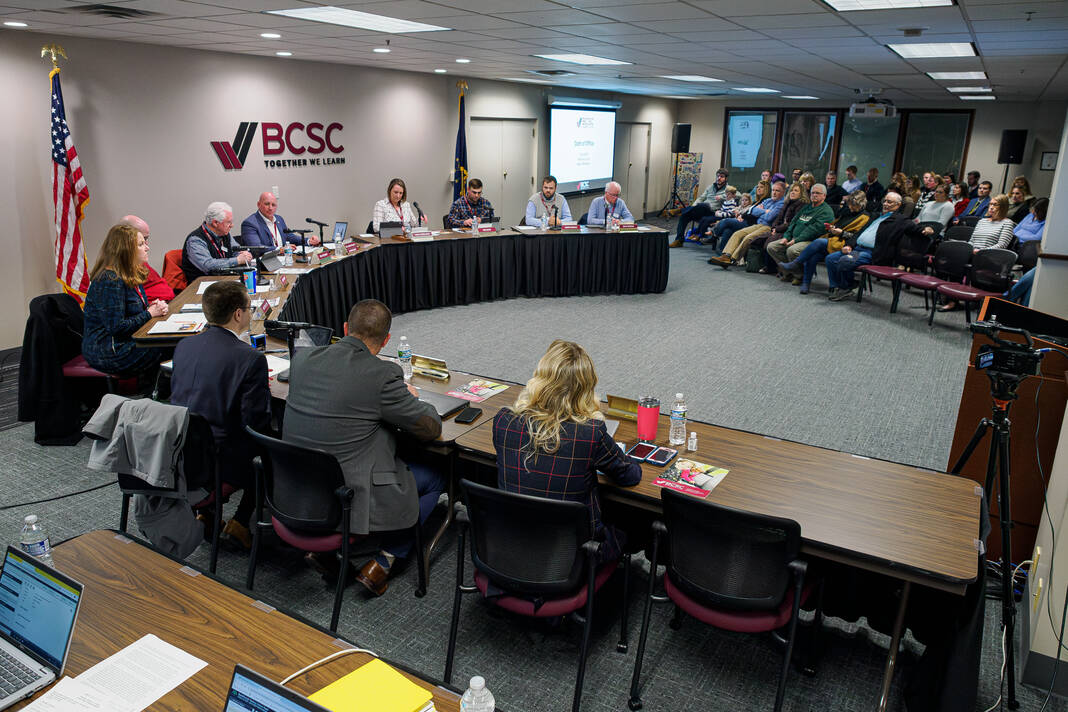
Mike Wolanin | The Republic The Bartholomew Consolidated School Corporation School Board holds their first meeting of the year at the BCSC building in Columbus, Ind., Monday, Jan. 14, 2025.
The results of a survey about renewing Bartholomew Consolidated School Corp.’s 2020 operating referendum at a lower levy showed there is a majority weighted support for renewing the referendum at $9.5 million.
Respondents were asked in the survey if they would support renewing the operating referendum to provide BCSC schools with approximately $9.5 million each year. The survey also asked respondents if they would support additional funding to address other priorities such as early childhood education.
The results of the survey, which saw about 4,518 respondents, were presented during Monday night’s BCSC board meeting. Weighted support from the survey’s results came to 63.3%, showing that there is support for renewing the operating referendum.
In June of 2020, just over 61% of Bartholomew County voters approved a property tax referendum for BCSC, with resulting funds going towards recruitment and retaining staff and safety and security.
The 2020 referendum allowed the district to impose an additional property tax rate not exceeding $0.1560 on each $100 of assessed value. These were collected beginning in 2021 and will be collected through 2028. The impact of that referendum has already been seen with the district improving graduation rates, state assessment scores of young readers and teacher retention numbers.
The referendum is expected to bring in about $10.5 million in 2026, with $9.3 million of that will go towards teachers salaries and $750,000 will be for the district’s new school security officers. The remaining $500,000, according to assistant superintendent for finance and operations Brett Boezeman, is earmarked for buses, among other items.
Six goals are outlined for the current operating referendum, which include teacher retention, student mental health, safety and wellness, updating the bus fleet, adding bus drivers and expanding STEM lab student experiences. BCSC keeps track of annual targets, which can be found at bcscschools.org/referendum-2020 under “Referendum Performance Goals and Targets.”
The survey was mailed out and made available online between Jan. 12 to Feb. 9. The original deadline of Feb. 2 was extended due to winter weather. About 1,169 responded via paper and the rest responded online.
Prior to the meeting, a work session was held with Scott Girard, project manager of School Perceptions, the Wisconsin-based research organization that was enlisted by the district to help with the survey. School board members Whittney Loyd, District 3, and Tom Glick, District 5, have been working on a committee regarding the survey’s development since the beginning of October.
Staff residents, parent residents, non-parent residents and non-staff residents were asked if they definitely or probably support or do not support renewing the operating referendum to provide BCSC schools with approximately $9.5 million each year. In response to the question:
- 87% of staff residents responded with “definitely yes” or “probably yes.” 6% responded with “probably no” or “definitely no.” 7% said they were undecided.
- 73% of parent residents responded with “definitely yes” or “probably yes.” 11% responded with “probably no” or “definitely no.” 16% were undecided.
- 60% of non-parent and non-staff residents responded with “definitely yes” or “probably yes.” 26% responded with “probably no” or “definitely no.” 14% were undecided.
Weighted support from “definitely yes” and “probably yes” answers from non-parent, non-staff and parent residents, the two groups that represent the majority of voters, came to a total of 63.3%, according to School Perceptions. From these results, there is enough support to put an operating referendum question on the ballot and there is majority weighted support for renewing the operating referendum at $9.5 million.
“… if the election were held today, that’s the level of support we would predict you would see on that operating referendum renewal…,” Girard said.
When asked by school board member Nicole Wheeldon, District 7, if anything from BCSC’s data stuck out to Girard, he said the 63.3% weighted support is higher than the trend School Perceptions has been seeing this school year compared to other clients.
“I would say the trend, specifically this school year, that we’ve been seeing on our referendum surveys has been much more toward toss-ups, right at that 50/50 level within the margin of error and you’re just significantly above that,” Girard said. “So that did stand out as pretty strong support compared to the trends we’ve been seeing this school year.”
Superintendent Chad Phillips said that high support could be because BCSC is proposing to renew funding for existing programs that have proven to show results.
“Great teachers and staff, safe schools, I think that’s different than maybe some of the other communities that are more unknown like we were back in 2019 and 2020, how effective would this investment be,” Phillips said.
From here, the board will have their last time to act on putting the referendum renewal question on the November 2026 ballot during its June board meeting. Phillips said the intention is to work with the board and work internally to make a recommendation during their April board meeting.
If the board were to move forward with the renewal and it was ultimately approved by voters, it would replace the existing referendum. As recent changes by state lawmakers restrict referendums to only even-numbered general elections, if the renewal was denied by voters in November 2026, the school board and district could still pursue a renewal in November 2028.
“Our contention and what we intend to do, I know the survey didn’t include it, is through education, through lots and lots of public work sessions and through lots of overcommunicating is to make sure that people understand that if you vote yes, we will be collecting less property taxes than what we are today by an average of about a million dollars per year assuming that the board ends with the conclusion that we leave the referendum at that average of $9.5 million per year,” Phillips said.
The survey also asked if the community supports investing funds into additional priorities. These priorities include:
- Early childhood education, which would fund high quality education for 4-year-olds with demonstrated financial need, at an estimated cost of $2 million per year. 48% of respondents said this was a high priority, 29% said this was a medium priority and 23% said this was a low priority.
- Additional safety and security, which would build on strong safety measures already in place by allowing schools to add security staff and equipment, at an estimated cost of $1 million per year. 49% of respondents said this was a high priority, 31% said this was a medium priority and 20% said this was a low priority.
- Enriching STEM programs, which would build on successful STEM work by funding more innovative and engaging opportunities for all students, at an estimated cost of $1 million per year. 44% of respondents said this was a high priority, 36% said this was a medium priority and 20% said this was a low priority.
The survey also clarified that while district leaders are considering a referendum renewal that asks for a lower amount than the $10.5 they currently receive, BCSC wants to understand if the community supports additional funding for these initiatives.
When asked what additional funding amount, if any, they would support, weighted support came to 9.3% for an additional $4 million, 12.3% for an additional $3 million, 18.5% for an additional $2 million and 32.3% for an additional $1 million. Philips said there’s no majority support for any dollar amount $1 million to $4 million.