
Home Blog

Teacher injury reports: BCSC approves new policy, with some concerns

Jason Major Mike Wolanin | The Republic

Bartholomew Consolidated School Corp. board members on Monday night approved a new policy that outlines how the district should go about counting and reporting incidents when a school employee is injured on the job by students, although further changes are likely.

The new policy, D525: School Employee Injury Reporting, comes against the backdrop of a state law from 2023, IC 20-26-5-42, which required each public school to provide data to the state about school employees on the job who were injured by a student in the previous school year.

During the first year of required reporting in 2023-24, BCSC reported the second-highest number of incidents in Indiana. However administrators said at the time that the numbers they submitted reflected over-reporting because of a lack of clarity from the state about what incidents should be submitted. Between the 2023-24 and 2024-25 reporting period, BCSC went from 142 reported incidents to 20.

But the number of “information-only” incidents has continually climbed over the past couple of years, according to District 1 school board member Jason Major, who authored the policy and receives confidential, information-only reports given to school board members from administrators quarterly.

Major stated that during a closed session in October 2025 regarding school safety, school board members learned that through the first three months of the school year, the number of information-only incidents was already at 80% of the total from the 2024-25 school year.

Information-only reports can range from a student stepping on a teacher’s foot to a student with special needs, for example, unintentionally striking a teacher. Information-only reports refer to any time a student and staff member had an incident resulting in a staff member going to a school nurse, but there was not a medical claim made.

Information-only does not necessarily mean the incident was minor, just that it didn’t currently meet criteria for formal action under policy or law.

The school employee injury reporting policy received its first reading during the school board meeting on March 2, although there was no discussion about it. The policy was finalized Monday by a 5-1 vote, with Board President Rich Stenner, District 2, the lone vote against because he thought the policy wasn’t fully ready. Nikki Wheeldon, District 7, was absent.

The new policy was not approved without school board members first bickering about procedural minutiae, disputes and finger pointing about which members actually are operating in the best interests of teachers and whether board leadership was slow-rolling consideration of the new policy.

Those interested can watch the matter discussed via a recording of Monday night’s school board meeting on BCSC’s YouTube page, starting at 1:15:50.

The school board initially was going to hold a work session to discuss the policy, but one was not scheduled in the time since March 2. The board did meet, however, for a closed session on March 23. Also of note is that spring break was held from March 16 to March 20.

Board leadership, in coordination with BCSC administration, is in charge of scheduling work sessions, according to BCSC officials.

Superintendent Chad Phillips remarked that there had been “multiple instances (in the past) in which a work session was requested, but was not scheduled before the next board meeting, just depending on the timing.”

Phillips emphasized that internal work is being done to produce a similar policy, also noting the district’s excellent teacher retention rates.

“That doesn’t mean we’re perfect, and it doesn’t mean that we don’t need to continue to share more information,” Phillips said. “But people are doing work right now to keep all of our teachers, staff and students safe.”

The policy wasn’t on the board agenda heading into Monday night’s meeting, but Major, before reading a long written statement, requested that it be added, which was approved 4-2, with Stenner and Dale Nowlin, District 4, voting against.

The policy drafted listed March 30 as the second reading of the policy, but Michael McIver, BCSC’s legal counsel, said that meetings are driven by the printed agenda.

McIver indicated that the policy as it was written was not fully fleshed out in his eyes, and that a work session would still be a worthy idea.

“What I would encourage the board to avoid is creating its own policy that creates a mandate to report without providing clear instructions as to what it is that the administration is supposed to report,” McIver said.

Informing that view is recently passed state legislation in House Enrolled Act 1249 that changes how school employee injuries are reported, replacing the 2023 law.

The new law treats injuries to school staff primarily though the lens of “battery,” making reporting requirements more about intentional acts such as teachers being hit or kicked than general injury tracking as was the case with the 2023 law. HEA 1249 also strengthens the criminal consequences of harming a school employee.

Assistant Superintendent for Human Resources Erin Stalbaum said that the reporting structure through the new law has not yet been clearly defined.

Nowlin, the school board’s legislative liaison, said that he had sent the policy to Julie Slavens, the senior counsel and director of policy services for the Indiana School Boards Association, who stated the policy was “excessively long,” Nowlin said, and that much of what was included in it would be better placed in administrative guides. Nowlin said he still believed the board should conduct a work session to work through details, but was generally in favor of such a policy.

Whittney Loyd, District 3, seemed to agree, saying that she had particular suggestions about the policy but that she wasn’t going to vote against it as of now because of that.

It was generally well-understood by the board that it would be likely the policy would be amended again, but Major, who is up for re-election in November, opted to move forward.

Major was frustrated that there hadn’t been discussion in the time since the first reading about the policy among board members, and that no emails were shared among them about any suggestions. The original policy draft was provided to every school board member on Feb. 3, Major said, adding that he had been in conversation with Tom Glick, District 5, and Logan Schulz, District 6, about the policy.

The policy was approved, but there really wasn’t any discussion about the contents itself.

Policy information

The policy establishes a transparent process for reporting employee injuries caused by student, parent or staff conduct and supports data collection for continuous improvement.

According to D525, the school board will designate a corporation administrator to collect and maintain records of each unique employee injury incident, which will be reported to the school board with regular frequency.

If a workers compensation claim is filed or an employee has to miss school because of an injury, a closed session of school board members will be convened to discuss the incident, including, among other things, any potential action against the person responsible for the injury.

A committee of safety and security team leaders, school board members, school faculty and staff, and parents of students will also be appointed by the board to review the policy, monthly reports, end-of-semester reports and end-of-year reports. Based on those reports, the committee will create and present recommendations of changes to the policy or school safety improvement plans to the school board.

Those interested can read the policy in full at BCSC’s BoardDocs page.

CEA viewpoint

The president of the BCSC teacher’s union, the Columbus Educators Association (CEA), Amy London, said that the matter of school employees being injured by students is in no way just a BCSC phenomenon, but something school districts across the state and country are dealing with.

London said the increased numbers of information-only incidents described by Major ring true to the experience of CEA membership and that the majority of the incidents involve students on the elementary level. She also said that many of the students involved in these incidents are in special education.

“I think it’s a very individualized situation because in my observation of being a teacher for the last 26 years, the type of behavior support that students have needed has increased and become more intense,” London said. “Mental health issues have been something that teachers have had to try to support students with in the classroom and we are not necessarily trained to do that.”

“It just seems to be the level of the type of behavior that students are exhibiting is more severe,” London went on. “…We see that a lot of the students that exhibit these behaviors are in special ed.”

BCSC is working to foster a culture of safety for its teachers and students, London said, but the accountability piece is still missing.

“I worry that we are not at a point, based on the behaviors that we see from kids now, that we are not working to foster a culture of accountability,” London “.. “Even 10 years ago in teaching, if a student were to exhibit a particular behavior or harm someone, there was a specific consequence that happened. And it seems like the line has moved.”

London reasoned that the moving of that line doesn’t come from BCSC in particular, but pointed to social media and the behavior it can bring out in students as one factor.

London said that the new policy itself does a “good job of making sure that incidents are reported,” but that it’s missing the accountability piece.

She also had further questions about some of the process of the policy, including but not limited too, more information about the administrator that would be in charge of maintaining the records and how it would ensure incidents are all reported in the same way.

She also said that she would hope that monthly and end-of-semester reports giving an overview of all incidents would be made public versus just being presented to the school board, plus that the committee that would continually review the policy and discuss certain incidents would also have a CEA representative.

Chang Ung, North Korean ex-IOC member who brokered Olympic joint marches with South, dies

SEOUL, South Korea (AP) — Chang Ung, a former North Korean member of the International Olympic Committee who once led sports exchanges with rival South Korea including joint marches of their athletes at the Olympics, has died, the IOC announced Wednesday. He was 87.

The IOC said on its website that it had learned with “extreme sadness” of Chang’s death on Sunday. It said the Olympic flag will be flown at half-mast for three days at Olympic House in Lausanne, Switzerland in a show of respect.

The IOC statement didn’t describe the cause of Chang’s death. North Korea’s state media has not reported on his death.

Born in 1938, Chang was originally a basketball player who captained the North Korean national team. After retiring from the sport, he became an athletics administrator, serving as a vice sports minister, a vice chairman of North Korea’s national Olympic Committee and a vice president of the Olympic Council of Asia.

In 1996, Chang was elected to the IOC. As North Korea’s only-ever IOC member, he represented his country on international sports fields and headed numerous — if often rocky — talks with South Korea to promote sports exchange and cooperation programs between the rivals.

The most notable results of this diplomacy came at the 2000 Sydney Olympics, when athletes of the two Koreas marched together under a “unification flag” depicting their peninsula during the opening and closing ceremonies, the first joint parade since their division in 1945.

Athletes of the Koreas walked together at following Olympic Games and major international sports events, including the 2018 Pyeongchang Olympics in South Korea. After watching a joint march in Pyeongchang’s opening ceremony, Chang told reporters that he was “deeply moved.”

Chang played a key role in earlier talks with South Korea, which led to the two countries sending their first unified male and female teams to the 1991 world table tennis championships in Chiba, Japan. In Pyeongchang, the two Koreas fielded their first combined Olympic team for women’s ice hockey.

But sports ties between North and South Korea have suffered as political relations frayed.

There have been no sports and any other exchanges programs between the countries for years. North Korea has shunned talks with South Korea and the U.S. since its leader Kim Jong Un’s broader nuclear diplomacy with U.S. President Donald Trump collapsed in 2019. He’s also branded South Korea a permanent enemy and rejected the idea of future unification.

The IOC said Chang’s contributions helped advance sports participation, cultural exchanges and the role of sport in society.

“His efforts to promote cooperation on the Korean Peninsula demonstrated the power of sport to build bridges and inspire hope,” IOC President Kirsty Coventry said.

The IOC said Chang served on several commissions including Sport for All and International Olympic Truce Foundation.

North Korea’s official news agency, KCNA, last mentioned Chang in 2023, when he was awarded the Olympic Order, an award given to those who have made extraordinary contributions to the Olympics, during an IOC session in Mumbai, India. Chang, then an honorary IOC member, joined the ceremony by video.

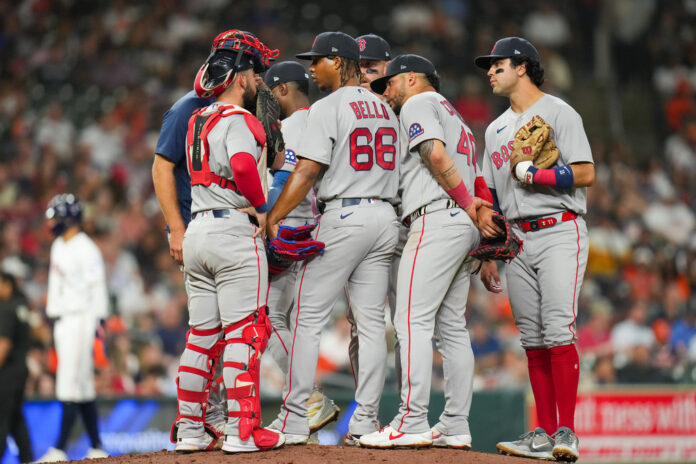
Umpire loses track of count, leading to walk instead of strikeout for Astros’ Cam Smith vs. Red Sox

HOUSTON (AP) — Plate umpire Mark Wegner acknowledged he lost track of the count during Cam Smith’s nine-pitch walk Tuesday night in the fifth inning of the Houston Astros’ 9-2 win over the Boston Red Sox.

In fact, Smith should have been out on strikes after the third pitch.

Smith swung and missed at two cutters from Red Sox starter Brayan Bello to begin the plate appearance. After the second pitch, Joey Loperfido stole second base and Christian Walker scored on the play thanks to a throwing error by catcher Connor Wong. After about 40 seconds, Smith swung and missed at a sweeper.

That should have been strike three but Wegner, a crew chief working his 29th major league season, flashed 1-2 for the count. Six pitches later, Smith worked a walk.

“I just watched the video. I didn’t know what happened until I came in here and apparently, I somehow didn’t count the second swinging one because I said the count was 1-2. It was actually strike three,” Wegner told a pool reporter after the game. “Had anybody caught it, we can always go and call replay and check the count. I’ve never done that before. I’m not happy about it. Just made a mistake.”

Wegner said no one on the field raised an issue in the moment.

Bello said Wegner gave the count as 1-1 after his second pitch, and he didn’t question it at the time.

“I thought the first pitch was a strike and I thought that he swung at the second pitch,” Bello said in Spanish through a translator. “None of that took me out of my focus in that inning. I tried to get out of that inning, and it didn’t happen.”

Smith was the last batter Bello faced in his season debut. He allowed six runs, five earned, on eight hits and three walks over 4 2/3 innings.

___

AP MLB: https://apnews.com/hub/mlb

Board condemns 13th Street house

City code enforcement asked the Columbus Board of Public Works and Safety to approve an order to vacate and condemn a house due to unsafe conditions.

Code Enforcement Officer Fred Barnett said he has been working with the 2909 13th St. property since the first of the year with issues regarding garbage, trash and unlicensed inoperable vehicles which he said the property owner did handle.

Barnett said that after the outside of the home was fixed up, his team inspected the inside of the building. He told the board that inside the building were issues such as holes in the roof and electrical issues from open-panels and spigot leaks next to electrical panels.

Due to these issues, he asked that the house be vacated, condemned and that legal action be taken if needed. Barnett also added a building permit requirement for any action taken on fixing the house.

Board member John Pickett asked if there is anything the board or the Columbus City Council could do to prevent houses from getting bad enough to the point of condemnation.

“It would be nice if we could be more proactive, because we have some crap housing stock,” Pickett said.

The board voted unanimously to approve the order to condemn, vacate and take legal action on the 13th Street home.

BCSC updates board on IREAD-3 projections

Hack

Bartholomew Consolidated School Corp. is continuing to make significant progress in fostering the skills of young readers, according to IREAD-3 projections provided to school board members on Monday night.

IREAD is an online test given to second- and third-graders across the state to determine their ability to understand letter sounds and assess their vocabulary and reading comprehension.

Just over 89% of BCSC third-graders passed the IREAD-3 assessment last year, up nearly 10 points from 2022-23, and projections show that figure is expecting to climb to 90% in 2026 at school year’s end.

The current crop of third-graders took the test as second-graders to give district officials and teachers the chance to find out ways to support those who are at risk of not passing, and that strategy has proved effective.

Students are able to take IREAD three different times before the year is out, and if they don’t pass, state law requires they be held back.

Students can also qualify for a good-cause exemption that would allow them to move on to fourth grade even if they don’t pass, including students who have been in the United States for fewer than two years or those who have an individualized education plan (IEP).

Students took the first administration of the test during the first two weeks of March. Director of Elementary Education Laura Hack, Elementary Curriculum Specialist Jeannie Long, and Taylorsville Elementary Principal Jennifer Dettmer talked about the results.

Of the current second-graders who took the test meant for third-graders, 54% were able to pass the test, Long said, up from 50% in 2025 and 44% from 2024.

“Over the past two years we’ve made intentional investments in structural consistency with teacher development grounded in the science of reading,” Long said. “These efforts have yielded measurable results.”

The science of reading is a way of teaching reading based on a large body of research on how kids actually learn to read.

Of the 819 second-graders testing, 441 passed. There are 90 students on track to pass the assessment next year as third-graders and 288 identified as at risk of not passing. There were 2% fewer students deemed at risk of not passing compared to 2025, according to BCSC.

Of the 810 current third-graders, 664 of those either passed the test in second grade or during the first administration of the test, or 82%. Of the remaining third-graders, 72 are on track to pass over the next to administrations and 74 were identified as at-risk of not passing.

“We still have intentional work to do with these students,” Hack said. “This comes in the form of small-group instruction and progress monitoring from now until the next two (test) administrations.”

The next two chances to take IREAD will be in May and June.

Some of strategies that district officials say have paid dividends include the small-group instruction and progress monitoring, but also mentoring of first year K-3 teachers by experienced colleagues; clear and consistent communication with student families about where their child is at; and strategic staffing of teachers in second- and third-grade that have experience with the science of reading.

Funk-rock band Here Comes the Mummies to perform at Brown County Music Center

Photo provided Eight-piece funk rock band Here Comes the Mummies will be performing at the Brown County Music Center April 11.

They might be 5,000 years old, but these mummies really know how to rock out.

Here Comes the Mummies, an eight-piece funk rock band, are invading the Brown County Music Center this April with their “terrifying funk from beyond the grave” that’s sure to leave audiences smiling.

The show starts at 8 p.m. on April 11. Tickets are available at browncountymusiccenter.com.

Formed in 2000 in Nashville, Tennessee, Here Comes the Mummies consists of eight members, all of whom go under stage names and keep their real identities under wraps.

“We’re just mummies when we hit the stage,” Mummy Cass, the band’s lead vocalist and guitarist, said.

The band’s members have shifted some over the years, but their current line up includes Mummy Cass, vocalist and drummer Eddie Mummy, vocalist and bassist K.W. TuT, vocalist and keyboardist Spaz, bassist The Pole!, vocalist, saxophonist and tambourine player Dr. Yo and tenor saxophonist Highlander.

There’s also “HPOD,” or High Priest of Death, on trumpet and Midnight Mummy on bari and tenor sax, keys, percussion, talk box and vocals, according to the Brown County Music Center. Mummy Cass said this line up has been performing for five to six years, though they do have past members come back every once and a while.

“Everyone’s kind of got their parts and we try to play as a section, as a band, we like to try to get the groove on as much as we can but we always let everybody have as much time as they want to just kind of be free,” Mummy Cass said. “So there’s sections where we’ll let the trumpet player go, we’ll let the sax guy go, that kind of thing. And then just some dancing and stuff that we do but you got to remember: we’re 5,000 years old so we’ve got some creaky hips and some bad knees.”

If artists like Earth, Wind and Fire, Prince and P-Funk are your style, Mummy Cass said Here Comes the Mummies is trying to go for something like that. They like to use lots of innuendo and double entendres in their songs, and Mummy Cass likes to think of their shows as high energy performances.

“It’s an eight-piece band with a big horn section and it’s… funky and we want people shaking their booties, having a good time,” Mummy Cass said. “It’s all about smiling and forgetting what’s going on in the outside world.”

Here Comes the Mummies have brought their freaky funk with them to appearances on That’s My Jam with Jimmy Fallon, festivals like Summer Fest, Summer Camp and Musikfest, and have become regulars on the Bob & Tom Show. They’ll play anywhere, from across the Midwest to down south in Florida and New Orleans to even internationally in Canada and Australia.

They’ve also performed at the Brown County Music Center before, where Mummy Cass said they had a good crowd and a lot of high energy the last time they played at the venue. Fans of theirs can look forward to the same energy they’ve always delivered and some new tunes from their latest EP “Road Trip.”

“We’re going to play some new songs, we’re going to do some old favorites too, so hopefully it’s just going to bring a smile to your face,” Mummy Cass said.

Commissioners approve building change

The Bartholomew County commissioners approved suggested changes to the new government storage facility being built at the county fairgrounds.

Larry Mohr Construction Inc. is building the new facility and recommended some ways to give the facility a longer lifespan. The suggested changes add another $18,580 to the project, lifting the total cost up to $758,930, which still falls under the initial $1 million cost estimation.

“I totally support these. The building will last much longer with the foundation change, I’m glad to see it,” Commissioner Larry Kleinhenz said.

The storage facility is important for the county to keep government documents secured in a safe location. Currently documents are kept all over the county: the Bartholomew County Courthouse, Purdue Extension Building, Bartholomew County Health Department and the Bartholomew County Youth Services Center.

Indiana law requires that certain documents be stored for 50 years with some even in climate-controlled environments.

Bedford native Clayton Anderson to perform at Crump Theatre

Photo courtesy of Hannah Fink Bedford native and touring country musician Clayton Anderson will be performing at the Crump Theatre on April 11.

Some may say all roads lead back home. For touring country musician Clayton Anderson, that’s especially true.

Though his musical career has taken him across the country and the world, for the time being, the Bedford native is back home in Indiana and will be making a stop at the Crump Theatre for a high energy concert.

The show starts at 7 p.m. April 11. Tickets cost $23.18 for general admission and $39.19 for early access general admission tickets. Early access ticket holders can enter the theater ahead of the crowd. The link to purchase tickets can be found at thecrump.org.

Growing up in Bedford and an alumnus of Bedford North Lawrence High School, music was always a part of Anderson’s household. He decided to pick up the guitar while attending Indiana University, where he said one thing led to another and the next thing he knew, he was playing shows, running around the country and making records in Nashville.

“Music’s really, it’s more than just music, it’s brought me everything that I have in my life,” Anderson said. “It’s brought me my wife, I met my wife through music, I met a lot of my best friends through music, I’ve met so many people through music and it all stems from there and I’m very appreciative for it.”

Throughout his musical career, Anderson has released a series of albums, a line up of singles and has performed alongside the Zac Brown Band at the Indy 500, according to his website. He has also opened for artists such as Eric Church, Blake Shelton and Thomas Rhett, and his 2023 track “Gotta Get Up” can be heard on ESPN as it was picked up by the network for their college baseball season.

Anderson also opened a country bar in Indianapolis last September. Though he technically resides in Nashville, he has spent a lot of time in Indiana lately because of the country bar keeping him busy, and he said it’s really nice to be back in the state again.

“I never wanted to leave to begin with,” Anderson said.

His musical style takes heavy influence from fellow Hoosier musician John Mellencamp, who he grew up listening to, but he also takes influence from ‘90s country artists he listened to growing up such as Johnny Cash and Willie Nelson. Anderson takes the “write what you know” approach to his music, and his experiences growing up in southern Indiana are where he takes inspiration.

“I’m a homer for Indiana, especially southern Indiana and I just think there’s a charm about it, there’s a goodness about it,” Anderson said. “I think people live the right way of taking care of one another the way we should and I’m very proud to be from here so all those things that I’ve witnessed growing up, obviously you got to write what you know and those are small town relationships and family ties and that type of thing.”

His upcoming show at the Crump Theatre will feature him performing alongside guitarist Aaryn Martin, drummer Niko Albanese and bassist Cole Mcglothlin. Audience members can look forward hearing songs Anderson wrote in addition to songs that have inspired him.

Anderson said he looks forward to entertaining the crowd at the Crump, a place he has driven past several times and always thought it would be cool to play at.

“Columbus is a great town, I have a lot of respect for Columbus, I think Columbus is one of the jewel towns in all the world,” Anderson said. “I appreciate its love for art and part of art is music and I think saving and keeping these… theaters alive is wonderful for the arts of music and entertainment, comedy, anything like that. So I’m very excited to be a part of that.”

Vance and Rubio’s differing postures on Iran war highlight their challenges ahead of 2028 election

WASHINGTON (AP) — As President Donald Trump assembled his Cabinet last week, he asked Secretary of State Marco Rubio and Vice President JD Vance to give an update on the Iran war.

Rubio, known for his hawkish views, gave an impassioned defense of the war, calling it “a favor” to the United States and the world.

Vance, who has long pushed for restraint in U.S. military intervention overseas, was more sedate. He said that the U.S. now has “options” it didn’t have a year ago and that it is important Iran does not get a nuclear weapon — before redirecting his remarks toward wishing the troops a happy Easter.

The exchange was a distillation of their diverging postures toward the war that their boss has launched in Iran. And it comes as some would-be Republican presidential candidates begin quietly courting officials in key states like New Hampshire in the early stages of the GOP’s next nomination fight.

With Vance and Rubio seen as the party’s strongest potential candidates in a 2028 primary, the two have to balance their roles in the Trump administration with their future political plans.

“It’s very obvious from the way that Rubio talks about Iran and the way that Vance talks about Iran that they are of different casts of mind,” said Curt Mills, the executive director of “The American Conservative” magazine and a vocal critic of the war. The Cabinet meeting episode was telling, he said, because it seemed as though Vance, discussing Easter, was “literally trying to talk about anything else other than the war.”

Vance’s office declined to comment. The State Department declined to comment but pointed to Rubio’s remarks last year during a Fox News Channel interview where he said he hopes Vance intends to run for president and wouldn’t rule out anything for himself.

It’s too soon to forecast how Republican voters might feel about the war next spring, when the 2028 contest is expected to begin in earnest, but the risks for both Vance and Rubio are acute. Rubio’s full-throated support for the war could come back to haunt him depending on how the conflict develops. Vance, meanwhile, would risk accusations of disloyalty if he were to stray too far from Trump, but struggles to square an appearance of support for the war with his past comments.

Vance’s restrained comments stand in contrast to Rubio’s full defense

Vance, who served in the Iraq war, has said that Iran cannot have a nuclear weapon, but he’s long been skeptical of foreign military interventions.

Trump seemed to allude that Vance may have held onto that position in private discussions about Iran, telling reporters that Vance was “philosophically a little bit different than me” at the outset of the conflict.

“I think he was maybe less enthusiastic about going, but he was quite enthusiastic,” Trump said.

Though Vance has been careful in how he speaks about the war, what he’s not saying has been conspicuous. On a March 13 trip to North Carolina, he was twice asked by reporters if he had concerns about the conflict. Each time, he said it was important that Trump could have conversations with advisers “without his team then running their mouths to the American media.”

A few days later at the White House, when Vance was again asked if he had concerns, he accused the reporter of “trying to drive a wedge between members of the administration, between me and the president.”

For Rubio, long before he became the country’s chief diplomat, he voiced support for muscular foreign policy and American intervention abroad.

Days into the war, he told reporters that it was “a wise decision” for Trump to launch the operation, that there “absolutely was an imminent threat” from Iran and that the operation “needed to happen.”

Fractures are emerging in the GOP

The apparent split between Rubio and Vance on the Iran war is emblematic of the divide starting to cleave within the Republican Party. A recent survey from The Associated Press-NORC Center for Public Affairs Research found some divisions within the GOP on Iran, with about half of Republicans saying the U.S. military action has been “about right.” Relatively few Republicans, about 2 in 10, say military action has not gone far enough, while about one-quarter say it’s gone too far.

While some conservatives have described the war as a betrayal, many other Republicans have cheered on the president’s actions.

Alice Swanson, a 62-year-old who attended Vance’s event in North Carolina, said she wants Vance and Rubio to run together in 2028 but favors the vice president.

“I think he fully believes and supports exactly what his convictions are,” Swanson said.

Swanson acknowledged, nonetheless, that Vance has been an outspoken opponent of interventionist policy but has been quieter on the subject since the war. “I can see both sides,” Swanson said after expressing full support for Trump’s decisions.

Tracy Brill, a 62-year-old from Rocky Mount, spoke highly of Rubio, but declared, “I love JD Vance.”

She made it clear she sides with the president, calling the course he’s taken “spot on.” But she defended the vice president if he seems at odds with his past statements, noting politicians do it frequently. “They’ve all changed their positions at one point or another,” she said.

However, Joe Ropar, attending the Conservative Political Action Conference last week, said Rubio’s unequivocal support for the Iran war helped crystallize his preference for the secretary of state for 2028.

“I’m not looking at JD Vance for president, and it’s for stuff like that,” said Ropar, a 72-year-old retired military contractor from McKinney, Texas. “I don’t 100% trust him.”

Benjamin Williams, of Austin, Texas, said at CPAC that both Trump and Vance are “tied to this war.” The 25-year-old marketing specialist for Young Americans for Liberty is looking elsewhere for a candidate.

The political risks might not be known until the field fills out

Whether the war becomes a political problem for Vance and Rubio depends on who ultimately enters the GOP’s next presidential primary.

While Vance and Rubio are currently considered the overwhelming front-runners, former New Hampshire Gov. Chris Sununu expects a half dozen high-profile Republicans to enter the contest.

Sununu and former RNC Committeewoman Juliana Bergeron told The Associated Press that multiple Republican presidential prospects have reached out to them in recent weeks to discuss the political landscape in the state that traditionally hosts the opening presidential primary; they declined to name them.

Republican strategist Jim Merrill, a top New Hampshire adviser for Rubio’s 2016 presidential bid, predicted that Iran would become a flashpoint in 2028 — just as the Iraq war was for Democrats in 2004 and 2008.

“If for some reason things don’t go as anticipated, there will be contrasts drawn,” he said.

Still, Sununu is doubtful that Iran would become a meaningful dividing line in a prospective Vance-Rubio matchup given their status as prominent members of the Trump administration. Both will likely take credit if the conflict ends well, and both would look bad if it does not, he predicted.

“They’re tied together with the success or failure of Iran. It doesn’t really separate one versus the other, at least I don’t think that’s how the electorate will see it,” Sununu said.

___

Peoples reported from New York. Associated Press writers Matthew Lee in Washington, Bill Barrow in Rocky Mount, N.C., and Thomas Beaumont in Grapevine, Texas, contributed to this report.

Column: Some statistics about Indiana’s ‘old’ houses

Morton Marcus

You can’t judge a house solely by its age. Unlike people, houses can be modernized, updated, and refurbished because they are less integrated than humans. Replacement furnaces are easier to install than human hearts and come with a longer warranty. Failed plumbing systems at home have complete, routine remedies while our personal systems often require extensive monitoring of their imperfect performance.

Data on the condition of houses is not as readily available as buyers would like. Most often we can discover the age of a structure, but we know little beyond that in most cases. It takes a professional inspector to tell us about the condition of the beams and the boards, the furnace and the fireplace, the garbage disposal and the garage doors.

As home buyers, however, we think of prospective properties in terms of their age. We base much on our prejudices of construction techniques and materials of today compared to yesterday.

“Oh, them old doors were real wood, not some cheap compost veneer.”

“Lordy, today’s kitchen will make your breakfast coffee, eggs, and toast before you can get down the stairs and to the table.”

Nationally, 48% of houses were built before 1980. That means nearly half went up more than 46 years ago, in a time before the cell phone or the WNBA.

Houses in Indiana rank 18th oldest among the states, with 52% built before 1980. That’s just ahead of Maine and right behind West Virginia. Illinois, Ohio, and Michigan are all even older than we are; only Kentucky, at 45% built before 1980, ranks younger among our neighbors

Now this can be a tribute to homebuilders and the suppliers of materials that go into homes. It also might be a compliment to home owners and renters who take care of property so that our residential infrastructure is well maintained.

But that is not what we see often as we drive our city streets and county roads. Maybe our eyes pick out the rundown porches, the unpainted boards, the broken windows of still occupied dwellings. And we label them as Old Houses because, in contrast, that really Old House across the way is so attractive with fresh paint, an intact roof, and flowers coming back for another burst of springtime. Certainly, that can’t be really old.

Within Indiana, 79.6% of occupied housing was built before 1980 in Benton County. Right behind are Wayne, Cass, Randolph, Fayette, and Henry counties, all with more than 75% of their housing structures built before 1980.

The newest housing is found (surprise!) in five counties adjacent to Indianapolis (Marion County). Only 18% of the occupied housing in Hamilton County was built before 1980. That is followed by Hendricks at 27%, then trailed by Johnson, Boone, and Hancock, each from 35% to 39%.

To me, age is not the crucial housing factor. It’s the volume of the neighbors’ music players and brightness of their exterior lights after sundown. A house is only as good as the people living in it allow it to be. Even the home inspector gathers no data on those factors.

Marcus is a research economist formerly with the Kelley School of Business at IU. Contact him at mortonjmarcus@gmail.com. Send comments to editorial@therepublic.com.