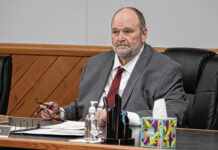
The race among Republicans to serve residents in a northern section of Bartholomew County pits an incumbent who voted to raise income taxes vs. a challenger who says he would vote to repeal that action.
Glenn Petri, 68, is challenging incumbent District 2 council member Laura DeDomenic, 53, in the May 8 Republican primary. The winner advances to the November general election, which could include a Democrat or Libertarian if those parties nominate a candidate by late June.
The Bartholomew County Council voted 4-3 on Oct. 10 of last year to raise the county’s local income tax rate from 1.25 percent of a worker’s gross pay to 1.75 percent. Council members voting in favor of the 40 percent increase were DeDomenic, Mark Gorbett, Jorge Morales and Chris Ogle. Council members opposed were Bill Lentz, Evelyn Pence and Matt Miller.
Petri, who is semi-retired, said the county council’s action was a motivating factor in his decision to seek the office. If elected, Petri said he would support repeal of the 40 percent increase.
“More tax revenue comes from increases in appraised values of property, higher personal income and expanding private business,” Petri said. “Lower taxes and less government will do this.”
When DeDomenic took office in 2015, she frequently spoke on budget matters as a fiscal conservative. Later that year, however, the council spent four weeks juggling funds and reducing line-item expenditures — only to find the proposed 2016 budget was still in the red, said DeDomenic, who works full time as resource and philanthropy director for Mill Race Center.
DeDomenic headed initiatives in 2016 to examine funding options and gather data with county department heads. Those efforts included working with financial experts and volunteers from Cummins, Inc. and Columbus Regional Health to look for solutions to the county’s fiscal crisis.
The resulting research, which included a Six Sigma efficiency audit showing an understaffed sheriff’s department, prompted DeDomenic to advocate on behalf of more financial resources for public safety. She has also frequently cited concerns regarding the county’s growing opioid crisis as a reason to increase tax revenues.
“I didn’t see any way to keep the county safe and viable without additional revenue,” DeDomenic said.
But Petri said he doesn’t believe that the council explored all possibilities, saying there were better ways to raise revenues. However, he did not offer specifics.
Petri described the local income tax increase as unfair because the city of Columbus receives a majority of the revenue, instead of county government.
He also objected to raising the tax 40 percent all at once, and criticized the council for waiting until this year to set plans to spend the money.
One important decision still to be made is whether some of the new tax revenues will be used to turn an old, unoccupied county jail into an addiction treatment center for inmates. Before such a decision is made, Petri said inquiries of treatment providers need to be made to determine if the jail is the best location for such a center.
Petri said he doesn’t believe taxpayers should pay to provide opioid treatment, and suggested those expenses should be paid either by the inmate or his or her insurance provider.
“There are a lot of people thrown into jail with addictions such as nicotine or alcohol,” Petri said. “We don’t address those problems while they are in jail.”
DeDomenic said most costs related to the opioid crisis should be shared by the community at large because it is a community problem.
However, taxpayer funding should be sought only after all other options are pursued or examined, she said.
“First, look at grants, state and federal funding, community partners and treatment providers,” DeDomenic said. “And then look at funding from the county.”
Asked to identify which three top areas of county government have the greatest need for additional funding, Petri didn’t provide specific answers — instead, restating his reasons for wanting to repeal the tax increase. However, he did respond to a candidate survey in which he said the county courthouse was in need of major repairs.
After insuring all facets of public safety are properly funded, DeDomenic said her next priority would be funding new and proposed court services programs, followed by maintaining county-owned buildings and facilities.
District 2 is comprised of a northern section of Columbus, most of German and Flatrock townships, and the Camp Atterbury area. Four members of the County Council represent geographical parts of Bartholomew County, while three serve as at-large members.
[sc:pullout-title pullout-title=”Responsibilities and salary ” ][sc:pullout-text-begin]
Responsibilities: The Bartholomew County Council has the ultimate decision-making power regarding fiscal affairs. The seven-member council has the authority to view or review fiscal matters, determine proper policy, and set priorities for the allocation and expenditure of county funds. Their duties include:
- Approving and fixing annual operating budgets of all county government offices and agencies.
- Establishing salaries, wages, per diems, and other compensation for all county officials and employees.
- Fixing tax rates and establishing levies on all county property for the purpose of raising funds to meet budget requirements in conducting county business, as well as authorizing the borrowing of money in the form of bonds and notes.
Salary: Annual salary of $8,361. Council members are also eligible for the same benefits as full-time county employees, including health and life insurance, as well as enrollment in the Public Employees Retirement Fund.
[sc:pullout-text-end][sc:pullout-title pullout-title=”What’s inside” ][sc:pullout-text-begin]
See bios and question-and-answer responses inside on Page A6.
[sc:pullout-text-end]