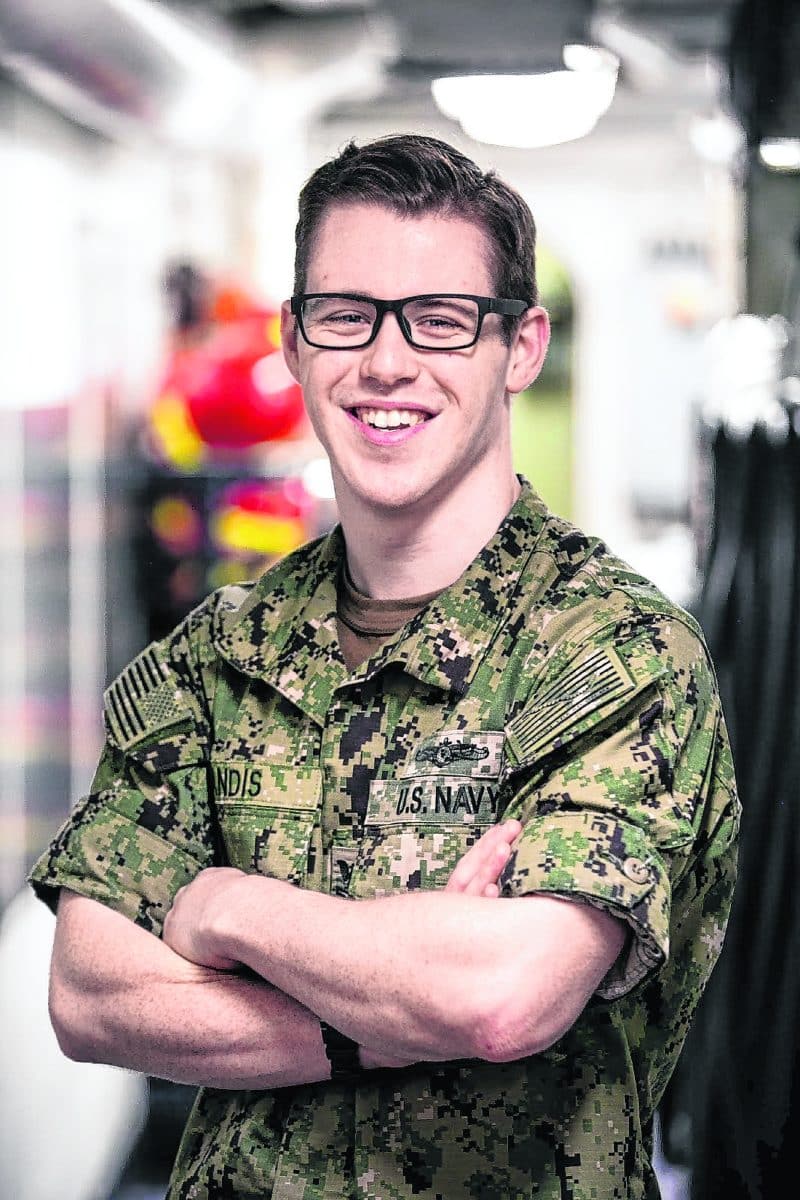
SASEBO, Japan — Petty Officer 2nd Class Neal Andis, a native of Columbus, wanted to serve his country, do something bigger than himself and protect people. He chose to do all three with the U.S. Navy.
Now, four years later and half a world away, Andis serves aboard one of the Navy’s most advanced amphibious ships at Fleet Activities Sasebo, patrolling one of the world’s busiest maritime regions as part of the U.S. 7th Fleet.
“I’m part of the amphibious squadron staff; it’s different from a shore command,” he said. “It’s a lot of fun while you’re underway, you get to see the water and be out here in a high-pace environment. The work day is long and hard, but it’s rewarding.”
Andis, a 2013 graduate of Columbus Christian School, is an intelligence specialist aboard the forward-deployed amphibious assault ship USS Wasp in Sasebo, Japan.
“I’m an all-source intelligence analyst, collecting from human, signals and imagery intelligence,” said Andis.
Andis credits some success in the Navy to lessons learned in Columbus.
“I had to work on understanding other people’s cultures,” he said. “I have two Chinese sisters; it’s a very melting pot-type family that taught me to not just judge people from the cover, but get to know them and understand that everyone comes from a different place.”
U.S. 7th Fleet spans more than 124 million square kilometers, stretching from the International Date Line to the India/Pakistan border; and from the Kuril Islands in the north to the Antarctic in the south. U.S. 7th Fleet’s area of operations encompasses 36 maritime countries and 50 percent of the world’s population, and involves 50 to 70 U.S. ships and submarines, 140 aircraft and about 20,000 sailors.
“The port calls are different,” Andis said. “You’ll experience a lot of cultures and you get to see a lot of things you wouldn’t normally see.”
With more than 50 percent of the world’s shipping tonnage and a third of the world’s crude oil passing through the region, the United States has historic and enduring interests in this part of the world. The Navy’s presence in Sasebo is part of that long-standing commitment.
“The Navy is forward-deployed to provide security and strengthen relationships in a free and open Indo-Pacific. It’s not just the ships and aircraft that have shown up to prevent conflict and promote peace,” said Vice Adm. Phil Sawyer, commander of the U.S. 7th Fleet. “It is, and will continue to be our people who define the role our Navy plays around the world. People who’ve made a choice, and have the will and strength of character to make a difference.”
Wasp, one of the Navy’s most advanced amphibious ships, is designed to deliver Marines and their equipment where they are needed to support a variety of missions ranging from amphibious assaults to humanitarian relief efforts.
Sailors’ jobs are highly varied aboard USS Wasp. More than 1,000 men and women make up the ship’s crew, which keeps all parts of the ship running smoothly, from handling weapons to maintaining the engines. An additional 1,200 Marines can be embarked. USS Wasp is capable of transporting Marines and landing them where they are needed using helicopters, vertical takeoff and landing aircraft and other water-to-shore landing craft.
These ships support missions from sea to shore, special operations and other warfare missions. They also serve as secondary aviation platforms. Because of their inherent capabilities, these ships have been and will continue to be called upon to support humanitarian and other contingency missions on short notice, according to Navy officials.