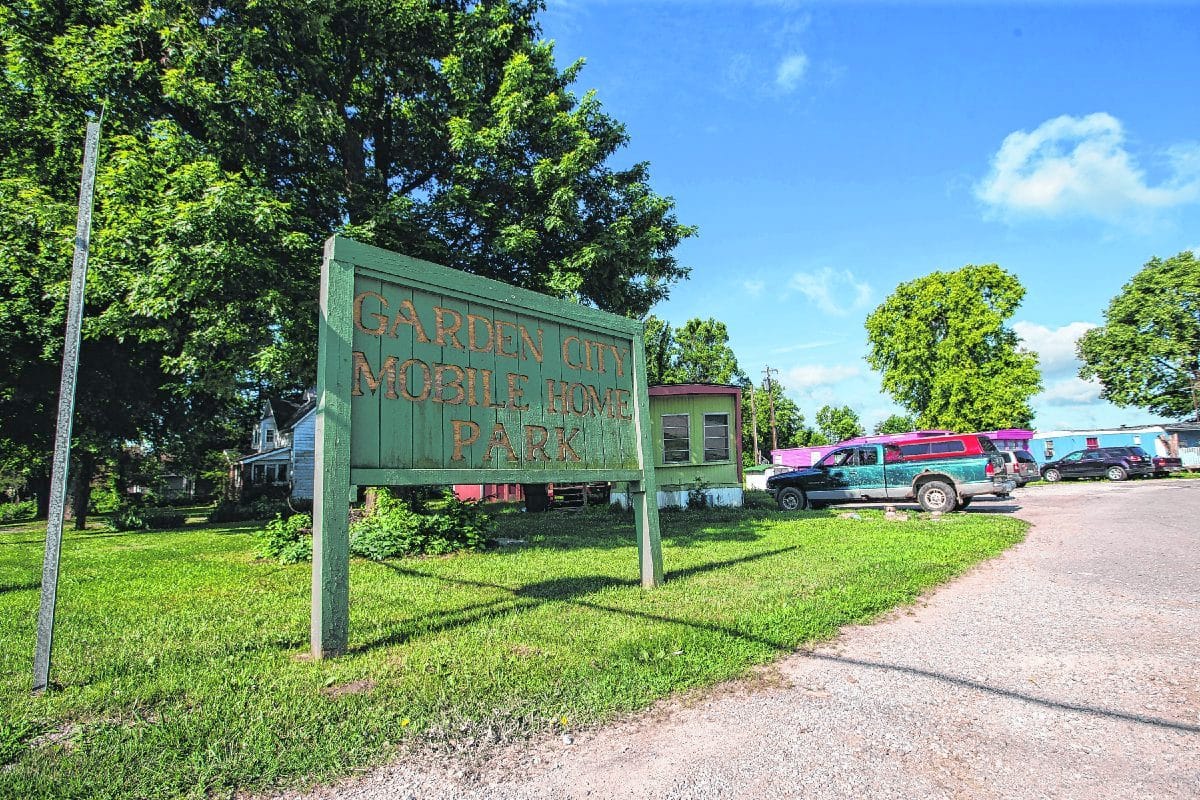
Garden City Mobile Home Community LLC is moving ahead with its plan to add additional housing to its mobile home park, despite a tied Columbus City Council vote to rezone a portion of the property.
The ordinance sought to rezone a 1-acre property on 960 Jonesville Road, immediately south of the existing Garden City Mobile Home Park, to “Residential: Manufactured Home Park.” The acre was previously zoned for “Residential: Single Family 2.” The owner, Dana DelSignore, is looking to add up to seven additional homes on the property.
Columbus City Council’s vote on whether or not to approve the second reading of the rezoning ordinance was split 3-3 on Tuesday night. City council members Elaine Hilber, Jerone Wood and Frank Miller voted against the ordinance, as they did before at the previous reading. Councilman David Bush was late to the meeting, leading to the tied vote.
State law dictates that because the city council was unable to make a decision within 90 days of the planning commission’s original recommendation, the planning commission’s recommendation to rezone the property stands as the final decision.
The rezoning ordinance contains six commitments for DelSignore. These commitments were presented by Jeff Bergman at a previous meeting and are as follows:
The subject property is to be combined with the existing mobile home park parcel and developed with shared access and amenities.
No new homes may be occupied until public water service has been established.
A 6-foot tall fence shall be constructed along the railroad tracks.
Direct access from the subject property to State Road 11 shall be limited to emergency and construction use only.
Additional State Road 11 right-of-way shall be dedicated along the frontage of the subject property.
A minimum of 3,400 square feet of open space, including picnic and playground amenities, shall be provided.
Bergman also recommended adding an commitment stating that no new homes would be installed until after annexation of the property. This amendment was approved by city council at its last meeting, when the first reading of the ordinance passed with a 4-3 vote.
However, as this additional commitment was not part of the planning commission’s original decision, it is not included in the approved version of the ordinance.
“There is another process by which the property owner … who is outside the city limits, who wants to connect to city utilities, goes through a vetting process. And if that property is eligible for annexation, they’re denied the connection outside of the city limits and told to file for annexation instead,” Bergman said.
He concluded that the end result is still annexation, although by a different path.
While the planning department staff gave a favorable recommendation for annexing the property, DelSignore has decided to hold off on seeking annexation for the time being. This decision is tied to his efforts to bring city water service to the mobile home park.
Bergman said that while the mobile home park is served by the city sewer system, it is not served by the city’s water utility at present. Instead, the park is served by shared wells.
“They are interested in being served by Columbus City Utilities for water,” Bergman said. “… One of the promising avenues that they’ve described to us, to get water to that site, is to apply for a grant through the Indiana Office of Community and Rural Affairs. … That grant would not be available to them if they were annexed into the city limits. And for that reason, they have withdrawn their annexation request.”
DelSignore said that they’re applying for a $500,000 grant from OCRA. DelSignore’s attorney, Jeff Rocker, said that the deadline for the grant proposal is October and that the grant funds are crucial for funding the project.
Bergman said that the planning commission waited to bring the rezoning ordinance to city council so that DelSignore would have time to work on the grant application.
Getting city water service for the mobile home park is a driving force in the project.
“The water line is very expensive,” DelSignore said. “So we’re trying to spread the cost. Currently, we’re licensed for 46 spots in our community. And so we’re trying to pick up the additional six or seven or so. I say six because we’ll have to eliminate one to provide access. … We’re trying to spread those costs, which are very expensive anyway among basically 46 or 47 houses, and it’s very difficult to do that.”
City councilwoman Grace Kestler said that DelSignore indicated to her that he intends to bring city water to the area regardless of whether or not the ordinance was passed.
Wood said that the idea of bringing city water to the area had been the only thing that would have made him consider approving the ordinance. But because of Kestler’s comment, his vote remained “no.”
“I understand the importance of lower-income housing,” he said, “and I understand that that’s a necessity for Columbus, but I’m not comfortable with putting more in that area.”
Hilber and Miller said that that they also felt uncomfortable adding more mobile homes to the area. The property is between State Road 11 and the Louisville-Indiana Railroad, leading to safety concerns.
“If we acknowledge that 60 years ago, we maybe shouldn’t have put homes on that property, then I don’t want to look back on this in 30 years and say the same,” Hilber said.
Kestler, Tom Dell and Tim Shuffett voted to approve the ordinance. Dell noted that the project provides an opportunity to improve conditions for existing residents.
City attorney Alan Whitted said that normally, a tied vote would result in continuing the matter over to the next city council meeting, as the mayor cannot break a tie in a rezoning case.
However, Bergman said that state law dictates that if 90 days pass since the planning commission’s recommendation and the city council has not made a decision, the planning commission’s decision stands as the final verdict. Bergman said that the next city council meeting, which will be held on Sept. 1, falls outside of that limit.
“We calculated that a little differently this time around,” Bergman said. “… The planning commission’s recommendation came in their March meeting. We subtracted from that total any days where the governor’s executive order would’ve prohibited nonessential business, such as this, from coming forward, and then calculated out those 90 days.”
Bergman said that he would double-check the number of days, just in case. Whitted said that a report will be presented to city council to document the results.
City council considered delaying voting on the ordinance until later in the meeting so that if and when Bush arrived, he could break the tie. However, a unanimous vote was required to take that action, and Miller voted against it. So the city council could not delay the vote.
Bush arrived later in the meeting, after the vote had already taken place.
At the previous city council meeting, Bush, who is the city council liaison to the city plan commission, said that the project would improve conditions for the current residents and respond to a need for affordable housing.
“Dana has a waiting list for this property,” Bush said. “… If it was available, he could add five homes tomorrow, because that need in our community is so great.”