The Columbus Police Department has a new general order requiring law enforcement employees to intervene when they witness another employee enact “unreasonable use of force.”
This change was one of several updates to the police department’s general orders, which were approved Tuesday at a city board of works meeting. The changes to CPD’s general orders came from recommendations by the Commission on Accreditation for Law Enforcement Agencies. The CPD is accredited through CALEA and annually reviews its policies with the organization.
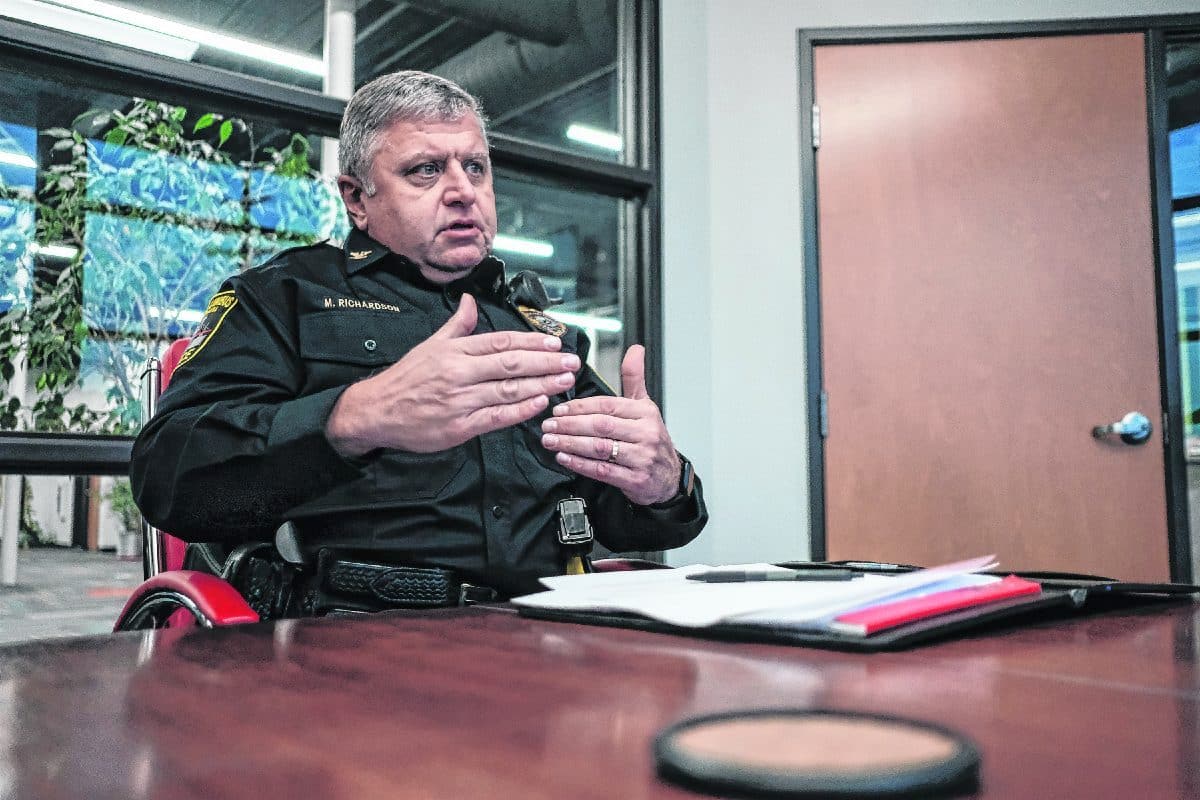
“Employees are required to notify appropriate supervisors … if they observe another agency employee or public safety associate engaged in unreasonable use of force or if they become aware of a violation of department policy, state or federal law or local ordinance. Situations such as unreasonable occasion of force or inappropriate due process procedures may necessitate immediate intervening,” said Chief Michael Richardson, as he presented the general order to the board.
Immediate intervention is now required if an employee witnesses “unreasonable actions” by another employee that could lead to injury, death or “violation of constitutional civil rights,” Richardson said.
[sc:text-divider text-divider-title=”Story continues below gallery” ]
Richardson acknowledged that the commission’s recommendations were likely formed in response to recent incidents of police brutality in the United States and public outcry against such actions.
Under this policy, other behavior “unbecoming of employees” should be reported to the appropriate supervisor or authority figure, he said.
Other approved general order updates included a ban against vascular neck restraints, which Richardson said the department doesn’t teach, and chokeholds. Both maneuvers may not be used unless deadly force is justified.
Richardson indicated that this policy update is not a change from what the department already practices.
“They’ve (CALEA) banned chokehold unless deadly force is justified, which has always been our policy,” Richardson said. “We did not specifically mention chokehold as being deadly force, but all the training we’ve ever done has always taught us that chokeholds are deadly force. So the only time that those maneuvers would be appropriate, would be allowed, would be in the situation that deadly force would be justified as well.”
CALEA’s recommendations regarding chokeholds and vascular neck restraints are likely in response to the death of George Floyd, a Black man who was pinned to the ground for almost nine minutes under a white Minneapolis police officer’s knee before he died.
Richardson said that employees will be required to read through the general order updates and sign off to acknowledge that they have read and understood the changes.
“Obviously if there’s training that needs to be done, that training will be implemented as well,” Richardson said.
Department officials hope to bring a CALEA representative to Columbus sometime in the future to give a presentation on how the commission creates general orders and recommendations. He invited the board of works members to attend the presentation if and when it is scheduled.
[sc:pullout-title pullout-title=”Where to learn more” ][sc:pullout-text-begin]
The Columbus Police Department’s current general orders can be viewed at www.columbus.in.gov/police/home/general-orders/.
[sc:pullout-text-end]