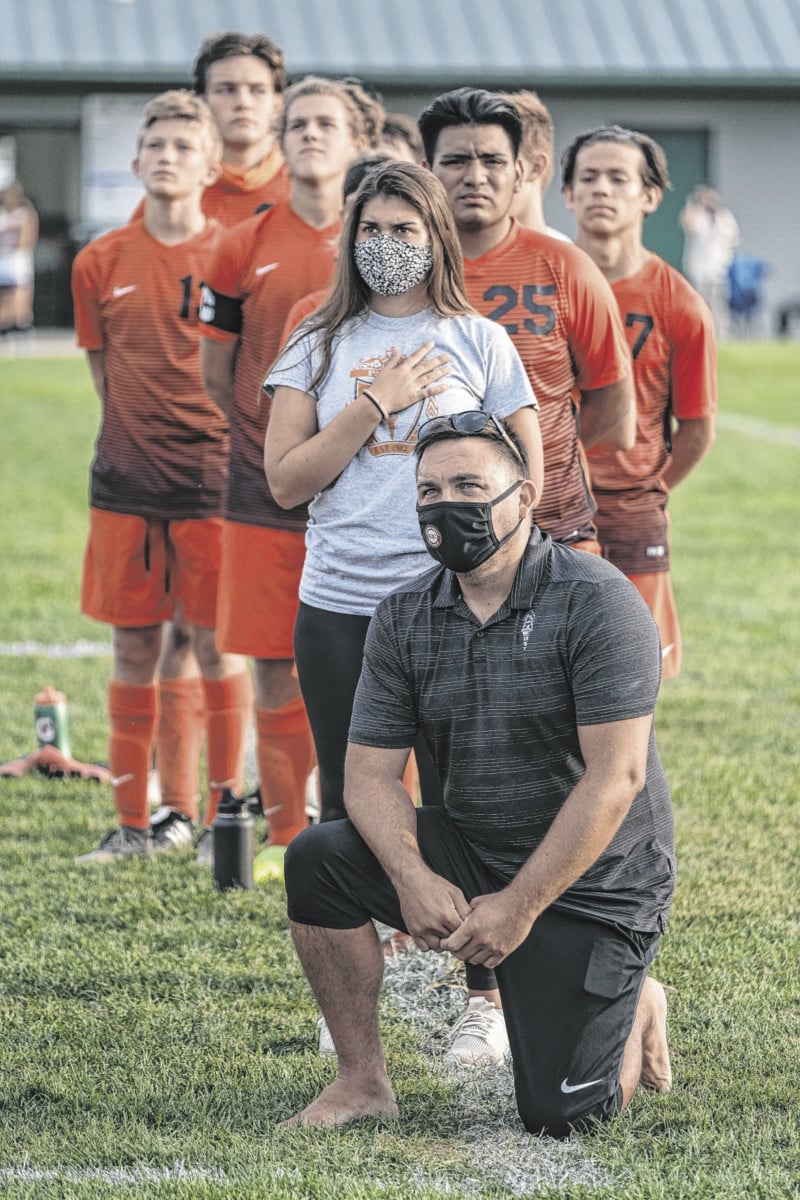
COLUMBUS, Ind. — When the Columbus East and Columbus North boys soccer teams players and coaches both lined up for the playing of the national anthem on Aug. 27, one knee hit the ground.
It was that of the Olympians head coach.
Josh Gonsior, who comes from a Polish heritage with a mix of other European ancestry, said he grew up being taught to not be silent in the face of injustice.
“I kneel in solidarity with the Black, Indigenous, and people of color (BIPOC) communities who have yet to be afforded the opportunity to achieve the American dream,” he said. “To quote Fannie Lou Hamer ‘Nobody’s free until everybody’s free.’ I was taught to never be silent in the face of injustice. Racism is systemic, and it is pervasive. Apathy will do nothing to change the status quo. Action is necessary.”
Gonsior, a Minnesota native, lived in Texas for seven years as a youngster. He said when he started school in El Paso, he was the minority in his classroom.
“I was always around people that were different from me, and I feel like I was fortunate to have had that experience early on,” he said.
One player on the team that Gonsior told before the Aug. 27 game that he was going to kneel was junior co-captain Chris Quisenberry.
Quisenberry, a Black player for the Olympians, said it meant a lot to him to see his head coach take a stand — or knee — for a cause he believes in.
“I appreciated it because it was nice to see someone standing with my culture, especially, and me,” Quisenberry said. “At the same time, I was nervous because I didn’t want him getting wrapped up in all of this huge situation and getting hate for it. But I was feeling admiration toward him kneeling.”
Gonsior also kneeled in the Olympians’ Thursday home matchup versus Seymour.
Kneeling during the national anthem to protest racial inequality and police brutality first gained national attention when Colin Kaepernick, then a quarterback for the San Francisco 49ers, did so during the 2016 NFL season. Numerous athletes have followed in recent years, including high-profile stars like U.S. women’s soccer’s Megan Rapinoe.
The practice gained more traction this year after the killing of George Floyd in late May. Floyd’s death sparked weeks of nationwide protests and brought more widespread attention — and approval — to the Black Lives Matter movement. During the opening week of the Major League Baseball season, numerous players took a knee either before or during the anthem. In the season-opener, the Washington Nationals and New York Yankees did so together.
The movement continued in late August when Milwaukee Bucks guard and Indiana native George Hill helped initiate the NBA boycott that lasted for three days stemming from the shooting of Jacob Blake in Kenosha, Wisconsin. Most of the rest of the professional sports world followed the NBA’s lead.
Quisenberry recalled watching Hill as a kid when he played basketball for the Indiana Pacers for five seasons from 2011-16.
“I watched a lot of his basketball. I watched a lot of the Pacers, but I didn’t watch the NBA a lot,” Quisenberry said. “Definitely seeing somebody that is an Indiana native makes me want to step up even more because it gives me a role model to look up to.”
Such protest might not be quite as popular in a rural area like Bartholomew County, but Gonsior wasn’t worried about how his actions on Aug. 27 and Thursday will be perceived.
“First off, equality isn’t controversial,” Gonsior said. “I have never worried about what anybody thinks about me. If people are offended, I will clearly know where they stand in the fight. As Desmond Tutu said, ‘If you are neutral in times in situations of injustice, you have chosen the side of the oppressor.’ I think it is important to use privilege as a platform to make a change.”
Gonsior said he has received numerous support from his family, friends, assistant coaches and players on the team.
Though none of the Olympians players have joined Gonsior in protesting thus far, they are united in their support for their coach.
“Coming into a new coaching role, I know it’s not easy, and him kneeling for the national anthem is a huge thing — it’s a huge, controversial subject, but he felt like it needed to be done,” Quisenberry said. “I admire that, and admire his courage and passion to stand up for something that he believes in and something that he thinks needs to be addressed in our country, and I definitely think that the team and everybody 100 percent supports him in all his decisions and ideas.”