Those still uncomfortable with roundabouts should prepare themselves to make changes to another driving habit.
At a number of construction zones where two-lane traffic is reduced to one lane during heavy traffic, the Indiana Department of Transportation will be transitioning to what are called “zipper merges” this year.
If you usually drive within INDOT’S southeast district — which includes Bartholomew and surrounding counties, it’s probably nothing to worry about at this time, said Natalie Garrett, spokeswoman for INDOT’s Seymour office.
“For this construction season, it’s more than likely that there won’t be any changes to implement zipper merges in our district,” Garrett said. “But that could change as more projects come on line.”
Beside Bartholomew and surrounding counties, INDOT’S southeast district also includes Clark, Dearborn, Floyd, Franklin, Harrison, Jefferson, Monroe, Ohio, Ripley, Scott, Switzerland and Washington counties.
To date, there have only been a few construction zones in Indiana where a zipper merge has been installed on a trial basis, Garrett said.
“Probably the closest to Columbus would be on State Road 67 near Mooresville (in Morgan County),” Garrett said, although she said zipper merges are used frequently in other states.
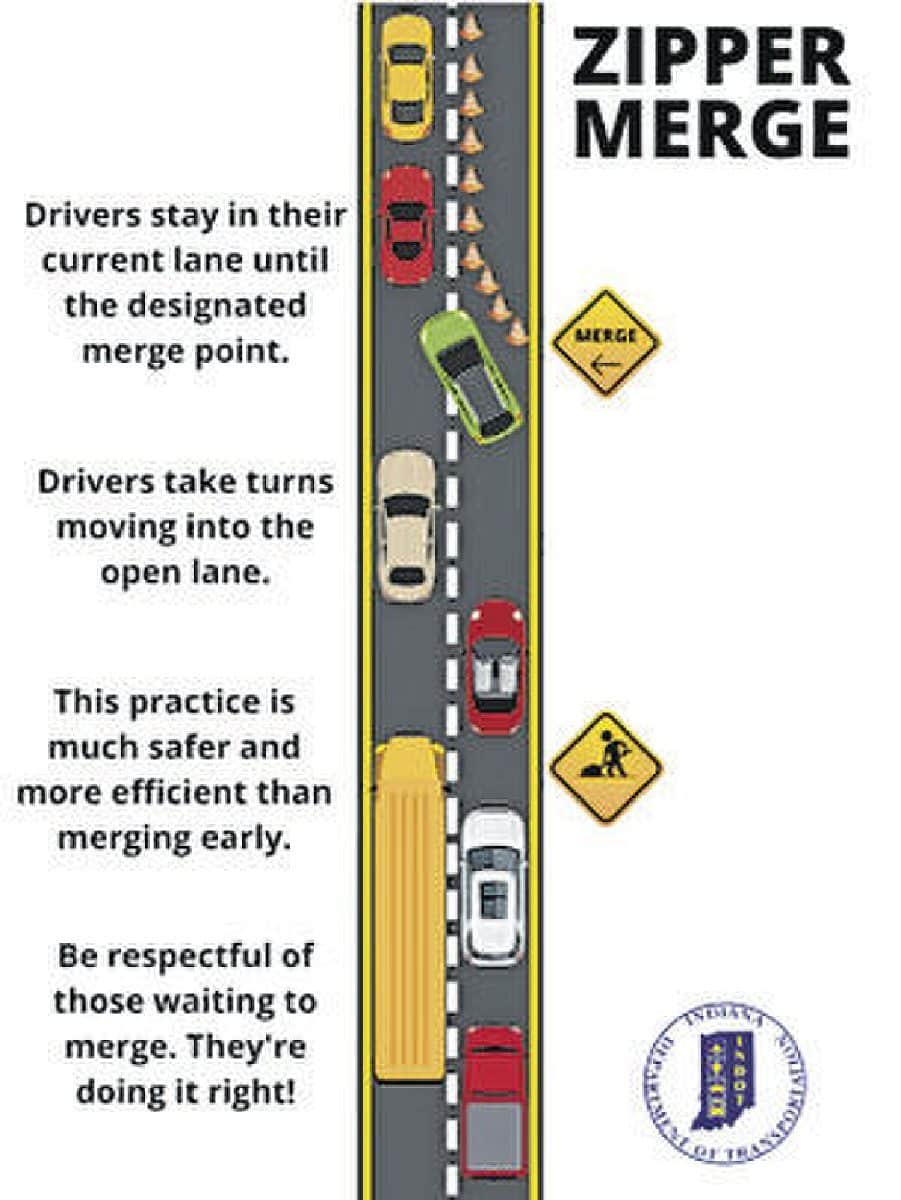
Zipper merges work exactly as they sound — like a zipper. Before drivers come across a lane closure, they are see signs that state “Merge ahead. Use both lanes.” That means all cars and trucks should stay in their current lane until they reach a designated merge point.
When the signs instruct drivers to “Merge here. Take turns,” that is exactly what they should do. Vehicles in both lanes should take turns moving into the only open lane that is next to the construction zone.
In the past, most drivers tend to merge at the first sight of a “lane closed ahead” sign. As a result, traffic will often come to a crawl when vehicles slow down too quickly, which can lead to unexpected lane switches, serious crashes and road rage, Garrett said.
Further problems are created by drivers who stay in the soon-to-be closed lane until they actually reach the construction zone. They risk creating more congestion and accidents by trying to nudge their way into a solid line of heavy traffic.
According to INDOT, the benefits of a zipper merge include:
Reducing speed differences between two lanes.
Reducing queue length by up to 40 percent.
Reducing congestion and keeping traffic moving smoothly.
Creating a sense of fairness and equity that all lanes are moving at the same rate.
But these benefits are only possible when motorists are respectful of one another and allow vehicles in both lanes to take turns moving into the only open lane, INDOT officials said.
Not all work zones are conducive to using a zipper merge. In situations where traffic is flowing at highway speeds with minimal back-ups, drivers can still merge early to the open lane. But when the traffic flow is heavy and slow, it is much safer for motorists to remain in their current lane until the point where traffic can orderly take turns merging, according to INDOT.
“As we continue to design and develop projects, different mergers will be worked into those projects where appropriate,” Garrett said.
If a zipper merge is used, the public will be informed through social and mainstream media outlets, Garrett said. For new drivers getting their licenses, educational materials will be provided that instruct novice motorists about zipper merges, she said.