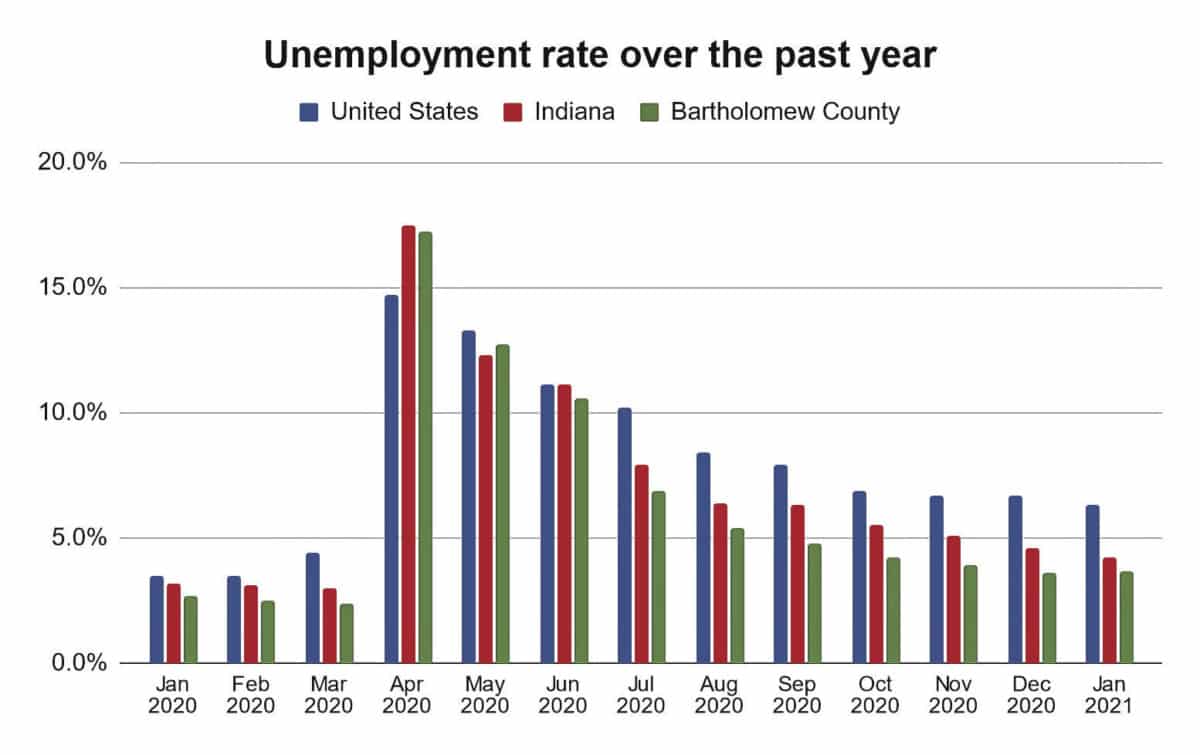
COLUMBUS, Ind. — Unemployment in Bartholomew County remained largely unchanged in January as state and national jobless rates fell, the Indiana Department of Workforce Development announced Tuesday.
In January, Bartholomew County’s unemployment rate was 3.7%, up slightly from 3.6% in December and higher than in January 2020, when unemployment stood at 2.7%, state records show.
By comparison, U.S. unemployment was 6.3% in January, down from 6.7% the month before, and Indiana’s jobless rate fell to 4.2% in January, down from 4.6% in December.
However, unemployment is considerably lower than in April, when Bartholomew County’s jobless rate was 17.2% and Indiana’s rate was 17.5%.
Additionally, Bartholomew County workers are still filing for jobless benefits at higher rates than before the pandemic, according to state records.
An average of 29 workers in Bartholomew County filed initial unemployment claims from 2015 to 2019, and the total number of workers drawing unemployment benefits never exceeded 398 during any week over the same time period.
A total of 116 Bartholomew County workers filed initial unemployment claims the week ending March 6, down from 137 the week before, according to the Indiana Department of Workforce Development.
Overall, 514 workers in Bartholomew County were drawing unemployment benefits the week ending Feb. 27, the most recent on record, which was down from 551 the week before.
Surrounding counties also saw varying degrees of increases in their jobless rates, according to state figures.
Brown County posted the largest increase in unemployment of any of the surrounding counties, with 4.7% unemployment in January, compared to 3.8% in December.
Jennings County’s unemployment rate was 5% in January, up from 4.5% in December.
Decatur County’s rate increased from 3.4% in December to 3.7% in January.
Jackson County’s rate largely stayed the same, ticking up to 3.6% in January from 3.5% in December.
The new local jobless figures came days after the Labor Department reported last week that the number of Americans seeking unemployment benefits fell the week before to 712,000, the lowest total since early November, according to The Associated Press.
The Labor Department said Thursday that applications for unemployment aid dropped by 42,000 from 754,000 the week before, evidence that fewer employers are cutting jobs amid a decline in confirmed coronavirus cases and signs of an improving economy, according to wire reports.
Though the job market has been slowly strengthening, many businesses remain under pressure, and 9.6 million jobs remain lost to the pandemic that flattened the economy 12 months ago.
In February, U.S. employers added a robust 379,000 jobs, the most since October, reflecting an economy in which consumers are spending more and states and cities are easing business restrictions, according to wire reports. Thursday’s figure, though the lowest weekly figure in four months, showed that weekly applications for jobless benefits still remain high by historical standards: Before the viral outbreak, they had never topped 700,000, even during the Great Recession.
All told, 4.1 million Americans were receiving traditional state unemployment benefits as of last week, according to the AP. Counting supplemental federal unemployment programs that were established to soften the economic damage from the virus, an estimated 20.1 million people are collecting some form of jobless aid.
The continuing job cuts reflect the extent to which the pandemic disrupted normal economic activity and kept consumers hunkered down at home rather than out traveling, shopping, dining out and attending entertainment venues, according to wire reports, according to wire reports. Cities and states restricted the hours and capacity of restaurants, bars and other businesses. Even where restrictions didn’t exist, many Americans for months chose to stay home to avoid the risk of infection.
Now, though, as vaccinations are increasingly administered around the country, business limitations are gradually eased and consumers grow more comfortable engaging face to face with others, optimism about the economy is rising. Last month, consumers bounced back from months of retrenchment to step up their spending by 2.4% — the sharpest increase in seven months and a sign that the economy may be poised to sustain a recovery.