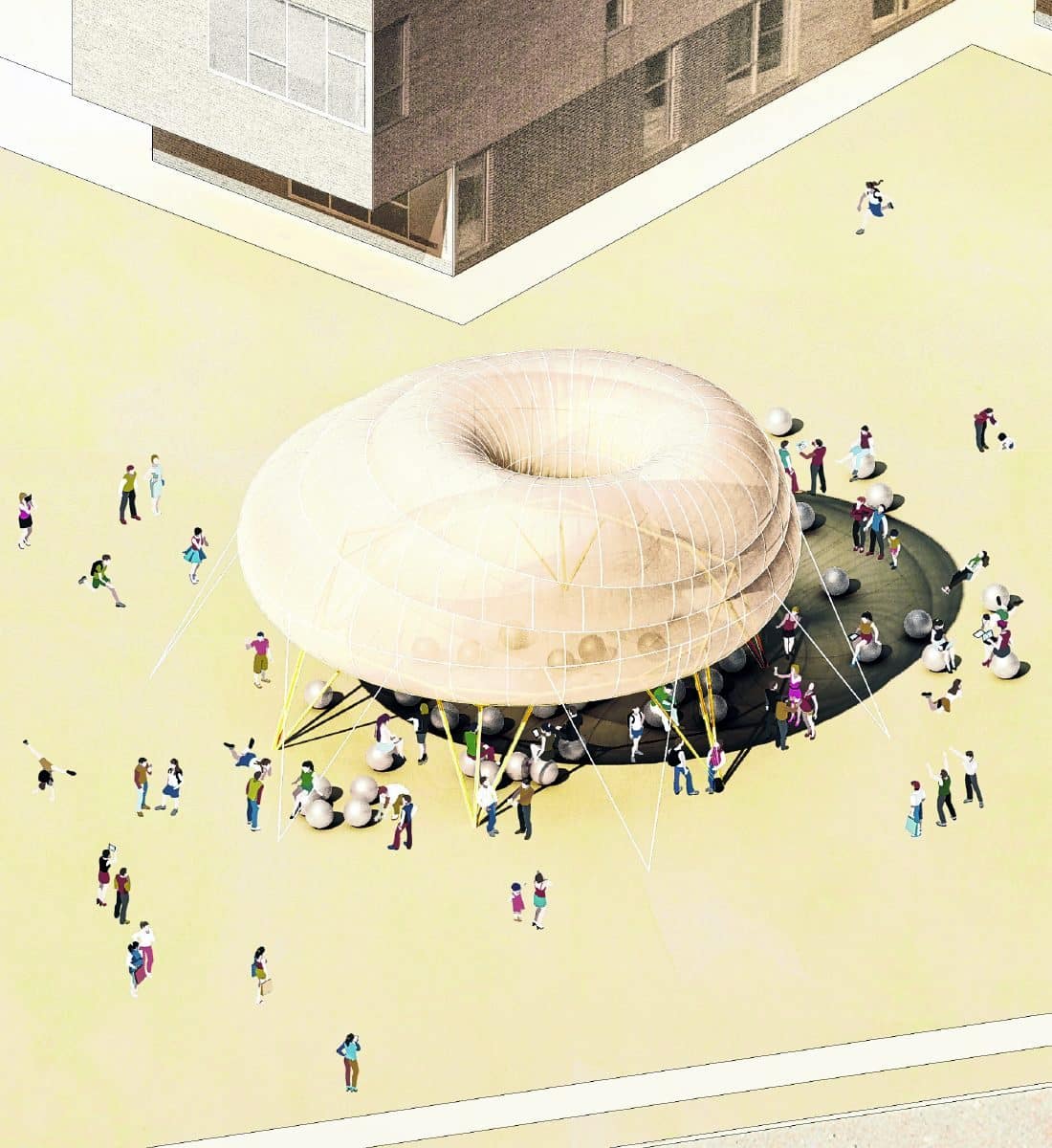
One of the planned Exhibit Columbus exhibition installations will encourage people to put their head in the clouds.
Or at least to put themselves right amid a cloud-like structure with a sky-high sense of interactive technology.
That’s part of the idea behind Ecosistema Urbano’s Miller Prize-winning work called Cloudroom to be located on part of the grounds of Columbus’ Central Middle School. Architects Belinda Tato and Jose Luis Vallejo, based in Miami and also Madrid, Spain, are designing an inflatable “cloud” that floats over a wooden structure.
According to plans, the cloud will create an environment with a comfortable microclimate to carry out a variety of activities between the school and the public space, encouraging learning through a direct experience. It was inspired by the duo discovering that Indiana hosted one of the first hot-air balloon races in 1909.
“We like the idea of re-activating the (school) lawn,” Tato said. ” … The goal was to program space for the students for playing, learning and interacting.”
That was just one of a number of Zoom presentations Friday before 450 registrants highlighting plans for some of the 13 installations to be a part of the exhibition running from Aug. 21 until Nov. 28. Other planned designs were presented in two sessions online March 19.
The five Miller Prize installations are the centerpiece of the exhibition with the theme “New Middles.”
Designers said practical shade for Cloudroom was a must, Tato said, so that some actual classes could be held outdoors at the installation.
Cloudroom will be connected to real-time pollution sensors, and illumination within the inflatable will dramatically change colors to reflect environmental qualities. The aim is to raise awareness among visitors and users about their immediate environment. Videos also can be projected onto it.
“We know the kids will love it,” said Central Middle School Principal Jay Payne.
Chicago architect Iker Gil, one of the two globally known co-curators of the exhibition, mentioned that he was impressed with all designers’ commitment to focus on elements of Columbus’ history and legacy, and how they also could add to that.
“Ideally, I would want people (in Columbus) to consider adding more layers to to their sense of history for Columbus,” Gil said.
Exhibit Columbus is an annual exploration of architecture, art, design and community. The program, under the nonprofit flagship Landmark Columbus Foundation, alternates between a symposium one year and a free, outdoor exhibition the next. The exhibitions highlight temporary structures and related works from some of the world’s leading designers, and even local high schoolers, linked to one or more of the city’s celebrated Modernist architectural gems.
The first exhibition in 2017 attracted an estimated audience of 40,000 people and sparked architectural discussions especially among young people and on social media. In 2019, an estimated 30,000 visited structures.
Brooklyn architect and former Bloomington resident Olalekan Jeyifous, another of the Miller Prize winners, wowed much of the audience with the creativity and practicality of his planned installation titled Archival/Revival aimed for the Bartholomew County Public Library Plaza.
“It brings the resources of the library outside the building,” said Jason Hatton, library director, emphasizing that such has long been part of the staff’s focus.
The installation revisits two of the library’s early minority-related events — ones coordinated by the Columbus Human Relations Committee, according to The Republic archives. One event was the Columbus Black Arts Festival held in the fall of 1970. And the second was an art exhibit, “Africa in Black and White America” in January 1970.
Jeyifous plans to highlight what he called “these inaugural and transformative exhibitions” through a series of interactive and programmable “thresholds/moments” that allow visitors to explore these events’ historical significance to the present and future. The installation will also include some elements of colorful sculpture (from news clipping abstracts) scattered throughout the plaza.
Electronic codes embedded in the installation’s viewing platform will call up phone images from the 1970 art exhibit, and compare them to relevant images of contemporary art. It also will include historic audio and video clips. Plus, a current art exhibit from Indiana University post-graduate student Wendell T. Brooks will hang in the library’s downstairs as a related point of reference.
“This experience will be the best,” said former Exhibit Columbus graphics and signage specialist Rick Valicenti.
Another Miller Prize entry is Future Firm’s “Midnight Palace,” an installation aimed especially at the city’s second- and third-shift workers — a group that constitutes 39 percent of the area workforce from automotive work to die casting, according to the design company’s leaders.
Future Firm’s Ann Lui said that the display at the former Sears building (now a Cummins Inc. office) facing Brown Street will feature window-hung video screens that could be programmed by area organizations, an interactive map that passersby can add to, and an artsy light motif that includes bulbs from the city’s past Streetscape project.
Lui and partner Craig Reschke theorize that the screens’ possibilities are wide-ranging, ranging from carrying a livestream of a cricket match in India to even interview clips of some of the city’s third-shift workers — manufacturers, bartenders and such.
[sc:pullout-title pullout-title=”To discover more” ][sc:pullout-text-begin]
Video clips of Exhibit Columbus’ planned 13 installations are available at exhibitcolumbus.org. The free outdoor exhibition runs from Aug. 21 to Nov. 28.
[sc:pullout-text-end]