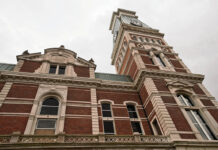
A public fundraising campaign to repair cracks and other wear in the 79-year-old, iconic, Eliel Saarinen-designed First Christian Christian Church tower in Columbus will launch June 23 outdoors at the church, according to organizers.
Details are still being finalized.
The overall project is expected to cost $2.4 million to restore the local landmark to its original architectural integrity. For now, work is tentatively scheduled to begin in spring 2022 and finish by the end of that year, organizers said.
The edifice is especially significant locally because First Christian was the first of the city’s Modernist’s structures designed by an internationally noted architect.
And much of the city’s international standing is linked to its architectural impact set against a backdrop of a small, Midwestern town. The church and the accompanying tower made headlines in publications such as Time magazine as the first and most expensive structure of its time.
In October 2018, a team of inspectors found significant cracks in the mortar joints of the 166-foot-tall tower.
Last year, the project landed a $500,000 grant toward the work from the National Park Service’s Save America’s Treasures program. And leaders of the restoration effort also have been seeking other grant help as well, along with the support of such organizations as The Heritage Fund — The Community Foundation of Bartholomew County and Landmark Columbus, which helps care for the city’s landmarks.
Jeff Logston, chairman of the First Christian Capital Projects Fundraising Committee, believes that many local residents love the tower and its place in the city’s noted skyline, so to speak. He said last year it would require teamwork from a broad-based coalition to reach the fundraising goal.
“So it definitely makes sense that we pull in the whole community as well,” Logston said.
Erin Hawkins, director of marketing for the Columbus Area Visitors Center, has said for several years that First Christian triggers the most interest from visitors asking about the city’s design standing and design legacy.
“First Christian is integral to the way we tell the community’s story,” Hawkins said last year.
Tracy Souza, president and chief executive officer of The Heritage Fund, has seen her organization be an integral part of campaigns with much larger goals than $2.4 million succeed through the years when the public got involved. The public, for example, raised $3 million in donations for the $18 million Commons in 2011.
“This community has a big capacity,” Souza said. “We have a lot of community-minded, generous people.”
Tax dollars are not a part of the restoration effort. Church members already have offered some of their support, but organizers have repeatedly made it clear that these repairs are linked to the city’s architectural legacy and not the church’s Christian mission.
Leaders have not released a current running total for the fundraising campaign, other than the $500,000 grant in August.
“We have to have support from different grants and foundations, but also the community, because a $2.4 million project is certainly not something the church can undertake totally on its own for a portion of church property not directly involved in primary Christian mission work.”