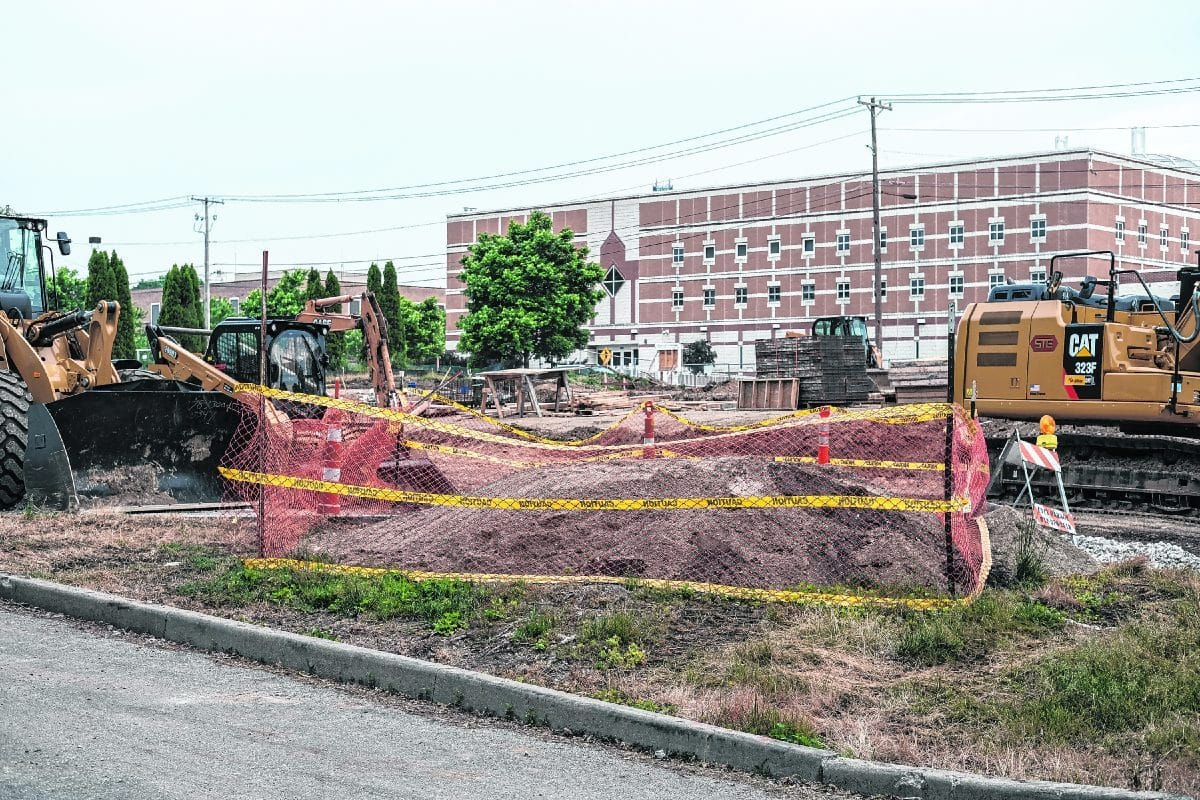
COLUMBUS, Ind. — Local and state officials are awaiting guidance from Native American authorities about human bones found by workers excavating ground looking for a sewer line near the future home of the Bartholomew County Court Services Center.
The tribal authorities could ask for the bones to be reburied at the site they were found and for the utility line work to be redirected around the area, or they could take custody of the Native American remains for reburial at a different site, said Rachel Sharkey, a research archeologist with the Indiana Division of Historic Preservation and Archeology, who is investigating the discovery.
Construction workers were trying to locate a 1940s-era clay sewer line as part of the court services building project at 555 First St., when on May 18 they found the human bones, intermixed with animal bones at the site. The bones were found about 6- to 7-feet deep, mixed with animal leg bones from pig and cattle that had been severed by some sort of serrated saw, said Health Pope, Columbus city redevelopment director.
Since the bones were not found in any sort of casket or burial container, Sharkey confirmed that investigators believe the bones were moved to the site at some unknown point in time. It is unknown why they were found in a somewhat jumbled formation, and why the human bones were not laid out in an anatomically correct way, as would have been expected with a burial.
It does still need to be verified that the bones themselves are of Native American origin, but Sharkey said it is “highly probable given the context in which they were found.”
There were no Native American artifacts found with the bones, another indication that the bones may have been moved, Pope said.
For complete details, see Wednesday’s Republic.