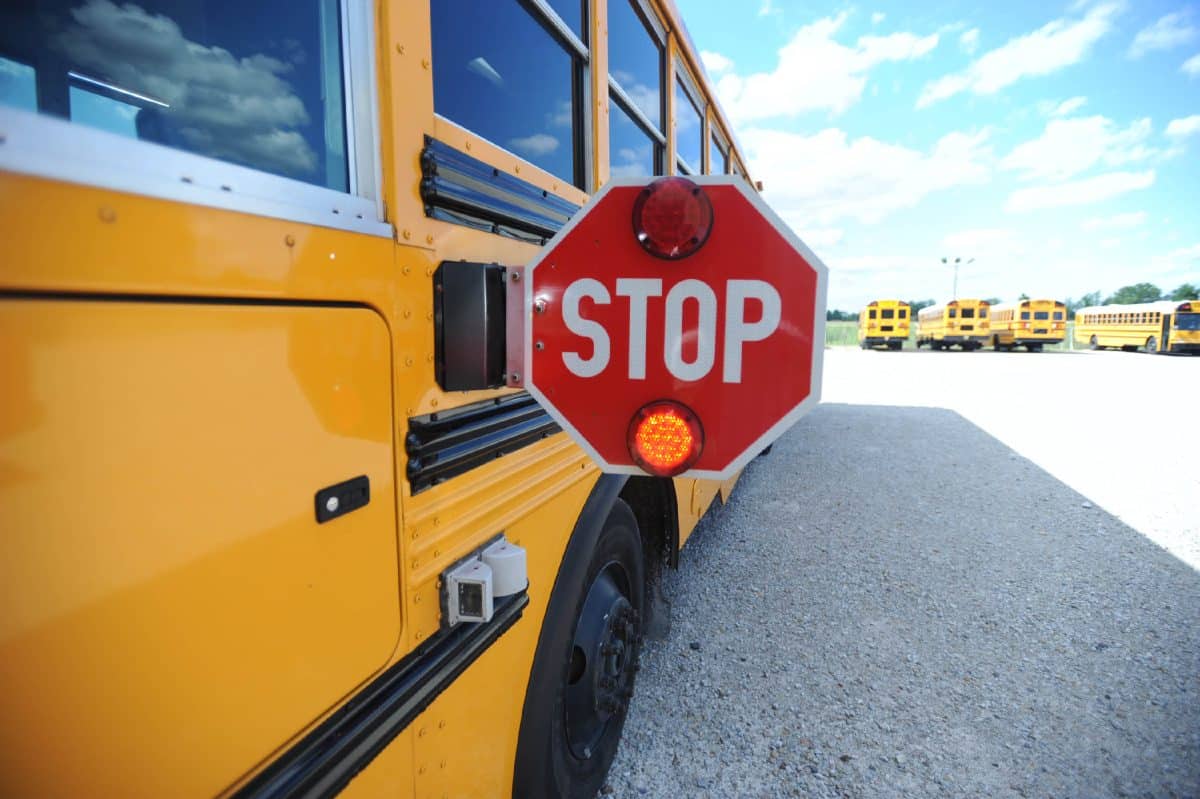
Police agencies around Indiana will increase patrols during back-to-school beginning this week to protect students, watching for stop-arm violations and those driving recklessly at bus stops or school zones.
Gov. Eric Holcomb said the effort is part of Indiana’s Stop Arm Violation enforcement program, or SAVE blitz, which is funded by the National Highway Traffic Safety Administration through the Indiana Criminal Justice Institute.
More than 200 police agencies will participate in the blitz, which is scheduled to continue through mid-September. As part of the effort, police will be working with bus drivers and school transportation officials to identify areas where the high-visibility patrols are needed the most.
Last spring, officers who participated in the blitz issued more than 5,600 citations and 1,700 warnings, according to state officials.
Of the citations, 251 were for stop arm violations, 309 for texting while driving and nearly 1,900, were for speeding, which state officials described as “alarming.”
“Speeding around a bus or ignoring its stop arm is not only illegal, it’s reckless,” said Devon McDonald, Indiana Criminal Justice Institute executive director. “It puts everyone on the road at risk, including children, and has to stop — too much is at stake.
In Indiana, it is illegal for motorists to pass a bus that is stopped, with red lights flashing and the stop arm extended.
This applies on all roads, with the exception of motorists who are on a highway divided by a barrier, such as a cable barrier, concrete wall or grassy median — those drivers only have to stop if traveling in the same direction as the school bus.
“If you’re driving and see yellow flashing lights, slow down and be prepared to stop,” said Robert Duckworth, the institute’s traffic safety director. “Don’t try to beat the bus. Give yourself plenty of time or just arrive late. It’s better than getting a ticket or possibly taking someone’s life.”
The National Highway Traffic Safety Administration says the greatest risk to a student isn’t riding the bus, but approaching or leaving one. Drivers are encouraged to slow down, put away distractions and watch for school buses at all times.
Students should always look both ways before crossing a street and arrive at the bus stop at least 5 minutes before the bus is scheduled to arrive. At the bus stop, stay 6 feet (five steps) away from the curb and wait until the bus comes to a complete stop and the driver gives permission to board.