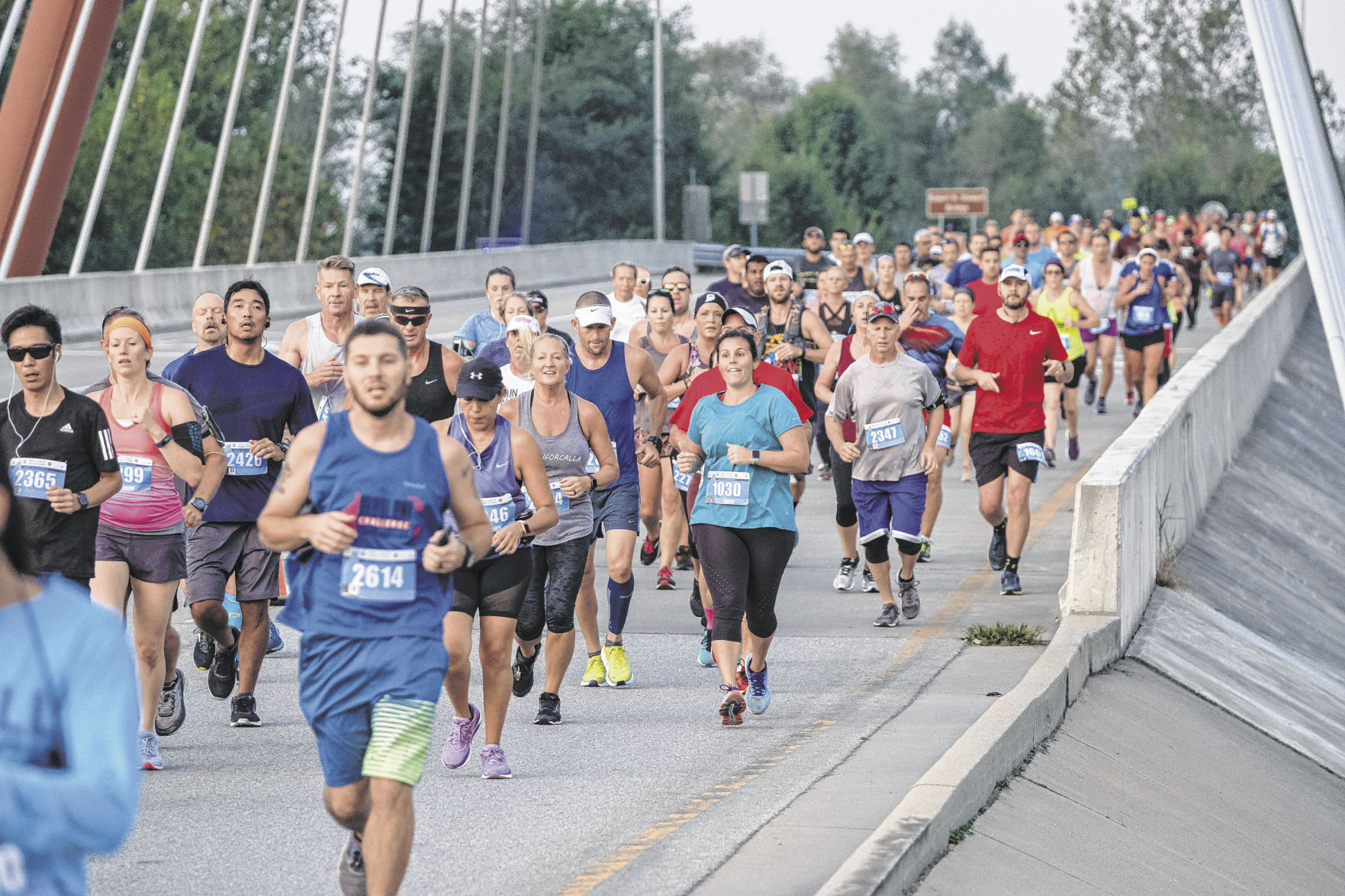
Mill Race Marathon officials canceled its full marathon on Friday, but are continuing to fine tune plans for a half marathon and 5K on Sept. 25.
Race director Randy Stafford said the Mill Race Marathon committee was concerned with having enough volunteers to staff the entire 26.2-mile marathon course.
“A lot of it is being driven by the COVID epidemic that’s going on right now, and we get a lot of support from the hospital, and with the surge that’s happening and what’s predicted, CRH cannot guarantee that they will have people that can support the race in four weeks,” Stafford said. “We also had some concern with the rest of the support that we get through police and fire. There’s not any loss in people yet, but that’s a potential that we could have people that are exposed, quarantining that reduce the number of essential safety workers for us for the whole event.”
Stafford said canceling the in-person full marathon was something the committee hoped it could avoid after all of last year’s in-person events were canceled, but found it necessary.
“That’s something we really don’t want to do, but by doing that, it reduces our need for the medical staffing and safety workers by about 50 percent,” Stafford said. “The (full) marathon has the fewest number of participants, so it’s the fewest number of people that will be affected.”
As of Wednesday, 170 people had registered for the full marathon. The committee was working Friday to notify those entrants of their options, which include, shifting to the half marathon, getting a refund, deferring their entry to next year or running the marathon as a virtual event.
“Unfortunately, that doesn’t help any of them that wanted to run a Boston qualifying time because that has to be done on an actual course,” Stafford said.
As of Wednesday, 907 people had registered for the half marathon and 440 for the 5K. Another 300 are registered for the Kids Fun Run, which will be on Sept. 24 at Mill Race Park.
Earlier this week, Stafford outlined a series of precautions they are taking this year, including the following:
For any inside events, such as the packet pickup in The Commons, masks will be required. Workers will ask for runners’ vaccination status at the packet pickup and working on some small token for anybody that is vaccinated.
Anybody coming onto the race site will be required to wear a mask while they gather and social distance as much as possible, and as they come up to the start, they can remove the mask. After they go through finish area and pick up their medal, snacks and drinks, they will be asked to put mask back on.
There will not be a mass start. Instead, runners will feed into lanes (4-foot separation between lanes; 6-foot separation between people in those lanes), where they will be social distanced. A select group of 30 to 50 men and women with the fastest submitted times for the half marathon and 5K will have a gun start, and all others will be chip-timed.
Any volunteers that will have direct interaction with participants will be masked. Spectators will be asked to mask when they cannot social distance, so especially around the start/finish line.
“One of the nice things is, the way the course is laid out, you can see the participants five times in the first 4 1/2 miles,” Stafford said. “So there’s multiple opportunities where you can see somebody early in the race.”
Meanwhile, the start line for the Kids Race will be greatly expanded. Kids will be asked to wear masks until they go to the starting line and then after they finish.
Stafford said the Mill Race committee still is working out the details for the After Party. Also, runners will pick up their own water along the course and medals in the finish area.
“We’re reducing touch points,” Stafford said. “Nobody is handing things to people anymore. The water stations, the runners will pick up. The amenities at the finish line, they’ll pick up. We’re limiting as much as possible the social interactions. We’re all social people, so that’s a hard thing to do.”
“Registrations are still down, so I don’t think there is going to be an issue with having to cap anything,” Stafford said. “Our biggest issue right now is, we get more than half of our volunteers through Cummins, and Cummins is not promoting people doing in-person volunteering. In the past, they did a lot of promotion to get volunteers.”
Stafford said the Mill Race Marathon committee looked at several options for canceling, keeping or postponing this year’s events before settling on the decision it made on Friday.
“We’ve gone through the whole gamut,” Stafford said. “We looked at, ‘Is there any way to save the whole event? Do we keep what we can?’ We really did not want to cancel if at all possible. We looked at, ‘Could we shift it to a later date?’ We don’t know what’s going to happen a month later after our original date, so what we settled on was putting in on on its original date with as many participants as we can. We felt that was our best option, especially after we had to do a virtual event last year.”