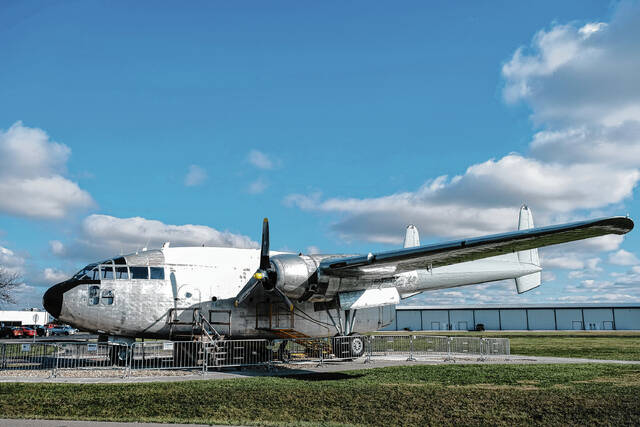
Mike Wolanin | The Republic A view of the C-119 at the Atterbury-Bakalar Air Museum and Columbus Municipal Airport in Columbus, Ind., Monday, Jan. 4, 2022.
Atterbury-Bakalar Air Museum volunteers have “pushed the brakes” for the winter to restore a C-119 “Flying Boxcar” aircraft on display near Columbus Municipal Airport but are hoping to essentially complete the restoration this spring.
The roughly 38,000-pound plane, which is not airworthy, was taken apart at an airport in Greybull, Wyoming, where the aircraft’s parts were loaded on to trucks and driven 1,460 miles to Columbus in 2020. At an airport restoration hangar, much of the aircraft was gradually reassembled and restored over the course of several months.
Last year, the volunteers reached several milestones, including preparing the display site; installing the wings, tail booms, propellers, new windows and flooring; painting 40% of the aircraft, among several other things, the volunteers said in an end-of-year email to project partners.
The plane was moved to its display site just south of the McDonnell Douglas F-4 Phantom II aircraft near the museum this past May.
Despite pausing for the winter, the volunteers “remain energized” and expect to finish painting the aircraft this spring, installing air control surfaces and seats, as well as putting numbers, letters and insignias on the plane.
“This will essentially complete the restoration of Charlie 119,” the volunteers said.
However, that doesn’t mean that there won’t still be things to do, said Skip Taylor, a museum member who is co-leading the C-119 project.
“We will have things to do like put interior coverings in the plane,” Taylor said. “That’s going to take some work. Like a lot of things, there will be things that a number of us have never done much of before, like work with fabrics. Little things like that. There will be probably several years worth of that kind of stuff.”
But seeing a finish line of sorts just a few months away feels like “a real accomplishment” for the community, Taylor said.
“It feels like it has been a real accomplishment on behalf of not only the team of volunteers that have done a lot of the work, but all those from the community that supported it in every way from cheering us on to getting in there and saying, ‘Hey, we’ll help you with this,’” Taylor said.
The C-119, also known as the “Flying Boxcar” due to the unusual shape of its fuselage, was in service with the U.S. Air Force from 1947 to 1972 and was designed to carry cargo, personnel, litter patients and mechanized equipment. The aircraft was also used to drop cargo and troops using parachutes, according to the Strategic Air Command and Aerospace Museum.
The Flying Boxcars were powered by two Wright R-3350 Duplex Cyclone radial engines, each with 3,500 horsepower, and could reach a maximum speed of 296 miles per hour.
The U.S. Air Force extensively used C-119s during the Korean War from 1950 to 1953. Retired C-119s were also used as air tankers to fight wildfires in the United States.
The particular C-119 purchased by the museum was built in Hagerstown, Maryland, for the Canadian Air Force, Taylor said. The aircraft was later acquired by Hawkins &Powers and used to fight forest fires. Its last known flight was in 1990.
The Flying Boxcars are of particular historical significance to Columbus, according to museum volunteers. Here, the pilots referred to them as the “Dollar Nineteens,” according to museum records.
From 1957 to 1969, 36 C-119s for the 434th Troop Carrier Wing were stationed at Bakalar Air Force Base, which is now Columbus Municipal Airport. The C-119s were a staple in Columbus, flown out of the base longer than any other aircraft.
Manufacturers Fairchild and Kaiser built 1,151 of the C-119s from 1949 to 1955. However, only around 40 Flying Boxcars are still left today, most of them in museums across the country or in a scrap yard.
The museum purchased the C-119 for $15,000 in 2019.
So far, Taylor said, the project has been worth it.
“When you have somebody come up to the plane and they either were a crew person stationed here at Bakalar Air Force Base or in some other location on a C-119, they always take pause to just absorb the moment. And sometimes it almost seems like it gets emotional, and that’s sort of one of the things that you say, ‘Wow, this really makes it worth it,’ ” Taylor said.