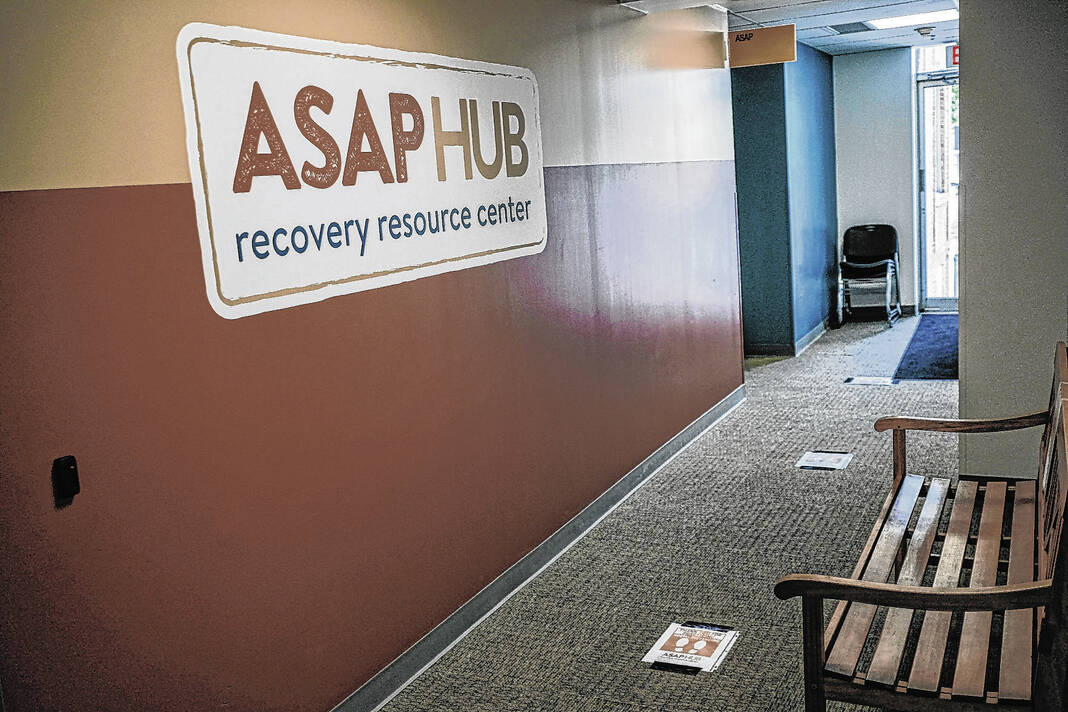
Mike Wolanin | The Republic A view of the hallway leading to the entrance of the Alliance for Substance Abuse Progress Bartholomew County Hub in Columbus, Ind., Monday, June 15, 2020. Mike Wolanin | The Republic
Local officials are considering $1.2 million in funding requests from a variety of efforts that seek to combat and treat substance use disorders in Bartholomew County as overdose deaths continue at a record-setting pace.
The Substance Abuse Public Funding Board plans to meet Tuesday at Columbus City Hall to consider 2023 funding requests from many of the efforts in the county to help those struggling with substance use disorders, including the Alliance for Substance Abuse Progress (ASAP) and other efforts in the criminal justice system.
The funding board will decide whether to recommend that the Columbus City Council and Bartholomew County Council approve the funding requests, said Mary Ferdon, the city’s executive director of administration and community development.
“If the public funding board makes a recommendation to approve funding to (the) city and county councils, the funding amount recommended is a 50/50 split by the two entities,” Ferdon said. “…Both the city and council councils would independently approve that amount, 50%, in their respective budgets for the next year.”
The funding board is comprised of Columbus Mayor Jim Lienhoop, Columbus Regional Health President and CEO Jim Bickel and other elected city and county officials.
ASAP request
Total request: $555,380
Opened in Sept. 2019, the ASAP Hub in the Doug Otto United Way Building provides resources needed to recover from addiction, including referrals to already existing programming. The hub also helps with navigating the health care, insurance systems, resources for connecting to community services, and even the basics of obtaining food, housing and transportation.
ASAP also has two recovery houses for men and one for women with a combined total of 28 beds, ASAP Executive Director Sherri Jewett told the the Substance Abuse Advisory and Accountability Committee earlier this month.
The funds requested include, among other things, $327,060 for salaries, $125,307 for beneifts, $21,600 for rent and $35,450 for legal, IT and other professional services, according to figures that Jewett presented to the committee.
ASAP also has received about $800,000 in grants for this year and 2023 that target specific populations and activities, including older adults and Black, indigenous and persons of color, Jewett said.
The grants also include outreach, transportation for sober living residents, as well as helping Jackson and Jennings counties develop substance use plans.
REALM request
Total request: $229,780
Modeled after a successful Community Corrections program for women, the goal of Recovery Enables a Life for Men (REALM) is to provide comprehensive, evidence-based residential treatment that focuses on the substance abuse needs of male offenders.
Since REALM began in early 2010, 68 inmates have participated, with 66% either having completed the program or still actively participating, according to Bartholomew County Director of Community Corrections Rob Gaskill. The remaining 34% have been removed from the program.
The additional money being sought for next year would provide salary increases for two residential officers and a case manager, Gaskill said.
Adult Drug Recovery Court (DRC)
Total request: $248,195
The Bartholomew County Adult Drug Recovery Court integrates evidence-based substance abuse treatment, mandatory drug testing, sanctions, incentives and transitional services. The goal is to reduce recidivism and substance abuse among high risk or high need individuals, Bartholomew Circuit Court Judge Kelly Benjamin said in previous interviews.
Much of the increase in requested funding is due to a federal grant expiring, Benjamin told the Substance Abuse Advisory and Accountability Committee earlier this month. The funding request also includes a 5% increase in salaries.
As of July 11, there had been 19 graduates of the program, Benjamin said. Of those graduates, just one had been re-arrested. As of July 15, there were 25 people currently in the program and there were plans to admit three or four new people within the next month.
Jail Addiction Treatment Program
Total request: $189,414
Opened in early 2020, the Bartholomew County Jail Addiction Treatment Program (BART) provides treatment for nonviolent offenders with historical disorders of addiction and mental illness. Candidates who meet the criteria receive group and individual therapy for up to 16 weeks. Upon graduation, they receive treatment for an additional 6 to 12 weeks.
To date, there have been 122 participants in the program, Bartholomew County Chief Deputy Maj. Chris Lane told the Substance Abuse Advisory and Accountability Committee earlier this month.
Of those, 106 have graduated the program and 39 have graduated the jail’s aftercare program, Lane said.
The decrease in funding being sought is largely due to a reduction in staff, Bartholomew County, Lane said.
“We’ve been able to run the program successfully, I believe, up to this point to where we’re confident that we can do that with a staff of two,” Lane told the Substance Abuse Advisory and Accountability Committee.