A Carmel-based developer is looking to prepare 150 acres in Wayne Township for future industrial use. However, neighboring residents are concerned about the potential impact on their properties.
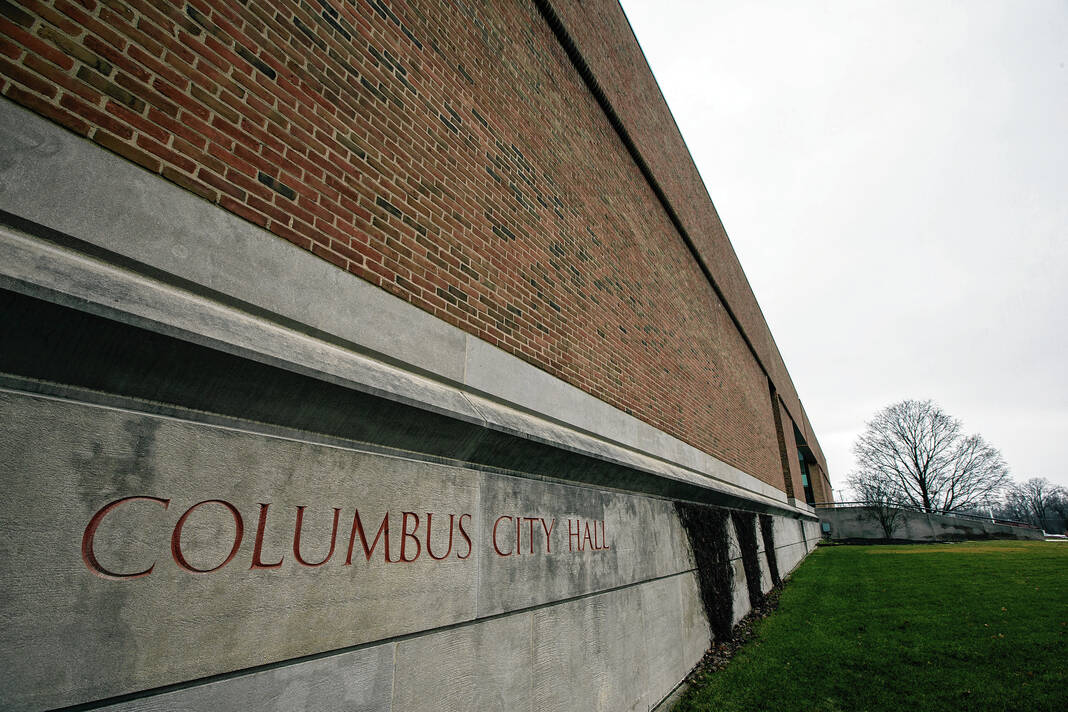
The Columbus Plan Commission voted on Dec. 14 to forward favorable recommendations to Columbus City Council on TMC Developers, LLC’s requests to annex 153.53 acres — including about 4 acres of right-of-way — into the city and rezone 149 acres from Agriculture: Preferred to Industrial: Heavy. The property in question is located at 5180 West 450 South and 5440 West 450 South, in Wayne Township.
While the commission voted unanimously to approve a favorable recommendation on annexing the property, commission members were split 6-2 on the rezoning request, due to differences of opinion on what conditions should be included. Zack Ellison and Evan Kleinhenz voted in opposition.
Columbus City Council makes all final decisions on annexation and rezoning requests. According to City/County Planning Director Jeff Bergman, the council is expected to have its first vote on both requests on Jan. 17.
As stated in a report from planning department staff, the reason for the two requests is to prepare for future industrial development.
“We do not have a specific client in mind at this time,” said TMC Director of Construction and Development Mike Balog. He also noted that the property, due to its size, could likely be subdivided in the future to provide spaces for multiple companies, though they can’t rule out the possibility of a single user either.
Bergman noted that if the property is involved in a major subdivision, the preliminary subdivision plat would come before the commission for their approval. If, however, there is just one property, no need to subdivide, and the intended use is allowed under the zoning district, planning staff would review the user’s site plan to make sure regulations are being followed, but this would not require commission approval.
During the time for public comment, neighboring property owners expressed concern about issues such existing traffic problems, property values, noise, pollution, drainage, and general impact on neighboring properties.
“There have been all kinds of wrecks there, at that intersection, and the increase in traffic is not going to help,” said Carol Waggoner, who lives near the intersection of State Road 58 and County Road 400 West. “And I just really don’t want to look out my front window and look at a cement block building.”
Commission member Barry Kastner later said that the city should communicate with the Indiana Department of Transportation (INDOT) and Bartholomew County on the need to evaluate traffic issues on State Road 58 and County Road 400 West, respectively.
“It just seems like it’s getting too dangerous out there,” said Kastner.
City Engineer/Executive Director of Public Works Dave Hayward, who has a seat on the commission, said that they can reach out to both entities, though he doesn’t know how they’ll respond.
Bergman said he’ll contact the county and added that he believes INDOT would be more responsive once there are more details available about a proposed development and user. Both men also indicated that the state’s intervention is typically triggered by high numbers of accidents in an area.
Greater Columbus Economic Development Corp. President Jason Hester also spoke during the time for public comment to express support for TMC’s requests.
He said that in the last two years, the EDC encountered 38 projects where developers were seeking sites of 100 acres or more and were willing to consider Columbus and Bartholomew County. However, the EDC was only able to submit on six of these projects, which all ended up being located in north Bartholomew County near Exit 76 due to the availability of large properties there.
“So what did we lose by not being able to submit on 32 of those projects?” said Hester. “In total, those projects represented a potential for $40 billion in capital investment. Now I’m not suggesting we would have won every single one of those. The smallest project was $100 million of capital investment. And those are dollars that add to the assessed valuation, keep all of our taxes lower, help pay for schools, public services, etc. Of course it does also create jobs.”
Out of 71 project leads that the EDC saw in 2022 alone, only about 17% were seeking less than 20 acres, he added. About 4 out of every 10 projects were looking for 20 to 80 acres, and another 4 out of 10 were looking for 80 acres or more.
Commission member Amber Porter responded to some of neighbors’ concerns by including conditions in her motion to give a favorable recommendation for the rezoning request.
One of the conditions, which was recommended in detail in the staff report, states that for so long as residential use is present at 4880 West 450 South — a one-acre parcel to the east of the subject properties — the developer shall install and maintain a landscape buffer on the subject property along the property line.
Porter also included Bergman’s recommendation to include a condition providing odor protection to adjacent agricultural properties at the same level residential properties would receive and added another condition requiring buffering along farmland just west of the subject properties, which are owned by Craig Bolte.
This will be a 36-foot-wide buffer along the west property line. It must include a berm that is at least 6 feet tall with a 3-to-1 slope and a staggered row of evergreen trees that are a minimum of 5 feet tall. Breaks should be included along the berm to allow for natural drainage. As with the other property line, the existence of a buffer requirement is contingent on how the property is used.
Ellison, however, did not agree with the idea of having a berm be part of the buffer.
“If you were to require a berm, and Mr. Bolte decides to rezone his property, then I just think you’ve really added a lot of expense in the development of the overall property,” he said. “I, myself, would personally like to see a row of white pines or some kind of vegetative buffer.”
Porter pointed to Bergman’s comments earlier in the meeting, which indicated that buffers made of plant material are difficult to maintain and enforce. He also stated that berms are “probably the most sustainable type of buffering.”
Kleinhenz, on the other hand, said that he didn’t want to require a berm or buffer on the property’s west side.
“There’s almost a football field from the nearest backyard,” he said. “… I just hate to lose any potential perfect business there that would go because of that less acreage of the property and added expense in developing it.”