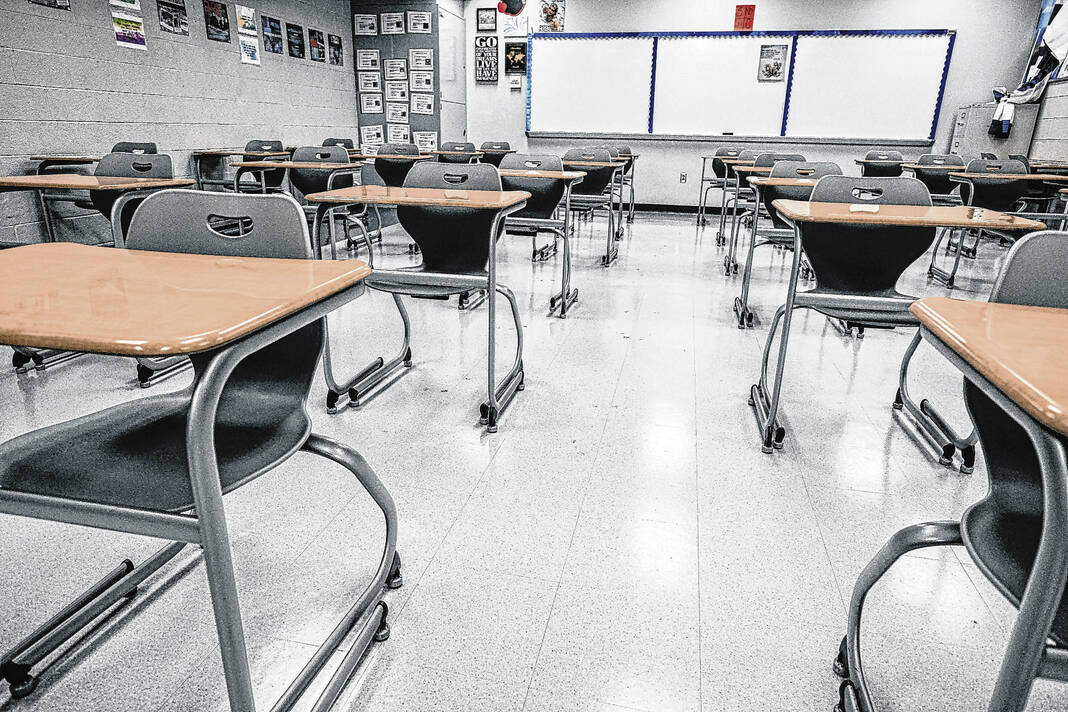
Mike Wolanin | The Republic Desks are shown in a classroom at Columbus North High School in Columbus, Ind., Tuesday, July 28, 2020.
A large percentage of Bartholomew County students who took a survey about resilience said the stress of the COVID-19 pandemic was so acute that their response was not to think about it at all.
This was just one of the findings discussed Thursday night, as individuals from the Council for Youth Development Bartholomew County and Search Institute gave a virtual presentation on the 2022 Resilience Through Strengths Survey results. About 65 individuals were on the call, including school and community leaders.
CYD officials said that a recording of the presentation, slides and a frequently asked questions (FAQ) document will be made available at cydbartholomew.org. The organization will be accepting questions for the FAQ through March 17, said CYD director Sara Dunlap. These can be submitted at cydbartholomew.app.neoncrm.com/np/clients/cydbartholomew/survey.jsp?surveyId=13#.
In September, students in grades 4-12 in the Bartholomew Consolidated School Corp. and the Flat Rock-Hawcreek School Corp. were given the option to participate in a survey titled “Resilience Through Strengths.”
The survey is part of a larger project known as the Resilience Through Strengths community pilot. In January 2021, CYD, the Indiana Department of Education and local school officials announced that Bartholomew County would be a pilot in international efforts to study and enhance youth development.
The county joined an international research team led by the International School Psychology Association, the International Institute for Child Rights and Development, Search Institute, IUPUI’s School of Education and the Indiana Department of Education. Local leaders are working with the team to study whether asset-based practices “reduce the effects of childhood trauma and improve youth resiliency.”
According to former CYD director Heather Carson, a total of 6,206 students completed the Resilience Through Strengths survey. This reflected a participation rate of about 78%, said Justin Roskopf, manager of survey services and measurement strategy at Search Institute.
“We feel we have a better understanding of our own young people locally,” said Carson. “So we could look at data from broader statistical information, but this is our own children and adolescents and teens that are sharing with you and me and all of us how they’re doing, their perceptions. And for us, we would really want to take it in tonight and see how we can address things and actually maybe do better for them.”
COVID-19 and its effects
One of the modules included in the survey focused the COVID-19 pandemic and its effect on students.
“This was a unique period of time when the survey was conducted,” said Roskopf. “So it was conducted in fall of last year, September, as noted, but there were still lingering effects (from the pandemic), I think.”
The survey reported 86% of students were experiencing some level of stress during the pandemic, with 22% saying it was very stressful. In the survey, 67% did not feel as connected to their teachers at this time, with 42% reporting the same for friends and 20% saying the same for their parents.
However, 41% of students feel that their relationships with parents are stronger now than they were before pandemic and 39% reported the same for friends, and 20% for teachers.
Conversely, 15% of students felt their relationships with teachers are weaker than pre-pandemic and 14% said the same for friends and 8% for parents.
“There was a key role that was played by adults that surround these young people in helping them mitigate some of the concerns that they highlighted,” Roskopf added.
The survey reported 45% of students felt that their teachers helped “make things feel more normal during the pandemic” while 78% said the same for parents. Similar percentages of students reported that teachers and parents helped them “make sense” of their emotions about the situation and gave them the opportunity to share these feelings.
In regards to students’ own coping skills regarding COVID-19, the survey found that 82% of students talked about their feelings related to the pandemic, while 64% saw it as a learning opportunity, and 79% used problem-solving to deal with related issues.
Inclusivity and bias
Other sections of the survey dealt with inclusion and discrimination. The survey reported 66% of students said their school meets or exceeds their expectations when it comes to inclusion with 23% said that their school approaching this goal, and 11% felt that a lot of work needed to be done.
Students were somewhat less likely to identify their school environment as inclusive if they were another gender, Black, financially strained, gay, lesbian or in grades 10-12.
Questions regarding experiences of bias or discrimination were limited to high school students, with about 2,900 responding. In the survey, 41% of these students said that they had experienced bias or discrimination — with Roskopf noting that this included any context, not just school.
Out of students with these experiences, 47% said this prejudice came from both peers and adults while 35% said it was from peers only, and 18% said it was from adults only.
Students were also asked about the perceived reason behind the bias or discrimination they experienced and were able to select more than one option, said Roskopf.
The responses were that 47% said that they felt it was due to their gender,44% said that it occurred due to their age, 34% identified race or ethnicity as a factor, 33% pointed to sexual orientation, and 31% mentioned their family’s financial situation. The responses showed 22% said there was another reason they had experienced prejudice.
The top four ways in which students experienced discrimination were being treated with less respect (73% reported this), being subject to false assumptions (70%), being treated like they weren’t smart (57%) and being ignored (51%), while 36% were excluded, and 31% were threatened or harassed.
Relationships
There were also questions on the survey that dealt with developmental relationships, which Roskopf defined as close connections with adults and peers that help youth to “cultivate their abilities to shape their own lives, build resilience and thrive.”
The survey identified that 56% of students had three or more developmental relationships, 19% of students had two relationships, 15% had one, and 10% had none.
The report said 80% of students felt they had strong developmental relationships with their parents, 62% with teachers, 61% with friends, 46% with program leaders and 22% with neighbors.
“Relationships tended to become weaker as we progressed higher in grade levels,” said Roskopf. “And this held true in all relational targets, outside of friends, where we actually saw an increase. With teachers, we had a high of 87% of young people experiencing a developmental relationship with teachers in grades 4 and 5. However, by the time we’re looking at high school students, that actually fell to just shy of 50%.”
He also noted that students with the most financial strain were less likely to experience developmental relationships their peers in every category except for with teachers, which showed a minimal difference.
LGBT+ students showed a slight decrease in most categories, with the exception of parental relationships, which were about 20% less likely to be identified as a developmental relationship.
Adverse experiences
Another module, which was limited to high school students, focused on Adverse Childhood Experiences (ACEs). CYD officials define ACEs as “traumatic events that create dangerous levels of stress, can derail healthy brain development and have lasting negative effects on health and well-being.”
There were 1,268 students who responded to this section in full. Of this number, 50% of teens felt no one in their family loved them on at least one occasion, and 41% felt that their family did not feel close to each other on at least one occasion.
Additionally, 41% of teens lived with someone who was “mentally ill, suicidal and/or severely depressed”, 39% have parenting adults who either separated or divorced, and 33% lived with someone who had a problem with alcohol or drugs. Almost one-third of teens felt that they “had no one to protect them on at least one occasion.”
Overall, teens experienced between an average of 2 to 3 ACEs; 33% had none. Girls had closer to 3 ACEs, while boys were closer to 2. Nonbinary students typically had more than 4.
“The experiences did not vary significantly across race/ethnicity, except for teens who selected more than one race,” Search’s presentation stated. “This group of teens experienced 3 ACEs, on average, compared to ~2 for other groups.”
Students with high financial strain typically had higher ACEs experiences — nearly 7, compared to less than 2 for those with low financial strain.
Straight students experienced 2 ACEs, on average. This increased to over 4 if a student identified as gay, lesbian or bisexual.
Carson noted that stakeholders involved in the project are looking at how to make sure that everyone, regardless of whether or not they’ve experienced ACEs, can “thrive equally and equitably in our community.”
“So the pilot project, the whole focus that we’ve had and what we’ve worked on, is can a community-wide investment in well-being buffer the harmful effects of Adverse Childhood Experiences?” she said.
Development assets
Project leaders have emphasized the role of developmental assets in answering this question.
Roskopf defined development assets as external factors and internal strengths that, as suggested by research, youth need to “grow into healthy adults and contribute to society.”
In discussing this section of the survey, Roskopf compared the 2022 results to those from CYD’s 2018 Development Assets Profile Survey.
“It’s an identical measure, which gives us the ability to really look at how the results differ now, after having been through a global pandemic, compared to what we saw back in 2018,” he said.
However, the 2018 survey only focused on grades 6-12, whereas the recent survey was for grades 4-12. Roskopf clarified that as he discussed aggregate data, it would be limited to grades 6-12 in order to provide a more 1:1 comparison.
The 2022 survey found that in regards to their levels of assets — which were scored from 0-60 — 42% of students were in the vulnerable range (30-41), 33% were adequate (42-51), 17% were challenged (0-29) and 8% were thriving (52-60).
Compared to the 2018 survey, there was a 7% drop in thriving levels of assets and a 7% increase in vulnerable levels. Female students were more impacted by this than males.
Assets that were surveyed included support, empowerment, boundaries and expectations, constructive use of time, commitment to learning, positive values, social competencies and positive identity.
Two assets that were particularly notable were constructive use of time and positive identity, said Roskopf.
“78% of our students — so just over two-thirds of our students —feel that they don’t really have a space outside of school that’s productive,” he said. “And the second one here, positive identity, about two-thirds of students, 66% of our students, felt that their own perceptions of their identity are low. And within positive identity, we asked questions about self-esteem, we asked questions about their autonomy or agency, we asked questions about their own positive view of their personal future.”
Female students responded more negatively in this area than males.
Additionally, 59% of students were challenged or vulnerable when it came to their commitment to learning.
“It takes a village to develop these assets in young people,” Roskopf added. “There are multiple sectors involved. We know that it’s a community-based effort. We know that we’re only successful when this goes beyond the home, beyond school and really broaches the community.”