Jennings County boys basketball coach Josh Land chats with Keegan Manowitz during a game against Columbus North Nov. 25, 2022 at Jennings County High School.
The Republic file photo
What if the Jennings County boys basketball team was in a different class? Could the Panthers have advanced farther in this year’s state tournament? What about the girls basketball team, the volleyball team or the baseball and softball teams?
With just south of 1,200 students, Jennings has been fighting an uphill battle for many years, and the Indiana High School Athletic Association may be taking notice to the smaller enrollments in the Class 4A sports realm.
A proposal has been made that would base classifications on hard enrollment barriers starting in the 2024-25 school year, potentially replacing the current system that splits up the four classes up evenly.
Under the new proposal, every school above 1,400 students will remain in Class 4A. Enrollments of 600-1,399 would be in Class 3A, and enrollments under 325 would be in Class A, with Class 2A splitting the difference with enrollments of 325-599. The vote is scheduled to take place on May 1 by the IHSAA board of directors. If approved, it won’t take into effect until the start of the 2024-25 school year when the next realignment begins.
IHSAA Commissioner Paul Neidig said it began with response from a survey that was issued by the Indiana Interscholastic Athletic Administrators Association. One of the topics that was originally discussed was about moving from a four-class system to a five-class system due to the extreme gap of enrollment in Class 4A. Under the current system, Carmel has the largest student enrollment of 5,327, and South Bend Riley is the smallest 4A school with 1,030.
“You try to look at what would be an acceptable number of teams to still run a quality tournament. I understand that it is a number that can certainly be debated, but 1,400 was the number the committee came up with,” Neidig said. “At some point, you had to establish a standard, and then after that, it was really trying to keep, not exactly, but somewhat an equal number of schools in each of the remaining classes, so that’s why the other numbers were applied. Basically it puts over 100 schools in each class in 1A, 2A and 3A, but that’s a ballpark number because we have no idea what the classifications numbers would look like next year before we would realign it in the fall (of 2024).”
While having a fifth class was considered, Neidig said travel played into significant consideration, particularly in the largest class, and also trying to book venues like Gainbridge Fieldhouse, home of the Indiana Pacers, for more than one day.
“We want to celebrate our championships in the great facilities that we are already getting to. Asking the Pacers to vacate a Friday night Pacers game when we’re going to be there all day Saturday, it’s not fair. They have to run a viable NBA program also, and Friday nights and Saturday nights are primetime games,” he said. “You think about trying to run five basketball games in a day, could we develop a schedule that we could get that done? Absolutely we could, but that would start early in the morning and end late at night. People would say, ‘Just go to one or other big facilities for the Friday night game,’ and I’m not willing to tell any team in the state of Indiana that they can’t play their final game at Gainbridge Fieldhouse.”
With 403 total IHSAA-sanctioned schools, each class had either 100 or 101 schools. The proposed change will have 117 schools in Class A, 116 schools in 2A, 102 schools in 3A and 68 schools in 4A, based on the current 2022 enrollment numbers. Those numbers would certainly shift in the summer of 2024 with new enrollments and success factors being brought into the equation. Keep in mind, schools won’t move down a class if a smaller school moves up due to the success factor since the new proposal will be based on hard enrollment numbers.
The potential change won’t impact Columbus North, with well over 2,200 students, at all, and it is very doubtful Columbus East would move down with an enrollment of 1,534 under the new proposal. Jennings would be the biggest beneficiary with an enrollment of 1,181, according the last IHSAA count.
“It is a positive move and a move in the right direction. I think overall for the state, it’s a move in the right direction,” Jennings athletics director Cory Stevens said. “It starts to reduce an enrollment gap in the largest class.”
While the proposal impacts Jennings directly, Hauser also could benefit based on how the enrollment numbers move in 2024.
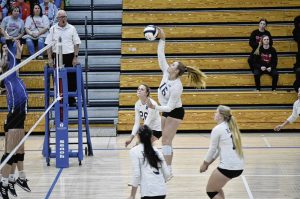 Hauser’s Kenze Bostic goes on the attack against Linton-Stockton during the Class 2A volleyball regional semifinal Oct. 22, 2022 at Mitchell High School.
The Republic file photo
With an enrollment of 327, Hauser would be the smallest 2A school in the realignment and would have a chance to move back down to the smallest classification if the enrollment drops down a few kids.
Hauser athletics director Tyler Phillips expects the Jets to stay in Class 2A if the proposal passes, and the next round of realignments begin due to the enrollment growth of the school recently.
“It won’t dramatically change, but our junior high classes are bigger, and our elementary classes behind them are bigger,” he said. “We are not going to dramatically grow, but we are going to continue to grow. Whether they stick with the old plan, or they implement this new one, we’re going to be a 2A, regardless. It’s just a matter of, are we the smallest 2A or the 10th smallest 2A?”
Schools typically like to schedule their sectional opponents in the regular season. The realignment last year has made it difficult for some athletics directors, and the new proposal may make it more challenging.
For the Jets, the sectional likely will be tweaked if the proposal is approved. North Decatur, with a current enrollment of 302 would move down to 1A, and Milan would possibly go down to 1A as well with 319.
“Depending on who that team is, and if they’re not on our schedule, we’ll try to add them,” Phillips said, “but it’s not going to be any more dramatic than what it was a couple years ago when we went up to 2A.”
Stevens said it shouldn’t be the case for him.
“If we were to go to 3A, and you look at the schools close to us, we are playing them already, so I don’t think it’s going to change the scheduling all that much, at least for us,” he said.
At the end of the day, the new proposal won’t please everyone. While small 4A schools like Jennings will get a reprieve, some other schools may not be as excited, but the IHSAA will do what they believe is best for all the Indiana high schools come May 1.
“I try to look at what’s best for the membership. Everybody that looks at this looks at it with the lens of their school, and I understand that and don’t blame schools for doing that,” Neidig said. “I’ve said many times that everybody can draw up the perfect bracket or the perfect number of schools in a group based upon what their school looks like, and then they would start picking and choosing. The unique thing about my seat and my staff’s seat is that I can operate and think about this without a lens of an individual school.”
Phillips echoed Stevens’ sentiment about the new proposal.
“Personally, I like it,” Phillips said. “I was a small 4A when I was the (boys basketball) head coach at Seymour. We had an enrollment of 1,500, and then competing with schools that had over 5,000, it’s really hard to do. If it’s going to make the competition better across the board, I’m all for it.”