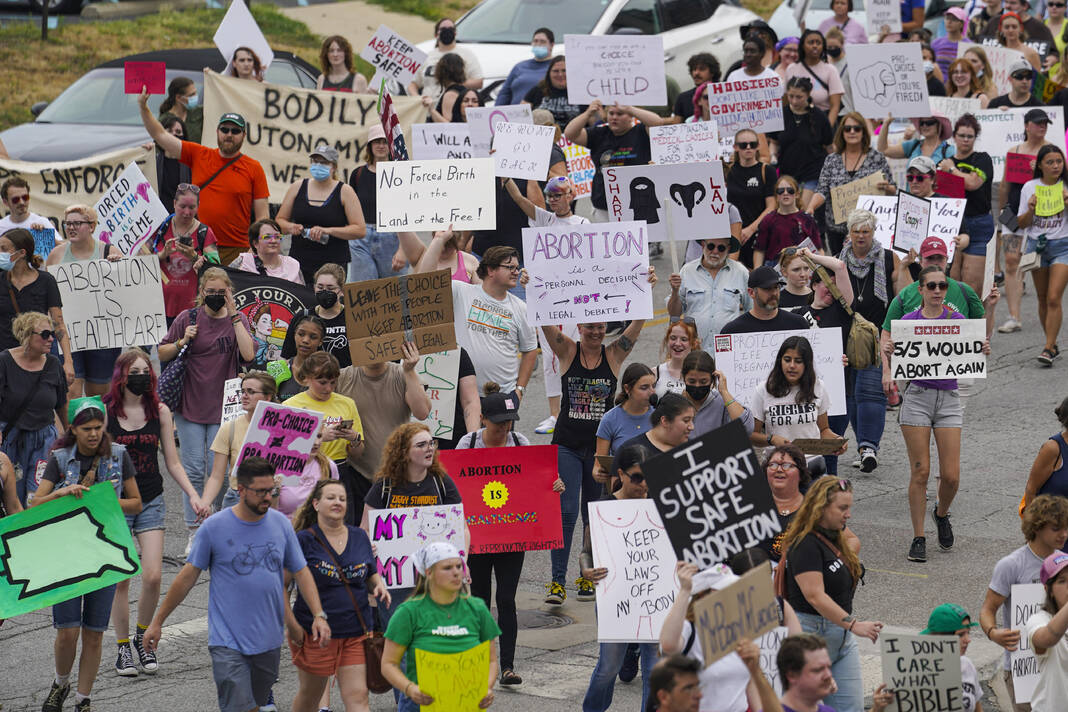
Abortion-rights protestors march outside the Indiana Statehouse on July 25, 2022, as lawmakers deliberated abortion restrictions in the wake of a US Supreme Court decision overturning a federal right to abortion one year ago today. AP file photo
Maribel G’s at-home pregnancy test came back positive near Labor Day last year, days before Indiana’s abortion ban briefly went into effect.
She was 20, lived with her parents in Delaware County, and worked in retail. And she was dating a man whom she said hit and verbally abused her.
“I think deep down we did both love each other. … That’s why we stayed together. But it was never going to be a long-term relationship, I think I knew that,” Maribel told the Capital Chronicle.
The then-couple agreed on an abortion, but accessing the procedure around the time of the ban’s effective date – Sept. 15 – proved to be “a nightmare,” Maribel said.
“I didn’t have any idea how complicated it would be — I didn’t understand all the seriousness around the ban and places not knowing if they could help, and I’m making all these phone calls, overwhelmed,” she said.
Maribel said she tried to make appointments with clinics in Indianapolis and got nowhere. Instead, she turned to an online consultation for mail-order abortion pills, but learned on the call of the required in-person examination and administration — in Chicago.
During the last week of September, Maribel made the journey. She was just under the pills’ 10-week pregnancy cutoff.
“I never planned pregnancy. I did not want to get pregnant … in that situation, and not until I was older, and more ready,” Maribel said. “I also never wanted to get an abortion, but I felt like I didn’t really have a choice, because the only other thing I could do was have the baby, and I just couldn’t do that.”
She told her parents the trip was for fun: socializing and shopping. She asked to keep her last name anonymous out of fear they’d disown her.
Legal challenges
The U.S. Supreme Court rolled back federal-level rights to abortion nearly a year ago on June 24, in Dobbs v. Jackson. Indiana was the first state in the nation to approve abortion-restricting legislation, passing a near-total abortion ban during a heated, two-week special session that concluded last August.
The ban was in effect for just a week before a Monroe County judge granted a preliminary injunction – reverting to the state’s previous abortion law allowing abortions up to 20 weeks. But the Indiana Supreme Court is expected to rule on that lawsuit any day.
The tenuousness has complicated abortion access for Hoosiers — as abortion clinics struggle to retain staff and comply with the state’s existing snarl of regulations and health care providers re-examine their careers in Indiana.
“The ban hasn’t completely taken effect yet, but we are seeing the shadow effects,” said Dr. Alison Case, a family medicine physician who has worked with Planned Parenthood in Bloomington and Whole Woman’s Health Alliance in South Bend. The latter closed the South Bend clinic – its only one in Indiana – this month, citing “politically driven and medically unnecessary abortion restrictions.”
“One year ago the U.S. Supreme Court put the power of addressing abortion back into the hands of the people in each state — via their representative government,” Indiana Right to Life President and CEO Mike Fichter said in a news release Wednesday. “And while our lawmakers to some degree fulfilled the will of the people to stop abortion in our state, the lower judiciary has allowed abortion to go unabated in Indiana. Every day that passes is a day when pregnant moms and their babies might otherwise have been protected from the pain and often lifelong trauma of abortion.”
Abortions decline
Indiana is performing fewer abortions despite the injunction, as clinics struggle with staffing. But residents of states with bans in force increasingly travel to the Hoosier State to access the procedures.
Indiana abortion clinics and hospitals recorded a steep drop in procedures after the ban’s week in effect. They submitted 1,030 terminated pregnancy reports in September 2022, and just 446 the month after, according to Indiana Department of Health data.
Abortions remain down this year as well, with providers filing 3,087 reports from January through May. Over that time period in 2021 — the most recent annual report available — they filed 3,668 reports.
Multiple physicians said clinics have struggled with staffing due the injunction’s uncertainty. While physicians typically perform abortions at clinics in addition to another full-time job, clinic work is increasingly precarious primary employment for other staff members.
And Indiana requires an 18-hour waiting period, which necessitates a second appointment. More than half the time, an Indiana Planned Parenthood official said, women choose to go to Illinois rather than deal with the hassle of abortion in Indiana.
Chicago has a walk-in clinic where the maximum price for a procedure is $360. At Planned Parenthood in Indiana, the process will likely cost somewhere between $800 and $900, and will take two visits under state law.
Planned Parenthood spokeswoman Nicole Erwin said the organization regrouped in the wake of the Supreme Court ruling.
Fewer Hoosiers sought abortions in-state from Planned Parenthood even as the number of out-of-state clients surged. The organization said 25% of its non-Hoosier clients are from Kentucky, which has a near-total ban in place. Planned Parenthood facilities include providers in Bloomington, Indianapolis, Lafayette and Merrillville.
“States around us are sending people here, which means less access for people here,” Case said. “The volume is high, with fewer appointments available. Most of the people I see in Bloomington are from Kentucky or Tennessee, not Indiana.”
‘Targeted and threatened’
Some have expressed fear for physicians and patients as members of the profession navigate the state’s looming abortion ban and aggressive enforcement of the remaining 20-week law.
Several pointed to the Indiana Medical Licensing Board’s admonishment of Indianapolis obstetrician-gynecologist Dr. Caitlin Bernard last month. Indiana Attorney General Todd Rokita filed a complaint against the doctor after she publicly discussed a 10-year-old Ohio rape victim seeking an abortion in Indiana.
“Even when providers comply with the law, we’ve seen abortion providers like our own Dr. Caitlin Bernard targeted and threatened by politicians just for providing legal medical care,” Planned Parenthood’s Erwin said in a statement. “The most recent attacks have come from Attorney General Todd Rokita, who used a 10-year-old’s tragedy as an excuse to intimidate abortion providers. This fear is paralyzing health care providers across the country who are scared that simply following their Hippocratic oath could make them pawns in a political attack.”
Physicians say the restrictions could limit options for patients, and some medical students and residents have chosen to leave the state.
Lucy Brown starts her OB-GYN residency in Maryland next month. She made the move alone, leaving behind family in central and southern Indiana, and a significant other in Chicago. That’s because, Lucy said, her top priority in location was a state with minimal restrictions on abortion.
“I’m not going to compromise my career to live in a state that doesn’t respect my job,” Brown said.
Accredited OB-GYN residency programs must provide training in abortions, which sometimes means flying residents from states where the procedure is largely illegal to states where it’s not. Brown said she found “some solace” in the Accreditation Council for Graduate Medical Education requirements.
“But the problem is that abortion is such an integral part of your everyday practice, especially on labor and delivery, when you’re on triage,” Brown said. “Like if someone is pregnant, you have to offer them full resources.”
Meanwhile, the state’s supreme court is expected to weigh in on a challenge to Indiana’s abortion ban, rooted in arguments of privacy, before the end of its fiscal year.
“We are hopeful the Indiana Supreme Court will soon confirm what is clear: There is no right to abortion in the Indiana Constitution,” Indiana Right to Life’s Mike Fichter said. “As we await the day when Indiana’s new law can fully take effect, we will continue to work as we always have — providing love and support for pregnant moms and their babies.”
And while the appeal in a second lawsuit plays out, both parties have asked for a pause on the underlying religious freedom-based case. The Marion County Superior Court granted that motion in a brief ruling on Wednesday.
“Make no mistake: Planned Parenthood providers will not be intimidated. We have the majority on our side in support for access to abortion,” Erwin said. “… Together, we can create a future where our reproductive rights are guaranteed — not vulnerable to whoever has power at the moment.”