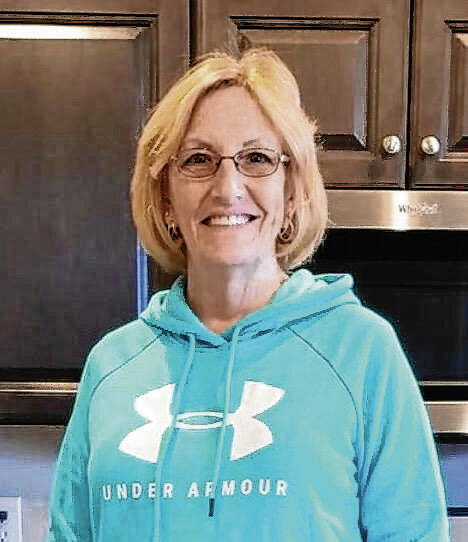
Sandy Martin of Hope praises her palliative care experience: “The care I received was fantastic.”
Living under palliative care is a new kind of experience for Sandy Martin. Until about three years ago, the 74-year-old had been largely healthy and fit. She had many enjoyments in life, and proceeded under the assumption that she’d go on enjoying them.
“I’d only ever been in the hospital to have my three children,” she says. “I never thought I’d get cancer.”
But after multiple diagnoses and surgeries, Martin is undergoing palliative care at home, provided through Our Hospice of South Central Indiana. Palliative care emphasizes patient comfort in addition to medical treatments — a layer of care in addition to ongoing medical care, says Donna Butler, a palliative care nurse practitioner with Our Hospice who is familiar with Martin’s case.
“We try to meet patients where they’re at in their diagnosis and their treatment,” Butler says. Palliative care takes a team approach that in addition to nurses and care providers also involves a social worker who can connect a patient with available resources and a chaplain who can meet a patient’s spiritual needs.
Martin, a Muskegon, Michigan native, moved to Bartholomew County when her husband took a job with Seymour Tubing. Two of her children were teens and the youngest was 9 years old.
She still lives in the house on Schaefer Lake in Hope where she’s resided for 37 years.
Until the recent changes in her life, she’d take a five-mile walk around the lake every day.
Martin was the first employee of Action Filtration, a Hope-based manufacturer of air purification products.
“I was the sewing department,” she says. “I loved my job. I’ve always loved to sew.”
She’s still friends with the women who came on board to work alongside her.
At age 71, she developed a sore in her mouth and consulted a dentist. He wanted to remove it, but his staff left her with the mistaken impression that she’d have to pay $1,200 that day. Insurance wasn’t mentioned. She declined the procedure.
“That was the worst mistake of my life,” she says.
She went on a trip to Arizona to go mountain climbing. The sore got worse and she consulted a dentist there. Several biopsies yielded various conclusions.
When she got a cancer diagnosis, she went to a specialist who determined the cancer had spread to her jaw bone. At that point, she decided to come home.
Both of her daughters are nurses, and they made sure she got admitted to IU Health University Hospital in Indianapolis. She had the first surgery to address her condition there.
“They put in a whole new jaw by taking bone tissue from my left arm,” she says.
Next came 30 rounds of radiation. After the last round, her chest and neck broke out in painful blisters. Topically applied sulfadiazine cleared them up fairly quickly.
However, radiation also burned her saliva glands. She can no longer produce saliva and takes a couple of medicines to address that. Radiation also gave her a growth on her chin that kept getting worse.
“I ended up back at IU. I was given two choices: have another operation, or do nothing.”
The replacement bone from the first surgery hadn’t fused with the natural bone in the area. She opted for a second jaw rebuild. This time, the surgical team took the bone tissue from her left shoulder.
“It was 100 times worse,” she says. “I was in the hospital 11 days, and had no water for 31 days.”
She spent five weeks in rehab at Four Seasons Retirement Center and speaks highly of the staff there.
That’s also the case with the palliative care team, which she describes as “awesome.”
She currently lives at home. Her daughters, Amy Roseberry and Angela Wells, look in on her.
“Between Amy and God, I think that’s why I’m still here today,” she says. “Angela would have helped more, but she was dealing with cancer as well.”
From May through August 2023, Martin had physical therapy (“I can move my arm really well now”) and she also sees a speech therapist.
To top it off, she had a squamous cell carcinoma removed from her leg in the spring.
The self-described foodie describes being reliant on a feeding tube as one of her biggest frustrations. Both Martin and Butler observed that this can be a major adjustment for patients who can no longer swallow, because food and eating are at the heart of so many social events and family gatherings.
Nevertheless, Martin remains upbeat, an attitude that she says stems from the support base she gets from her friends, as well as her fellow congregants at Hope’s First Baptist Church who visit and inquire.
She also cites the people “all over the United States who are praying for me. I don’t know how anybody who’s an atheist could get through this.”
Martin is cancer-free now, but she continues to receive palliative care. “The care I received was fantastic,” she says. “My friends and family have been fantastic.”
Another key element of her outlook is staying focused on the day currently in front of her. “It can all change so quickly,” she stresses.
She also wishes to encourage anybody with an unusual sore spot to “get it checked out right away. Don’t wait, even if you have to borrow the money to do so.”
She also stresses this for anyone facing a cancer diagnosis and the resulting treatment: “Live one day at a time. I wouldn’t have gotten through it, even now, without living one day at a time.”