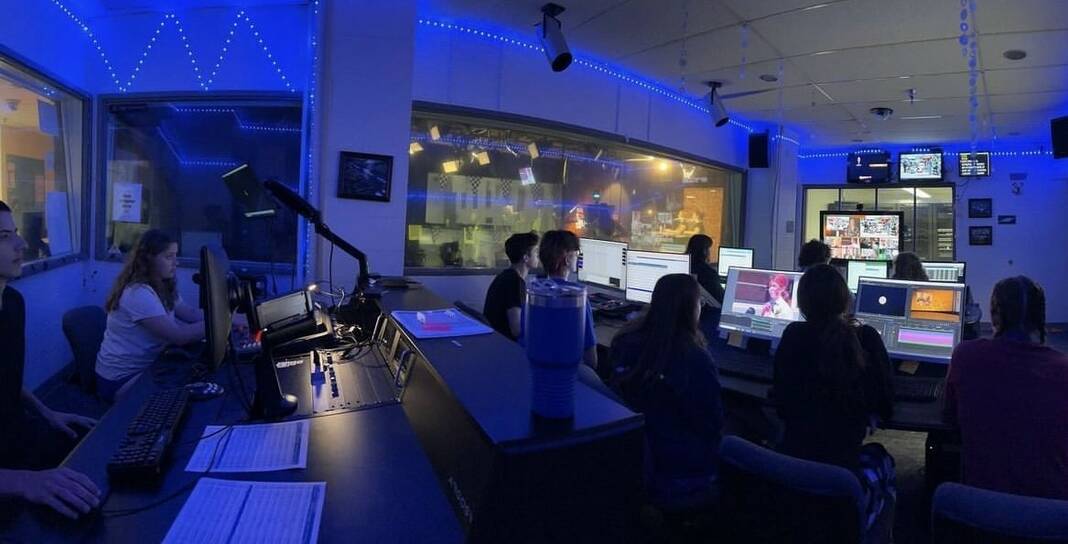
Photo provided Members of the Bartholomew Consolidated School Corp. C4 television program work on a show.
BCSC’s C4 television program participants recently finished their final Torch TV newscast of the school calendar, capping off a year where their work earned a prestigious recognition for the second year in a row.
Torch TV, the program’s magazine show, earned a Cardinal Award for Broadcast during the annual Ball State Student Contest, where middle and high school students involved in broadcast and print journalism, yearbook, media design, photography and more received recognition for their work.
The awards were announced during the Ball State College of Communication, Information and Media (CCIM) JDay+/CCIM+ conference on April 26.
Nine students in the program also received individual awards for news and sports packages they produced this school year.
Lauren Degner, Cambree Martinez, Cate Roeder and Jackson Warren’s work was recognized in the highest category of Superior, while Faline Fox and Avalon Henrichson had feature stories judged as Excellent. Junior Cameron Klawon and sophomore Girum Linnemann also received honorable mentions.
The Cardinal Award for Broadcast is given to an entry of three consecutive broadcasts showcasing overall production, graphics, content and delivery. It’s the highest award a program can receive.
East’s winning Torch TV broadcasts were aired originally on Feb. 2, Feb. 23 and March 1.
Students in C4 TV teacher Jim Roeder’s program come from a variety of areas locally and often become friends as they work together on productions, he said.
In the morning, his class may be comprised of Columbus East and Columbus North students. In the afternoon, it may be students from East, CSA New Tech, Edinburgh, Seymour, Crothersville and South Decatur.
“I’ve got all these different schools that gather in so it’s pretty awesome to get these kids who don’t know each other at all,” Roeder said. “… Within three days, they’ve got each other’s Snapchats, and they’re on a text chain, and then they just become friends and they make television together.”
Among the many technical skills students learn, perhaps most of all they learn how to work with each other.
“Just because you aren’t going to go out and be best friends with somebody who’s sitting next to you doing a totally different job, you still need them to do their job as well as everybody else. You have to root for people to do their best work,” according to Roeder.
In preparing for an episode of Torch TV, it all starts with a pitch meeting. Roeder tells his students the best pitches can be encapsulated in one sentence.
“Sometimes they’re home run, slam dunks,” Roeder said, using a recent four-camera shoot of this year’s Operation Safe Prom program at East as an example.
Students use software called Rundown Creator to meticulously craft a plan—called a rundown— that the episodes are based on with announcements, news packages, weather updates and sports information. Once the rundown is complete, they come together as a team to evaluate.
“Is this too full? Is is not enough? Should we look for something else? Can we get a quick VO/SOT from the counseling department on something that’s going on scholarship-wise?” Roeder said.
Sometimes, they toy with what are called double-boxes, where an anchor and reporter can interact on the screen.
“It’s fun for the technical directors to do, it’s fun for the kids in the control room to do and it’s also fun for the kids to see themselves in the double-box and how they respond,” Roeder said. “And they’re trying to make that camera a person as opposed to the person 10 feet away who’s asking the question, but they can’t look at them because otherwise it wouldn’t make sense.”
Content-wise, students are encouraged to not only focus their stories on what’s going in their school, but the community at-large. Students have interviewed mayors in Columbus and Seymour for stories. Sometimes, interviews don’t work out or come to fruition— but it’s all a part of the learning process, Roeder said.
“The problem is, you have to interview working professionals, so they have to get back to you, and then we have to figure out who can drive and how you can get to that story, so a lot of that stuff takes us longer time than I would like,” Roeder said.
The first semester of his program, Roeder said, is getting those taking TV for the first time up to speed. By second semester, they begin thinking about when to plan on recording productions to be entered for awards recognition.
Students in the program rotate through a wide spectrum of jobs when producing from anchor, to technical director, to teleprompter operator to running the audio board. Some students may be more inclined to be on-camera or off-camera— but they all try a little bit of everything to learn how to work as one and for the overall betterment of their work, Roeder said. The more students are familiar with all aspects of the production, the better the production.
“There’s no way to continue the same position over and over and still get the learning atmosphere that I want,” Roeder said. “It might be the same MOD, but it’s a totally different show with totally different people and totally different roles and I think that to me is as gratifying as anything else.”
Unlike some other high school TV classes, Roeder’s class puts an emphasis on live production, giving students valuable experience as they learn to execute under pressure and roll with the punches when small issues arise. Some elements like the packages may be edited, but the rest is up to student performance when the moment of truth arrives.
“So yeah, there are graphic mistakes, there are mispeakings, there are times when the music rolls when it shouldn’t— but my number one thing I tell my students is make sure you do the next thing right,” Roeder said. “… As long as you can limit those mistakes to one mistake, as opposed to six in a row, you’re putting on good TV.”
Learn more about the program at bcscschools.org/Page/1919.