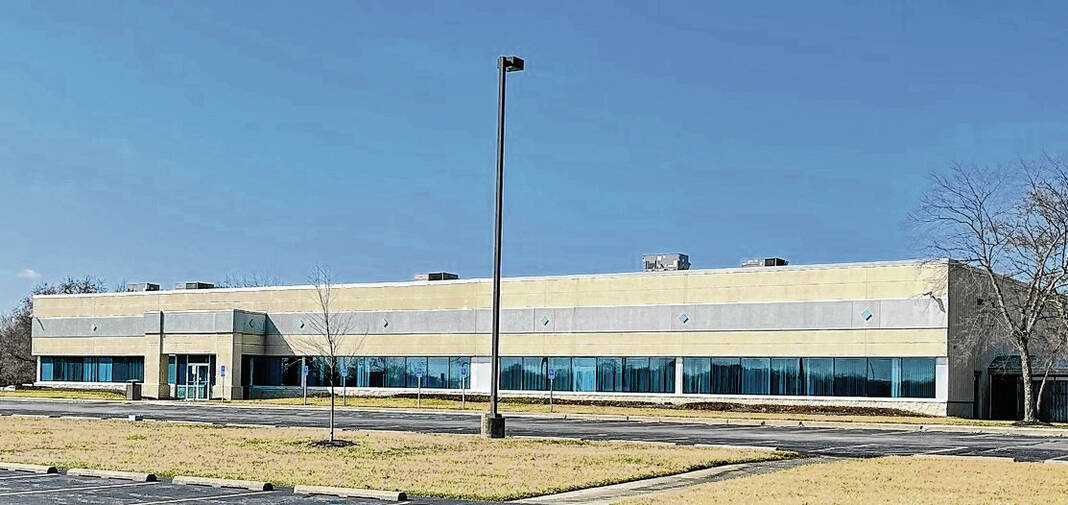
Photo provided A view of the building at 1350 Arcadia Drive that the city is considering purchasing and retrofitting for a new public works facility.
The Columbus Redevelopment Commission has voted 4-0 to approve a purchase and sales agreement to buy 1350 Arcadia Drive for use as a new city public works facility.
The purchase is for $2.6 million plus an additional $25,000 to compensate for closing costs on the 20-acre property.
“Relocating DPW (department of public works) here will not only make this current site available for acquisition by the redevelopment commission, but will also provide DPW with the ability to expand along with their increasing responsibilities,” Director of Redevelopment Heather Pope said.
The agreement has a 120-day due diligence period and includes several approval conditions including an environmental site assessment, the commissioning of design and master planning concepts and Columbus City Council approval.
The council must approve any expenditure greater than $500,000.
Public Works Director Bryan Burton said his department had significantly outgrown capacity at the 3-acre facility at 740 S. Mapleton St. and has been in need of a new one for “at least 15 years.”
Burton showed the commission a slide presentation that detailed just how crowded the current facility is inside the building and outside in the parking lot. Some employees have to be bussed to the location to make up for the lack of parking.
In addition, the age of the building has begun to show— the night before the commission met, the fire suppression system leaked and flooded parts of the building.
“We just run into constant problems like this,” Burton said.
Burton has been with the department for more than 30 years and said the use of the facility goes back further than that.
Demolishing and rebuilding the existing facility would cost “$15 million to $20 million,” Burton said. Along with the $2.6 million price for 1350 Arcadia Drive, Pope estimated that an additional $4.4 million would be tacked on to retrofit the building.
“Budgeting around $7 million, we can get him a nice new facility with plenty of room, and a lot newer building— it comes with cubicles, comes with furniture already, and really the interior just needs maybe the carpet cleaned. So it’s a huge cost savings as well,” Pope said.
The commission also enlisted Force Design, Inc. for an amount not to exceed $25,760 to help with the master planning and capital outlay of the property, which Pope said has some floodplain issues.
“We’ll need to have this design completed, we’ll need to get cost estimates and make sure that this is something that we can afford and the city wants to do,” Pope said. “… They are planning a programming design charrette for the parties that are involved the week of May 27, then (Force Design) has six weeks to come up with a schematic design package for an RFQ.”
The current public works facility at 740 S. Mapleton St. is of interest to the commission should it become vacant because it could potentially free up “other sites prime for affordable housing development in the upcoming years,” according to Pope.
One such site is the former county highway garage at 2452 State St., “that the redevelopment commission has looked at for awhile,” Pope said. Since county highway garage operations relocated in 2021 to a new facility, their use of the site has been limited to storage and access to the county’s salt barn.
Pope said the commission has an interest in 2452 State St. because it was identified as ideal for future development, specifically for an affordable or workforce housing development. Two appraisals have already been done on the property, according to Pope.
“We also wanted to provide the county a place to relocate their salt barn, we don’t know if it’ll go with the department of public works location, but it could be a convenient location for both entities to either share a facility or Bryan (Burton) can still use it because he’s got plenty of equipment that needs stored.”
Pope emphasized that there isn’t an agreement with the county highway department to move the salt barn to the Mapleton Street facility, but said the county is interested in selling their State Street property.
“I don’t know that they’re interested in having a shared salt facility on this old DPW site, we were just giving that as an example. If DPW, the whole facility moved out, that would be a good location, conveniently located for both,” Pope said.
The commission also voted to enlist Jason Larrison of consulting firm J.S. Held “for the solicitation and selection of a Build-Operate-Transfer (BOT) developer,” according to a resolution.
JS Held will be paid an amount not to exceed $20,000.
BOT is a new procurement method the city had been looking into where a municipality enters into an agreement with a developer “who provides a holistic package of services in order to acquire, plan, design, develop, reconstruct, repair, contain or finance any public facility on behalf of a governmental body,” Larrison said during the redevelopment commission meeting on April 15.
Basically, a developer is selected to build, operate and eventually transfer a project to a municipality. The time of operation is typically around 30 days, Larrison said.
Unlike a traditional design-build process where there may be multiple contracts with a general contractor, there would essentially be one contract for the bulk of the project. The developer would assume the risk and the city would save on infrastructure and development costs.
“Basically in the end, you’re reducing the amount of hassle, responsibility, participation that the city has to have,” Larrison said, pointing out that doesn’t mean there should be a zero participation on behalf of the city.
Particularly, Larrison said the most important element is that the city is involved in making sure the RFQ/RFP outlines precisely what it is looking for in a particular project, such as the new public works facility.
“The details are in on the front end, you want to make sure that you’re laying out exactly what it is that you want, that the developer is building their proposal against,” Larrison said during the April 15 meeting.
But first, the Columbus City Council must vote to approve that the BOT method can be used by the city. Larrison will present information about BOT to the council at later meetings before they vote whether to do so.
Pope mentioned that the engineering department has expressed an interest in the BOT method for some of their other projects as well.