Our children had been beseeching my wife and me to get a dog for years. They were enamored with friends’ pets and thought it would be fun to have a dog of their own in the house.
My wife signed on with them after some dedicated pleading.
I was the last holdout. My reluctance sprang from my understanding of who would be taking the dog out in the wee hours to do its business.
But I couldn’t stand in the way of something the people I loved most in the world wanted, so I agreed. We would get a puppy for my son’s 13th birthday.
When we went to pick up our Cavapoo—half Cavalier King Charles Spaniel and half miniature poodle—we had to choose between a male and a female.
The female was quiet, demure and well-behaved.
The male, on the other hand, wanted to make friends with everyone. He played with and licked my daughter and son. He raced around my wife.
In a moment that made everyone laugh, he scrambled up my shirt and onto my shoulder so he could lap at my face.
His message was clear—“I’m your dog and you’re my humans. Let’s get going.”
The kids chose him. We named him Dewey, after my late grandfather.
When we got him home, things worked out how I expected. When Dewey had to trot out in the dark, I was the one holding his leash in the back yard.
Given that he was going out every three hours at the start, this meant Dewey and I spent a lot of time together.
He charmed me from the beginning. I loved his energy, his sniffing curiosity about the world around him and his all-embracing spirit.
I came to love watching the sun come up with him while the rest of our family slept. I loved taking long strolls around our neighborhood with him, marveling at the way he wooed every walker he encountered.
Most of all, I loved him.
I’ve never been a man who has found inner peace easy to come by. Even though my demeanor often seems placid, my spirit always has been restless—and prone to private self-critiques that start at harsh and accelerate fast to self-loathing.
Dewey calmed me.
When he was sitting on my lap, sleeping beside me or sauntering along at the end of a leash I held, I could hear my demons go quiet for a time.
He could bring me peace.
At the start of the COVID pandemic, my younger brother started a losing war with esophageal cancer. I went to all my brother’s doctors’ appointments and medical visits with him, right up to the morning almost three years ago when he died in intensive care while holding my hand.
During a period of magical thinking—if I could just figure out a way to be smarter, tougher or more determined, my brother wouldn’t have to die, I found myself believing at times—Dewey helped pull me back so I could hold it together.
He soothed my raging soul.
When my father and mother died, on the same day, a little more than a year after my brother did with me witnessing Mom’s death, Dewey tethered me again.
Being with him brought stillness to the center of my being.
My wife and children teased me about the closeness I shared with Dewey. They said—accurately—that I went from being the lone holdout to the biggest pushover.
I didn’t argue.
“It’s Dewey’s world,” I said. “I’m just grateful to live in it.”
Dewey died on a Friday evening not long after I came home from work.
After my wife and I played a game of fetch with him with his favorite toy, he wandered into a corner in my wife’s home office, lay down and passed away, the veterinarian thinks from a heart attack.
When my wife and I found him, I rushed him to the vet, but it was too late.
Dewey was 10 years, seven months and 11 days old when he left this life.
I kept it together until the vet confirmed he was gone.
Then tears streamed down my face, sobs coming like a flood bursting through a dam.
Dewey owned me from day one.
He always will.
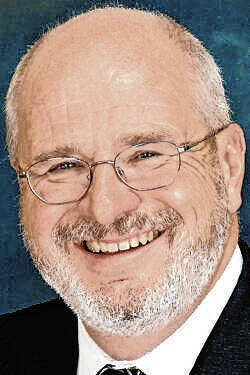
John Krull is director of Franklin College’s Pulliam School of Journalism and publisher of TheStatehouseFile.com, a news website powered by Franklin College journalism students. The views expressed are those of the author only and should not be attributed to Franklin College. Send comments to editorial@therepublic.com.