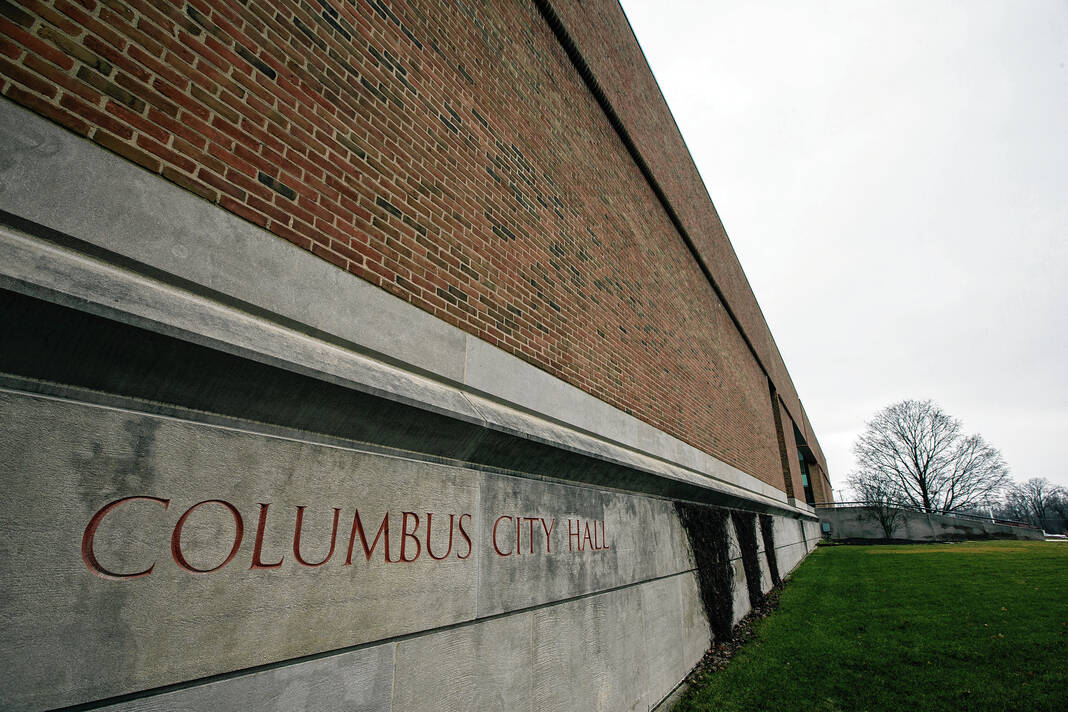
City officials approved an update to the city’s stormwater management ordinance, brought about because of changes made by a state regulator.
Columbus City Council members passed the second reading of an ordinance that repeals and replaces the city’s stormwater management ordinance, which was last updated in 2008.
Stormwater is defined as any surface load runoff and drainage consisting entirely of water from natural precipitation, resulting from such precipitation, City Engineer Andrew Beckort explained to council members.
Stormwater is managed during construction and regulated by the Indiana Department of Environmental Management (IDEM) and the United States Environmental Protection Agency (EPA).
In the past, IDEM regulated stormwater through Rule Five, according to Beckort, which required sediment erosion control measures and a permit for any disturbance greater than an acre. But in December 2021, IDEM shifted what governs permitting coverage from Rule Five to the construction stormwater general permit (CSGP).
The CSGP is a “performance-based regulation designed to reduce pollutants that are associated with construction and/or land disturbing activities,” Beckort said during the first reading of the ordinance on Nov. 6.
The CSGP will be processed by the city’s stormwater coordinator as part of the city’s MS4 program, another IDEM regulated program.
The new ordinance will mean slight tweaks to the city’s stormwater permitting process, Beckort said.
Previously, the city had one permit for any site disturbance greater than one-acre, with an associated fee between $75 and $100 depending on the disturbance.
The new ordinance involves three different permits— a blue permit for projects with a land disturbance 0.5 acres or larger, a green permit for projects with a land disturbance between 0.25 acres and 0.5 acres, along with an individual residential lot permit. The blue and green permits have application fees of $400 and $200, Beckort told council members. The individual residential lot permit does not come with an application fee.
In addition, IDEM now requires that the city inspect all private stormwater quality measures installed since 2008 every five years. Property owners will need to submit an inspection report annually by May 1 outlining the measures, and then a consultant hired by the city will verify what was submitted is correct.
This will be done at no cost to the property owner, Beckort said. Due to staff limitations, the city will hire a third-party engineering firm to complete the review.
The updated stormwater ordinance also has new penalties for violations. The previous ordinance had fines at $50 per day, per violation. The updated ordinance uses a penalty matrix, with fines ranging from $150 to $7,500.