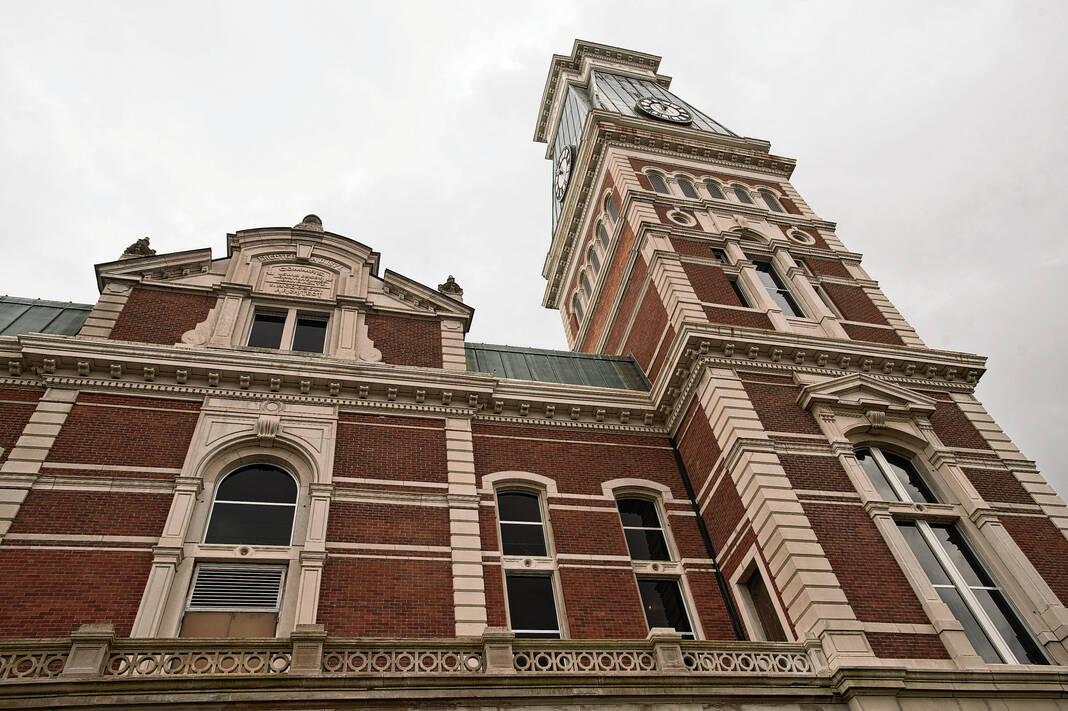
The exterior of Bartholomew County Courthouse in Columbus, Ind., pictured, Thursday, Sept. 29, 2016. Mike Wolanin | The Republic
An upcoming celebration of the 150th anniversary of the Bartholomew County Courthouse has been postponed.
The event, originally scheduled for Dec. 5, is being delayed until next year due to the extensive $3.28 million courthouse renovation that has been underway since March.
If the celebration was held as originally planned, there would have been very little to see, event co-organizer Bonnie Boatwright said.
“We would only be allowed into the entry way before we would have to turn around and walk out,” Boatwright said. “Nothing else would be available to the public.”
But does this means that there will be no official commemoration on the courthouse’s landmark anniversary? Boatwright said the answer to that question is a matter of perspective.
In an architectural sense, 2024 is the 150th anniversary of the completion of the Bartholomew County Courthouse.
However, judges including Kelly Benjamin of Bartholomew Circuit Court believe the years should be counted from when the Issac Hodgson-designed courthouse became functional. The first day that county offices opened and hearings were conducted was Monday, Jan. 4, 1875, according to reports in the Columbus Republican, the predecessor to The Republic.
So now, 2025 becomes the landmark anniversary year. The plan is to wait until the renovation is completed, which should be prior to May. The Bartholomew County commissioners, who have authority over all county buildings, will then be asked to reschedule the 150th anniversary celebration, so it can include full tours, Boatwright said.
A banner that commemorates the 150th anniversary is expected to be put up at the courthouse before the end of this year, she said.
It will be difficult for the upcoming celebration to match the pomp of the courthouse dedication on Dec. 29, 1874.
Judicial dignitaries and their wives from as far away as St. Louis, Missouri, arrived in formal attire for the event, Boatwright says. In addition, journalists from throughout the Midwest were assigned to cover the event, the Republican wrote.
“The (courthouse) is the finest, most elegant and costly building by all odds, in the state,” according to an article in the Louisville Courier-Journal. “It is a noble structure and an honor to the people of this state, as well as of the county.”
But in written accounts of the behavior displayed during the dedication, the newspapers had varying descriptions.
Columbus Republican editor Issac M. Brown said that “considering the immense number present, a better conducted and managed affair has seldom been witnessed in our state.”
But the newly-formed Seymour Weekly Star reported the event was held “with much noise of music, speaking, dancing and kicking up of heels generally.”
In a newspaper column written 10 months before his death, Hope founder and Moravian minister Martin Hauser wrote that while the dedication was “good in its place,” the rowdiness on the second floor was a different matter.
“Perhaps a little too much eating and dancing,” Hauser stated. “And brandy, rum and gin were not unknown.”
On Jan. 4, 1875, the judges, elected officials and their staff got to work. Jeptha Stucker of Ninevah Township received the dubious distinction of becoming the first person to pay taxes at the courthouse.
The first large-scale criminal matter involved defendant Joseph Knott, who had no less than eight cases filed against him. On Jan. 12, 1875, police discovered his Columbus home had been turned into a depository of stolen goods, which included 300 bushels of wheat crammed into one room. The grain was used to hide other stolen items, police said at the time.
Investigators said they believed Knott was associated with a gang of outlaws that extended from Indiana into Ohio, Kentucky and Pennsylvania.