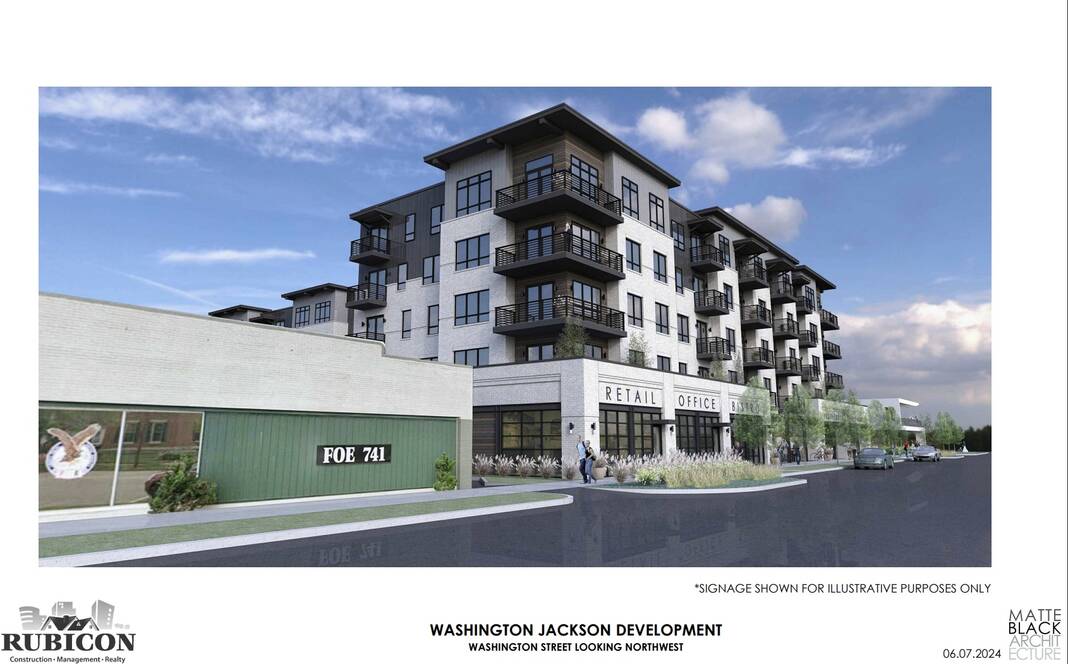
Photo provided An artist’s rendition of the Rubicon project, a planned five-story, 120-unit apartment building that would cause the demolition of a drive-thru bank at 921 Jackson St. and house with historical ties at 1008 Washington St.
Columbus City Council members gave final approval for what will be a five-story 120 unit mixed-use development, at the corner of 11th and Washington streets in downtown Columbus.
In a packed council chambers and amidst high emotions on Tuesday night, members voted 5-3 to approve the second reading of an ordinance authorizing a direct loan of $6.4 million to Bloomington-based Rubicon Development to cover a financing gap for the $30.9 million project, which will include apartments, commercial space and a parking garage on three parcels at 921 Jackson St. and 1008 and 1020 Washington streets.
Councilors Grace Kestler, D-at large, Jerone Wood, D-District 3 and Jay Foyst, R-District 6 voted against the measure. Council member Chris Bartels, R-District 1, was absent.
Council members in favor of the project view it as a means to revamp a gateway into the city that’s remained dormant and said the 120-units it would bring are helpful in working towards reaching needs for housing identified in the city’s recently completed housing study, as well as increasing density.
The study showed a total demand of 3,628 units through 2035, made up of 1,995 owner-occupied and 1,633 renter occupied units, spread across all price-points.
Members disagreed, however, about whether another mixed-use development downtown would actually bring more people to the area and if the city should be subsidizing this type of development, given the pricing of the units would not be affordable for a sizeable chunk of the community. Some, like Bartels previously and Kestler, have called the project a form of gentrification.
The development is the third housing project that received approval this year, joining affordable housing developments in Thrive Alliance’s Haw Creek Meadows and TWG’s Flats on 14th, which will bring 174 units of affordable housing to Columbus. The city this year will have contributed $9.1 million total towards affordable housing and homelessness projects and initiatives, in the form of TIF funds, federal American Rescue Plan (ARP) funds and a payment in lieu of taxes agreement.
During about 40 minutes of public comment, several members of the Historic Downtown Neighborhood Alliance, made up of community members who live near the project site, voiced impassioned opposition to the project as they have done throughout the past calendar year since the local government process on it began.
After members of the Alliance spoke, applause filled the room. Among their concerns are the development’s price-point, comparable size to the nearby area, look and its perceived encroachment on the city’s architectural identity.
Another issue repeatedly brought up by those opposed to the project is that there is an environmental covenant placed on the site, meaning groundwater there is contaminated. A 2019 letter from the Indiana Department of Environmental Management (IDEM) states that there are environmental restrictive covenants placed on 1008 and 1016 Washington streets, along with 921 Jackson St. This is because 1016 Washington used to be the site of a drycleaning facility in the 1960s and 1970s and chemicals used during the cleaning process seeped underground.
The letter, dated Sept. 19, 2019, said that private wells shouldn’t be used on the property, but otherwise says that “no further response actions are required provided that current and successive owners of the site comply with the requirements and restrictions contained in the (environmental restrictive covenant) and (environmental restrictive ordinance).”
Rubicon is proposing a type of expensive underground detention system to address drainage issues, which community members have questioned, wondering if there would be any danger to excavating on the site. City officials said a similar system is under The Taylor and NexusPark.
According to site plans, the development would include a ground floor with 51,000-square-feet for parking and 5,300-square-feet of first-floor commercial and tenant common space, 2,600 square-feet of which are for commercial.
Floors two through five will be 32,000 square feet each for residential space, including eight three-bedroom units, 40 two-bedroom units, 48 one-bedroom units and 24 studio units.
Studio units would be $1,320 per month, one-bedroom units $1,435 per month, two-bedroom up to $2,167 per month and three-bedroom units up to $2,376 per month, according to Rubicon.
The developer will designate 10% of the building to be reserved for workforce housing, factored at a 20% discount. Rubicon representatives have said they define workforce housing as for those making between 80% and 120% of area media income (AMI), which is about $72,000, meaning someone making $60,000 would be eligible for the discounted units.
Redevelopment financial adviser Andrew Lanam said the $6.4 million coming from the central tax-increment financing (TIF) district would be recouped in 21 years.
Redevelopment also commissioned a return on investment analysis over the life of the 25-year life of the new TIF, done by Ed Curtin of CWC Latitudes LLC. Curtin is also the former executive director of the Columbus Redevelopment Commission from 2007 to 2015.
Curtin’s analysis found with the $6.4 million the city is providing, it would receive nearly $159 million “in ancillary benefits” over the life of the TIF, almost a 25-to-1 return. In addition, the project would generate $336,467 in new taxes annually, according to Curtin’s analysis. Currently, the property generates $20,518 a year.
Dale Nowlin disputed a number of Curtin’s calculations and assumptions built into them, including that 30 students would live in the development, its economic impact over 25 years and the additional property taxes that would be brought in, which assumes nothing else would be built on the site.
“The worksheet has $117 million in impact from the jobs of people living in these 120 apartments. These residents are not new to Columbus and their jobs are definitely not new to this project. It’s misleading to say that this new money was brought here by this project,” Nowlin said. “… Overall, the return on investment is off by at least $140 million.”
Mike Mullett wondered if the developer would ask for additional TIF money as they look to remake the adjoining area of 1034 Washington St., where they have previously proposed a restaurant. He has also said he does not believe the city is using TIF funding in the way it was intended, pointing in part to how the project is fueled by $9.6 million of public subsidy, made up of the $6.4 million in TIF and $3.2 million in redevelopment taxes from the Indiana Economic Development Corp., three times the amount of cash equity Rubicon is putting toward the project.
Lanam has said that the incentive structure of the project is similar to one’s he’s seen across the state.
Marc Rape, who lives on Franklin Street, brought up the manner in which the home at 1008 Washington was quickly demolished the day after council approved the project agreement for the development on Dec. 3. Dumpsters and an excavator were already on site before the vote that night and the house was demolished soon after.
“If we can’t trust them to demo a home with public safety in mind, should we be trusting them with $6.4 million of our money?” he asked.
After a complaint, an IDEM inspection on Dec. 5 found that there was “failure to submit written notice of the intention to demolish the residential building,” but noted the Office of Air Quality would not be taking any legal action. IDEM stopped the demolition for a short period of time to inspect for any potential asbestos, but gave contractors the all-clear to finish up the next day.
Rick Sprague, the owner of 1008 Washington and 921 Jackson streets, apologized for the timing of the demolition during the meeting, but reiterated that attempting to move and restore the property would have been prohibitively expensive, and stressed the need for more residents downtown.
The former drive-thru bank at 921 Jackson St. was already torn down by Wednesday afternoon.
Council member Kent Anderson, R-District 5, said he appreciated the community engagement in the process, as other councilors mentioned, saying he supported the project from an economic development standpoint.
“When people come to invest in our town, I can promise you the first place they come to before they go to industrial park, is downtown,” Anderson said. “If the downtown is not healthy, it’s telling you about the health of the community at-large and you will lose investors.”
Anderson went on to compare the downtown of Columbus with Seymour’s and Franklin’s, saying the city is falling behind their peers, something Ike DeClue of the Office of Downtown Development has discussed in past meetings.
“I believe if we provide housing at any level that is helps satisfy demand and that has effects across the entire spectrum. So even though this is higher-end, it will have positive effects on the lower-end,” Anderson continued.
Wood said he understood the need for density downtown and bringing more residents to the area but questioned moving forward with the project given “the outcry from our community members telling us we are not in favor of this.”
Council Member Foyst also shared the same sentiment after having voted for the project during the last meeting, saying that “even though I don’t live downtown, these people are my neighbors.”
“Not everyone works at Cummins, not everybody’s an engineer, there’s a lot of school teachers, there’s a lot of police officers— a lot people have regular jobs,” Wood said. “We can’t afford that.”
Kestler spoke similarly last meeting regarding how a third of community households earns less than $50,000 a year, and therefore couldn’t afford to live in the development, and suggested the city look into requiring developers to set units aside that are even 50% AMI.
“I think we can all say salaries are not keeping up with the cost of living— that’s just a reality,” Kestler said. “… If they’re not interested in setting those units aside, the developer has to pay a fee per unit into an affordable housing fund. Many other communities do this.”
Josh Burnett, council member, R-at-large, agreed with some of what Wood had to say about how activity in the downtown is lacking. Wood asserted that having things to do downtown—not housing— would be more helpful towards reactivation.
“There’s not a lot to do downtown more than pop-up events here and there,” Burnett said. “We’ve been focusing so much on the individual and forgetting something that really makes Columbus special, and that is the multi-generational family that chooses Columbus. I think if we can lean into the activities that are accessible along with housing, you don’t just attract people, you keep them. Not just for a little bit, but for 60 years or more.”
Wood, who previously worked as a leasing manager, listed 11 market-rate apartment complexes in Columbus, saying “In my opinion, that’s quite a few market-rate apartments. None of them are at 100% occupancy rate. None of them. And they’re not going to be, because what we’re doing is— we’re just going to build more.”
Council President Frank Miller, R-District 4, lamented “accusations” that had been made at some of those in the city during the process, saying that he likes some aspects of the project and dislikes others, but trusts the experience of those hired by the city and those who had gotten the project to this point.
“The city pays quite a bit for financial and legal expertise. The council has to rely on that expensive financial and legal expertise on a regular basis, whether it’s this topic or a lot of other topics that come before the council and (we) always have, always will,” Miller said. “… Everyone in this room is not an expert. We aren’t experts, you aren’t experts. But we do pay quite a bit for that expertise, and if we’re not listening to that expertise that we’re paying for, we’re not doing our job.”
Rubicon representatives have said they hope to break ground on the project this summer and start leasing around the spring of 2027.