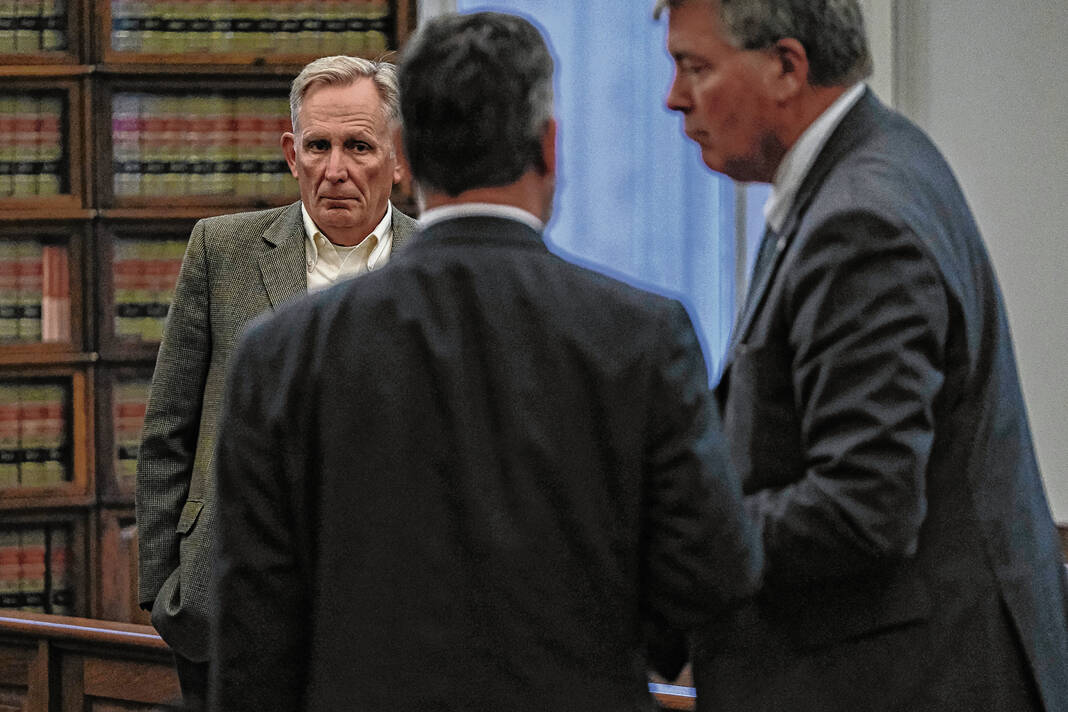
Mike Wolanin | The Republic Columbus City Council District 6 candidate Joseph Jay Foyst, from left, watches as attorneys Ross Thomas and and Peter King, representing the Bartholomew County Election Board, talk after a pretrial hearing for Thomas’ lawsuit against Joseph Jay Foyst and the Bartholomew County Election Board at the Bartholomew County Courthouse in Columbus, Ind., Monday, Oct. 16, 2023.
INDIANAPOLIS — The Indiana Supreme Court has invited briefs from interested groups or individuals, including Indiana Attorney General Todd Rokita, who may have expertise to offer on the long-running legal battle over the validity of a Columbus City Council member’s candidacy in the 2023 municipal election.
The state’s high court on Thursday published an order inviting amicus curiae briefs in the dispute over Columbus City Council member Joseph “Jay” Foyst’s candidacy in the 2023 election. An amicus curiae brief is a written submission to a court by an individual or organization not directly involved in a case, but one that possesses relevant expertise or perspective.
The case has been pending before the high court since August, when Foyst filed a petition asking the justices to take up the case after an appellate court unanimously ruled that he was not a valid candidate for Columbus City Council District 6 and directed a trial court to declare his opponent, Democrat Bryan Muñoz, the winner of the election.
While Foyst has asked the Indiana Supreme Court to take up the case, the high court has no obligation to do so. If the justices decide not to hear the case, the appellate court decision will be final.
Neither party in the lawsuit — Bartholomew County Democratic Party Chair Ross Thomas and Foyst — can file amicus curiae briefs. However, they can file responses to briefs submitted to the high court should they feel the need to.
The deadline to submit an amicus curiae brief is Jan. 31, according to the order from Loretta Rush, Chief Justice. The deadline for any responses is Feb. 20.
The legal fight over Foyst’s candidacy started in summer 2023, when Foyst was initially selected as the Republican nominee for Columbus City Council District 6 in the 2023 municipal election during a party caucus held in July 2023 after nobody filed to run for the seat in the GOP primary, leaving a vacancy in the Nov. 7 general election.
Thomas challenged Foyst’s candidacy, arguing that local GOP officials failed to file a required notice of the party caucus with the Bartholomew County Clerk’s Office before the state-imposed deadline. In August, the bipartisan Bartholomew County Election Board upheld Thomas’ challenge and removed Foyst from the ballot.
However, the Bartholomew County Republican Party decided to hold another caucus and selected Foyst once again to fill the vacancy, pointing to a section in the Indiana Code that allowed the GOP to fill the vacancy following “the successful challenge of a candidate.”
Thomas then attempted to challenge Foyst’s candidacy again, but his request was denied by Bartholomew County Clerk Shari Lentz because the deadline had passed to file a challenge, prompting Thomas to file a lawsuit against Foyst and all three members of the Bartholomew County Election Board, including Lentz.
The case was initially assigned to Bartholomew Circuit Judge Kelly Benjamin, who recused herself. The case was later turned over to Special Judge K. Mark Loyd. In November, Loyd dismissed the claims against the Bartholomew County Election Board, leaving Foyst as the lone defendant.
While the lawsuit was pending before the special judge, Foyst won the Columbus City Council District 6 seat in the 2023 municipal election, defeating Muñoz with 59.5% of the vote.
A couple of weeks after Foyst was sworn into office, Loyd upheld his candidacy, ruling that the additional Republican caucus in which Foyst was elected to fill a vacancy for the party’s nomination for Columbus City Council District 6 met requirements under state law.
Thomas appealed the lower court’s decision.
The panel of appellate judges, for their part, sided with Thomas, finding that “Foyst’s candidacy never existed in the eyes of the law” and therefore could not be placed on the ballot during the second caucus.
Whatever decision the high court ultimately makes will determine which party holds a majority on the Columbus City Council through the end of 2027.
With Foyst on the city council, the Republicans have a 5-4 majority. Should Thomas ultimately prevail in court, the Democrats would have a 5-4 majority.