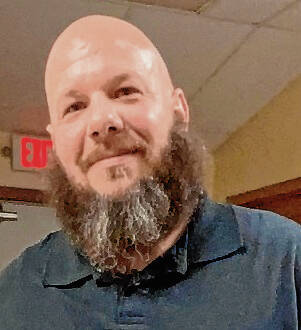
Travis Calhoun
Columbus City Utilities (CCU) board members are discussing beginning to dry biosolids and embarking on a new project to enable that, something officials said is in utility’s best interest for long-term resiliency.
Travis Calhoun, associate director of treatment operations, and Ashley Getz, associate director of engineering, set the stage for board members during a meeting on Thursday explaining how the biosolids program operates now, talked about concerns they had regarding continuing on with the program as is and then presented what biosolids drying would look like and its benefits.
Some of those benefits are — it would produce a biosolid product with wider applications and there would be more landfill options because of the reduced volume and water content from the drying process.
“It’s going to put CCU on the map in the state of Indiana, it really will,” Calhoun said. “And I think it’s going to be the best thing we could do for our biosolids program.”
Drying is not a new technology, but is becoming more popular with increasing regulation, utility officials said.
A $27 million drying installation project could be completed without a rate increase because of wastewater bonds being paid off in 2026, according to utility officials. The utility would essentially be swapping out part of its master plan that called for the construction of new aerobic digesters, which was expected to cost $24.3 million over two phases and would have encompassed continued production of Class B biosolids with a combination of land application and hauling to the landfill.
But aerobic digestion wouldn’t address worries about the continued production of Class B Biosolids and the accompanying landfill limitations, along with concerns about the feasibility of land application of biosolids in the future.
Utility consultants have already completed preliminary engineering studies to confirm the feasibility of constructing a biosolids dryer at Columbus’ wastewater treatment plant, located on South Jonesville Road. Design of the dryer installation would take place this year, with construction in the following two years, becoming fully operational in 2027.
Biosolids are organic materials produced during the treatment of human sewage at wastewater treatment plants, according to the Indiana Department of Environmental Management (IDEM).
Wastewater treatment techniques stabilize and disinfect the biosolids, which contain nutrients necessary for plant growth, including nitrogen, phosphorus, potassium, copper, zinc, calcium, magnesium and iron, according to regulators.
The program as is
Currently CCU produces 12,000 wet tons of Class B Biosolids every year, Calhoun said. Class B treatment processes significantly reduce, but do not eliminate, pathogens in sewage sludge, according to the U.S. Environmental Protection Agency (EPA).
About half of that is applied to farmland in Bartholomew County, while some of the rest ends up at Medora Landfill & Recycling in Jackson County. The Columbus utility pays farmers to do the land application.
If CCU were to transition to biosolids drying, that 12,000 wet tons would be significantly reduced to between 2,200 and 2,400 wet tons a year of Class A EQ Biosolids, which are pathogen-free, have wider applications and can even be sold to the public for use in home gardens or lawns.
Class A EQ (exceptional quality) sludge is treated sewage sludge that meets the most stringent pollutant, pathogen, and vector attraction reduction limits, according to the EPA.
“The problem is storage,” Calhoun said of the current situation. “… We try to do as much land application as we can, because we can land apply for about a third of the price as going to the landfill.”
But landfill costs have been continuing to go up and there’s nothing stopping that trend from continuing, Getz said.
The utility currently spends $500,000 a year on land application of biosolids and hauling them to the landfill, which doesn’t include what officials said are additional costs encumbered by hauling the biosolids all the way to Jackson County.
The 90-mile round trip to Medora beats up on the utility’s equipment. Calhoun said CCU spends $2 per wet ton of biosolids hauled to the landfill every year just to replace tires that get roughed up during the drive.
“We have to go to Medora because we produce so much we can’t use the Columbus landfill,” Calhoun said. “If they open up a new cell, they actually have the right to tell us that we can’t bring any for weeks on end, because they have to get that layer of trash in before they can start accepting biosolids. So there’s times that we could go a month without being able to use the landfill.”
Chief concerns for CCU about continuing on as is include landfill availability and cost, but also what they see as incoming regulations on the horizon.
“PFAS has been a very hot topic in biosolids. There’s no regulations right now, (but) a neighboring county is trying to put regulations on PFAS and biosolids,” Getz said. “So I think it’s coming at some point. And then we don’t know what the future land application regulations are going to be.”
PFAS, or per- and polyfluoroalkyl substances, are a cluster of industrial chemicals associated with a variety of serious health conditions and have been used in products ranging from cookware to carpets and firefighting foams and consumer products since the 1940s.
Research suggests exposure to certain levels of PFAS can lead to reproductive effects in humans, developmental delays, increased risks for certain cancers, elevated cholesterol levels and weakened immune systems, according to the EPA.
“While what we’re doing right now works, we’re concerned for the future and our resiliency as a utility because of these biosolids,” Getz continued, adding these concerns have really come to the forefront in the past year.
“I think it also future proofs us,” CCU Director Roger Kelso said of transitioning to biosolids drying. “This process wouldn’t age out like the land application is. The land application is just not going to be feasible in 15 years or so.”
CCU officials have already had accounting-firm Baker Tilly run the numbers, which said the drying installation project could be done without necessitating a rate increase.
Biosolids drying
Calhoun attended a a Water Environment Federation (WEF) Residuals and Biosolids conference last June in Oklahoma City, obtaining information about what other states are doing with their biosolids. CCU officials later visited three drying installations in Ohio and Wisconsin to get an idea how they operate and began considering what type of dryer CCU would prefer.
“With drying, you can do an 80% reduction in volume,” Calhoun said. “Once you put it in one of these dryers, you go through the permitting process, it’s guaranteed you’re going to get a Class A (Biosolid).”
The permitting process with the state would also be more efficient and would require less paperwork, according to Calhoun.
“It’s going to free up a lot of time, it’s going to give us a better product. More acceptable, virtually odor free,” he told board members.
“There’s so many applications with this. Other states— some of them use a compost so we could do that. There’s fertilizer applications, there’s soil amendments— you could take it and put it on a golf course,” Calhoun said.
While other states have begun drying biosolids, CCU officials indicated they would be among, if not, the first in Indiana to do so.
CCU officials visited drying installations in Mason, Ohio, along with Kenosha and Wisconsin Dells, Wisconsin to look at three different types.
Calhoun said they currently prefer what’s called an indirect dryer.
“They actually run this around the clock and they can look at it on an app on their phone. It looks like it’s going to cut down on some labor involved. It’s definitely going to cut down on trucking, wear and tear, and miles on the truck tires,” Calhoun said. “… That $500,000 savings is probably going to be extrapolated a whole lot more when you break it down with time spent.”