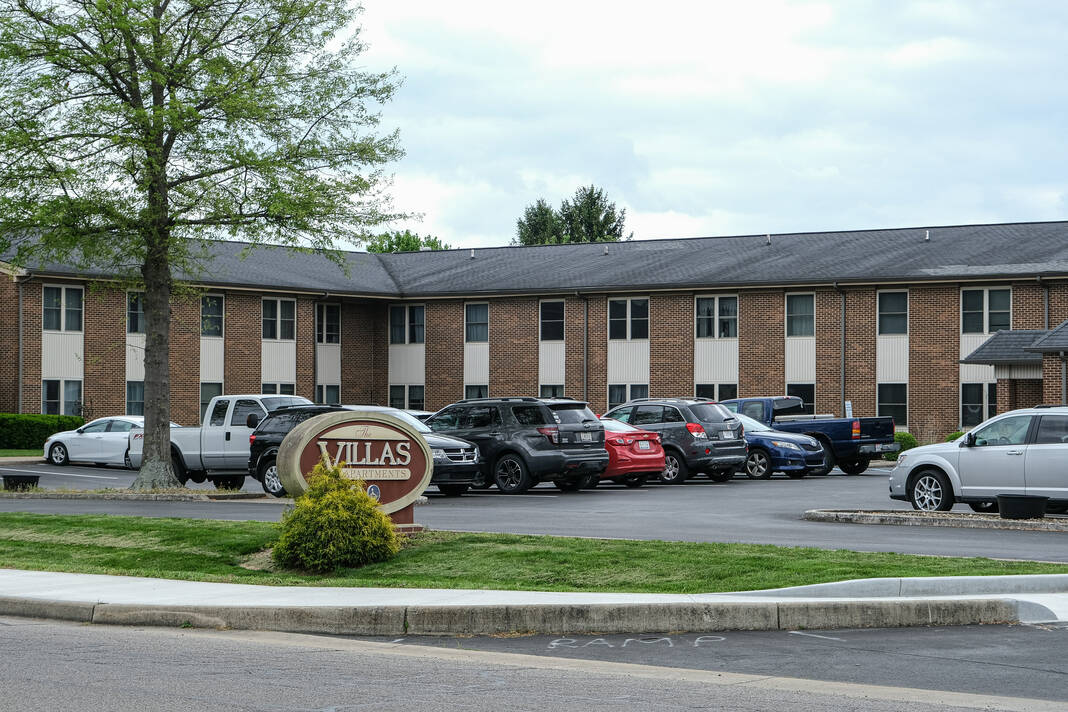
Mike Wolanin | The Republic An exterior view of the Villas Apartments in Columbus, Ind., Monday, April 29, 2024.
Residents of an affordable housing complex in Columbus that was scheduled to close at the end of the month have been given an additional two months to relocate.
The affordable housing complex, the Villas apartments at 4101 Waycross Drive, was previously expected to close by April 30, when property owner BHI Senior Living’s contract with the U.S. Department of Housing and Urban Development (HUD) that subsidizes rent for the residents of the 99-unit complex was set to expire.
HUD has authorized BHI Senior Living to extend the move-out date to June 30 to “provide added time and flexibility for those (residents) still in transition,” said company spokeswoman Megan Ulrich.
“BHI Senior Living remains steadfast in its commitment to supporting the residents of the Villas during this important housing transition,” Ulrich said. “In partnership with the Columbus Housing Authority, residents are receiving the tools and assistance needed to move forward with clarity and confidence. A two-month extension has been granted to provide added time and flexibility for those still in transition.”
The extension comes a few weeks after residents at the Villas, some of whom are elderly and disabled, received a special type of housing voucher from HUD aiming to, among other things, provide assistance to low-income residents who are at risk of losing their affordable housing.
As of Monday, 48 of the 99 units at the Villas were still occupied, Ulrich said. Of the 48 occupied units, 13 have given notice to BHI Senior Living of their plans vacate, while 35 residents have not yet provided formal notice of plans.
Columbus Housing Authority Executive Director Alan Degner told The Republic on Tuesday that most of the residents of the Villas who have made planes to move out have found housing in Columbus, including with private landlords and in local apartment communities.
Degner said previously that some residents had opted to move into assisted living facilities or move in with family.
“It has kind of been a mix across the board,” Degner said Tuesday, of the types of facilities Villas residents have moved into. “We’ve had a few who are leaving Columbus. They’re moving to other locations to be closer to family. …Most are staying in town.”
The decision to close the Villas is part of the company’s strategy to shift away from multi-family housing that does not include a health care component and focus on providing care to older adults through its continuing care retirement communities, company spokeswoman Megan Ulrich said in an earlier interview.
The closure of The Villas will not impact Four Seasons Retirement Community, which also is owned by BHI Senior Living, Ulrich said.
“All residents seem to be in good spirits now that they’ve received their vouchers and are able to move forward with plans,” Four Seasons Executive Director Rebecca Stenner said in a statement. “Many have expressed gratitude — not only for the support and guidance — but also for the stipends that accompany the vouchers, which are helping to ease the financial burden of relocating.”
However, finding a place for these residents to live may not be easy.
Local officials previously said the loss of the Villas’ 99 units “will have a significant impact” on affordable housing in Columbus, as the market for affordable units was already “extremely tight.”
Besides private property owners who offer affordable units, the Columbus Housing Authority owns public housing developments, but the wait list to get a unit is currently about 12 to 18 months, according to its website.
The lowest-income renters across the U.S. are currently facing a shortage of 7.3 million affordable and available rental homes, according to the National Low Income Housing Coalition, or NLIHC, a non-profit based in Washington, D.C., that seeks to end the country’s “affordable housing crisis.”
The shortage has widened since the pandemic struck, growing by more than 480,000 from 2019 to 2022, according NLIHC.
Indiana has a shortage of 139,318 affordable and available units for extremely low-income renters, according to NLIHC. That comes out to about 34 affordable and available units for every 100 extremely low-income renters in the state.
Extremely low-income renters are defined as households that are at or below either the federal poverty guideline or 30% of the area median income, whichever is greater.
At the same time, larger cities in Indiana do not appear to be faring better than Columbus in terms of affordable housing, according to HUD’s database and U.S. Census Bureau population estimates.
Overall, Columbus currently has more affordable housing units per capita than Indianapolis, Fort Wayne and Evansville and has a lower poverty rate. Even with the loss of the Villas, Columbus would still have more affordable units per capita than many Indiana communities, including Kokomo, Terre Haute and Bloomington.
In the meantime, officials said the two-month extension should take some of the immediate pressure off residents, who previously had less than month to find a place to live after receiving their vouchers.
“It will take a little of the pressure off (residents),” Degner said. “…Some of that pressure off allows them to interact with landlords, better identify where they want to go and take their time to make the best decision for them.”