Mike Wolanin | The Republic A view of the Driftwood River and the Lowell Road bridge in Columbus, Ind., Wednesday, Aug. 30, 2023. Levels of polyfluoroalkyl substances or PFAS above acceptable EPA limits were detected in fish in this portion of the river. Polyfluoroalkyl substances (PFAS) are man-made, long lasting chemicals that break down very slowly in the environment that present a health hazard for humans and animals.
Columbus’ utilities director said he does not expect the U.S. Environmental Protection Agency’s decision to weaken limits on some toxic “forever chemicals” linked to cancer and other illnesses to impact local operations or water quality.
Last week, the EPA announced plans to rescind restrictions on certain types of per- and polyfluoroalkyl substances — known as PFAS — and extend deadlines for utilities to comply with national standards governing two of the most widely used types.
PFAS are a cluster of synthetic chemicals that have been used since the 1940s in a wide range of products, including nonstick cookware, carpeting, firefighting foams and food packaging. Often dubbed “forever chemicals,” they degrade slowly in the environment and can remain in a person’s blood indefinitely.
In 2023, Columbus shut down a municipal well near Garden City after state regulators detected elevated levels of PFAS. However, follow-up testing conducted after the well was taken offline did not find concentrations in the city’s drinking water that exceeded federal thresholds set to take effect in the coming years.
Columbus’ drinking water met all federal and state drinking water standards in 2023, according to the utility’s most recent water-quality report.
“I don’t think it really has a lot of impact right at the moment,” said city utilities Director Roger Kelso, referring to the changes announced by the EPA. “…By shutting off that one well, we were able to get ourselves within the standards that are required.”
The move from the EPA comes just over a year after the Biden administration finalized the first federal drinking water limits on PFAS, citing growing evidence that exposure to the substances increases the risk of cardiovascular disease, certain cancers and low birth weight in infants.
The Biden administration’s rule set standards for the two most common types of PFAS — known as PFOA and PFOS — at 4 parts per trillion in treated drinking water, effectively the lowest level at which they can be reliably detected. The EPA will keep those standards but give utilities two extra years — until 2031 — to comply.
However, the EPA said it plans to scrap limits on three other types of PFAS — including PFHxS — that the Biden administration had set for 10 parts per trillion each, as well as other limits on their combined amount, including some mixtures containing PFBS.
To put the limits in perspective, one part per trillion is roughly the equivalent of a single drop of water in 20 Olympic-sized swimming pools, experts told The Republic previously.
The EPA’s announcement also comes nearly two years after several types of PFAS — including PFOA, PFOS, PFHxS and PFBS — were detected in the aquifer that supplies Columbus with drinking water, particularly in one well, where concentrations were found to be “literally an order of magnitude higher” than in other wells, officials said previously.
The well, which city officials took offline in 2023, was located between Garden City and railroad tracks on the south side of Columbus.
In the now-closed Columbus well, PFOA was detected in untreated water at 45 parts per trillion and in the city’s finished drinking water at 7 parts per trillion, according to IDEM, which conducted the tests.
After the well was closed, follow-up state testing did not detect PFOA in Columbus’ finished drinking water.
PFOS was detected at 9 parts per trillion in a sample taken from one city well and at 2.2 parts per trillion at another well but was not found in finished drinking water.
PFHxS also was detected at 6.3 parts per trillion in the well that was shut down but was not detected in finished drinking water.
PFBS was detected in nine different municipal wells in Columbus, including at 40.9 parts per trillion in the well that the city shut down and ranged from 3.1 to 14.2 parts per trillion in the other eight wells. It also was detected in the city’s finished water during follow-up testing at 3.7 parts per trillion, which Kelso said was “well within the guidelines.”
“It’s there, but it’s so low compared to what the limitation is that it’s really not an issue,” Kelso said.
Officials have said it is hard to identify the sources of the PFAS contamination or how long the chemicals had been there but have suspected that it may have originated locally from surface contamination.
Parts of the aquifer system in Bartholomew County “lack overlying clays” and are “highly susceptible to contamination from surface sources,” according to the Indiana Department of Natural Resources. The rest of the aquifer system in the county is classified as “moderately susceptible to surface contamination.”
Officials suspect that the general area near the well that was closed in Columbus may have been used to store several types of chemicals over the years.
PFAS also have been detected in fish caught in rivers in Bartholomew County in recent years.
Testing by the IDEM has found PFOS in tissue samples of several species of fish in the Driftwood River and East Fork White River in Bartholomew County since 2017, including longear sunfish, smallmouth buffalo, freshwater drum, spotted bass and rock bass.
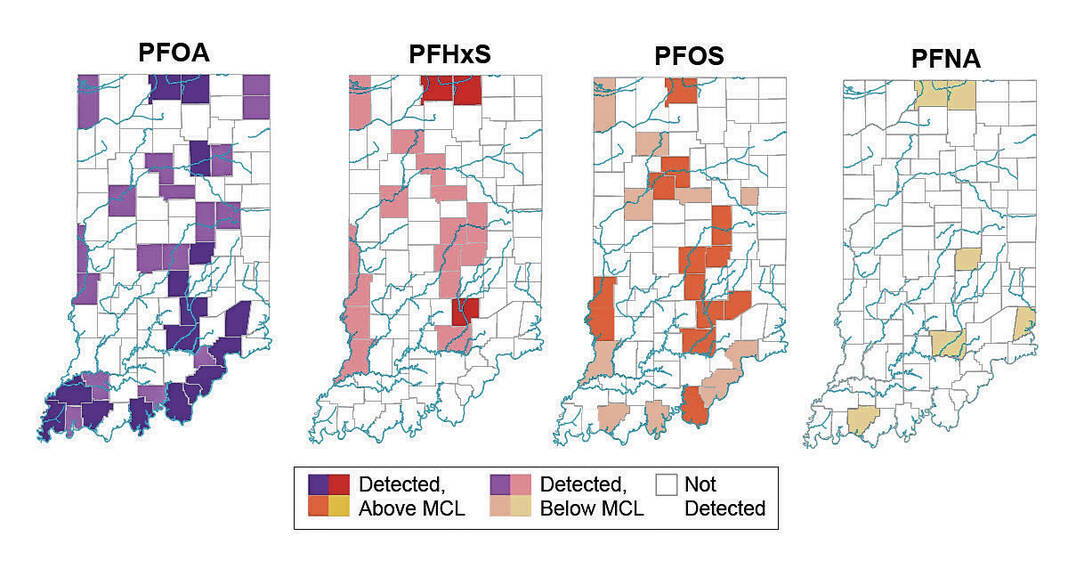
Last week, Purdue University’s Institute for a Sustainable Future released the first Indiana Statewide PFAS Assessment report summarizing the uses of, exposures to and sources of contamination from PFAS across the state.
“Indiana does not have any fluorochemical production plants in the state,” according to the report. “PFAS-using industries in Indiana include manufacturers of electronics, pharmaceuticals, adhesives and paper products, among others.”
In the meantime, Kelso said Columbus City Utilities is planning ahead to ensure it can adapt to future regulatory changes, including the potential need for expanded treatment capabilities for PFAS.
“We are making provisions that if additional treatment (for PFAS) should be needed or required with the new plant improvements and that sort of thing, we’re making sure that it would be possible to add another phase of treatment in order to the removal,” Kelso said.
“We’re just kind of waiting to see (how) the rest of this rolls out,” Kelso added. “…I think we’re prepared to do something should additional regulation come on and we’re required to add something to our treatment chain.”