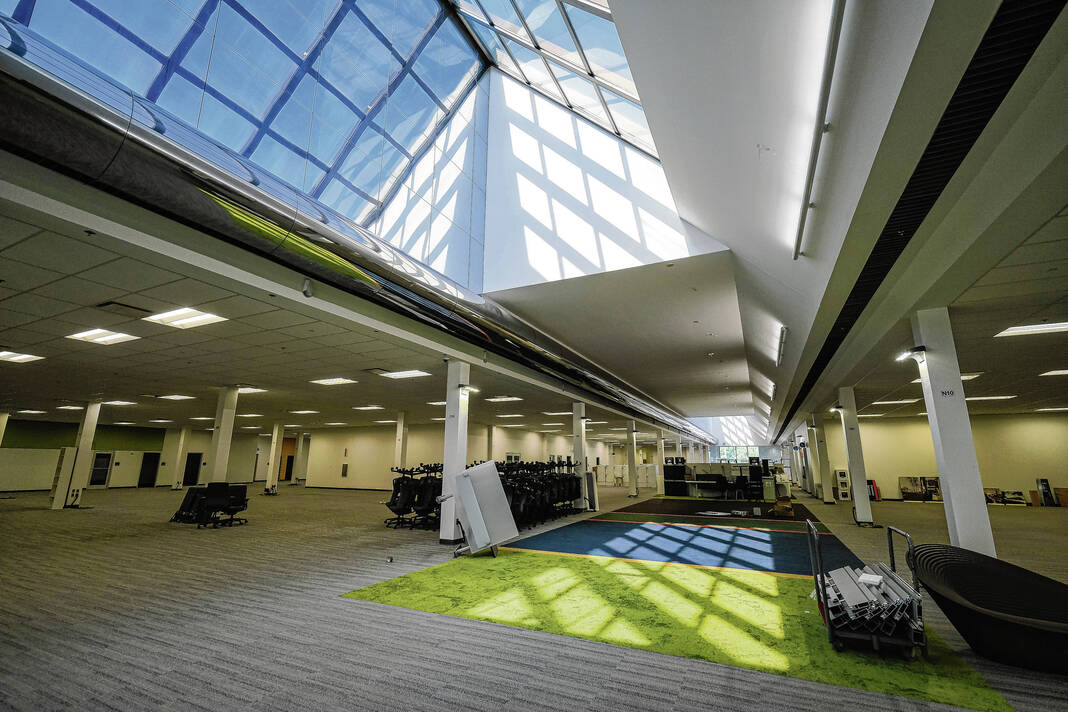
Mike Wolanin | The Republic An interior view of the former Sears building recently owned and occupied by Cummins in Columbus, Ind., Friday, May 24, 2024. The City of Columbus recently purchased the building from Cummins.
Columbus City Council members finalized an appropriation to pay for expenses incurred after the city’s redevelopment commission took ownership of the former Sears Building last summer.
During their meeting on Tuesday night ,the redevelopment department asked for an an additional appropriation of $324,925 out of its own “Fund 4451,” also known as the Redevelopment District General Fund. It was required that redevelopment receive consent from the council because the appropriation is beyond what the department initially budgeted for 2025.
The redevelopment district general fund is fueled through interest income from the city’s tax-increment-financing (TIF) districts, as well as rental income from YES! Cinema.
The expenses were in part the result of a leak in the fall that damaged the facility. The damage was not covered by insurance because the building was vacant at the time. Other expenses were in the form of property taxes owed on the building that city officials thought would be waived.
Councilors finalized the appropriation on second reading 7-0, with members Chris Bartels, R-District 1, and Josh Burnett, R-at-large, absent. The matter was discussed at length during their last meeting, but was wrapped up rather quickly the second time around.
The Columbus Redevelopment Commission on March 18, 2024 entered into a purchase agreement with Cummins to acquire the 91,380-square-foot property at 323 Brown St., including the adjoining parking lot, for just over $4.2 million.
City officials have said that they intend to move quickly and not possess the building for long, and that the building’s ultimate use is contingent on what comes out of the new downtown strategic plan, Downtown Columbus 2030, which is going to be finished by the end of next month.
The Columbus Redevelopment Commission currently owns more than 10 downtown properties including the parking lot at Second and Franklin streets, former location of the probation center at Third and Franklin streets, three behind city hall on Water Street and others, whose uses will be informed by the downtown plan.
Redevelopment has money in its general fund to pay for the additional expenses. According to financials provided to The Republic, the fund is estimated to end the year with about $2.7 million, even with the additional appropriation.
The former Sears Building had been vacant since the pandemic struck, with no Cummins employees working there since October of 2022.
Redevelopment’s purchase of the property was backed by Columbus City Council members during a spirited meeting on May 21 — required because it was a city expenditure greater than $500,000 — but not without a fair amount of discussion from a couple of members and local entrepreneurs who attended the meeting—and the last council meeting as well—who said they had their own plans for the property, which Cummins chose to sell to the city.
The full breakdown of the appropriation request was as follows:
- Flood remediation ($87,027.19)
- Insurance deductible hold ($25,000)
- 2024 Property taxes payable in 2025 ($116,169.30)
- Repair contingency ($25,000)
- Facilities maintenance expenses ($71,728.51)
After the water leak at the former Sears Building in October, the city paid Columbus-based water damage restoration company ServPro $87,027.19 for remediation services in January.
Mike Richardson, the city’s director of security and risk, said the flood event was not covered, in part because the building was sitting vacant. Director of Redevelopment Heather Pope told council members that their insurance company not covering a flood event was a revelation to her in the fall and that it was not asked about during the process of closing on the building.
One of the plastic lines in the facility had sprung a leak, redevelopment officials said and Eric Frey, executive director of administration, told council members during first reading it was due to a valve-pressure issue.
Regarding the property taxes now payable, Pope said redevelopment simply failed to include them in their appropriation request for the 2025 budget and that the matter was an oversight.
Property taxes are generally waived for city-owned properties, but because the state considers ownership as of Jan. 1, 2024— when Cummins still owned the property— property taxes for the full year are required, but would not be next year.
Redevelopment had expected expenses to maintain the building to be at $200,696, including electric, gas and water utilities; service agreements and inspections; and repairs. In actuality, the yearly maintenance expenses landed at $272,424.51.
Council members largely have said that regardless of what they think of the city’s strategy of acquiring downtown property in hopes of ensuring cohesive development, that paying the taxes owed and for the flood services already rendered is a must.
“Like we said before, whether anyone liked the purchase of the Sears Building or not, these appropriations have to be done,” Council President Frank Miller, R-District 4, said. “These taxes and these costs have to be paid.”
“I know this is not ideal, but things happen and I’m happy to move forward with the understanding that we can continue to think about the strategy behind these types of buildings,” Council Vice President Grace Kestler, D-at-large said on Tuesday.
A member of the public, John Bryan Slater, submitted a letter to the council which was read by Clerk Luann Welmer. Slater reiterated comments made previously that he believed the redevelopment commission was engaging “real estate speculation” and urged the city to seek “a private partner to collaborate on this project.”
“While it’s understandable that mistakes can happen, it is unwise to continue on a path where we are not fully equipped to manage the complexities involved,” Slater wrote in the letter.
“I think the council actually probably agrees with a lot of what’s being said there,” said Councilor Kent Anderson, R-District 5. “I think there’s pretty broad consensus on the council that we want to be less in the real estate business going forward.”
“We’ve got the administration doing a great job working on the downtown plan. When the downtown plan’s in place, I think that you can make a lot of decisions about these different pieces of real estate to get them off the city’s books and back into private hands,” Anderson continued.
A second community survey regarding the Downtown Columbus 2030 plan is open and organizers are still seeking input from the public about what the future of downtown Columbus may look like.
The recently-extended survey can be found here, and is available until May 26.