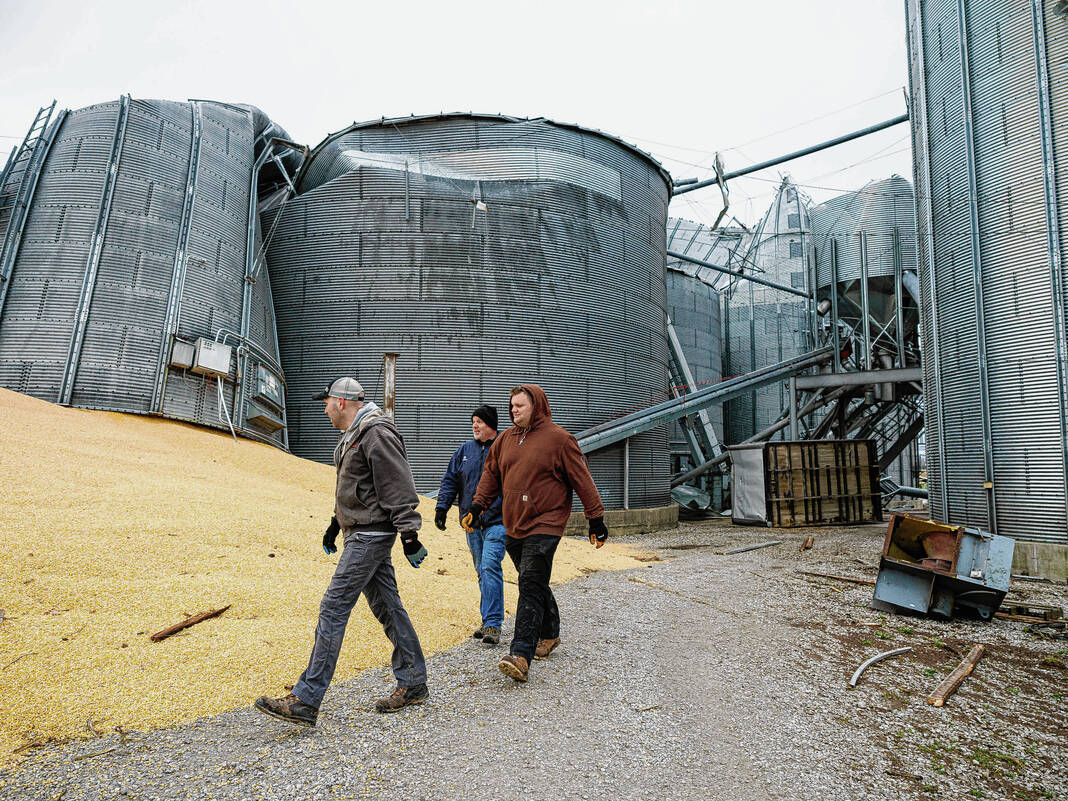
Mike Wolanin | The Republic Nathan Schiefer, from left, Drew Schiefer and Nick Cruser survey damaged silos on the Arnholt family farm after a suspected tornado in Columbus, Ind., Thursday, March 20, 2025.
Two tornadoes in eight weeks. The worst flood in nearly two decades. Bartholomew County is experiencing a spring unlike any on record — and climate scientists say it may be a sign of what’s to come.
As a warming climate fuels a wetter, more unstable atmosphere, the traditional “Tornado Alley” has begun to shift, experts said. No longer confined to parts of Texas, Oklahoma and Kansas, the area of concentrated tornado activity has drifted eastward in recent years — putting Bartholomew County and much of Indiana at a greater risk for destructive weather events.
“(This year) very well might turn out to be an outlier, but it’s not inconsistent with what we’ve been seeing over the last couple of decades,” said Gabriel Filippelli, a professor of earth sciences and executive director of the Indiana University Environmental Resilience Institute.
A spring like no other
For the first time in 50 years, Bartholomew County has weathered two tornadoes in a single season — a milestone hit on May 16, when an EF-2 tornado carved a 35-mile path of destruction across three Indiana counties.
The twister, which had 200-yard-wide funnel by the time it entered Bartholomew County, swept across the Grandview Lake community, with reports of significant damage. Just two months earlier, another EF-2 tornado, with winds of 112 mph and a width of 3.5 football fields, tore through 13.6 miles of southwest Bartholomew County, collapsing metal farm buildings, twisting transmission towers, downing powerlines and hurling debris half a mile.
And between the two tornadoes, another storm system dumped 7.5 inches of rain in the county in just 36 hours, resulting in the third-highest crest recorded in East Fork White River in 112 years and the most extensive flooding in 17 years.
Before this spring, Bartholomew County hadn’t seen two tornadoes in a single year since 1974, and only the floods of 2008 and 1913 surpassed this year’s flood, according to records with the National Weather Service, National Oceanic and Atmospheric Administration and Bartholomew County Emergency Management.
“Since 1999 is how far back I go in a public safety career, and I’ve not seen anything quite like this ever,” said Bartholomew County Emergency Management Deputy Director Mike Snyder.
‘We’re now within Tornado Alley’
For decades, “Tornado Alley” had been largely concentrated in the Great Plains and “kind of touched” the Midwest, experts said. But the atmospheric conditions that made the Great Plains a breeding ground for tornadoes has shifted east.
And over the past decade, tornadoes have become increasingly common in eastern Missouri and Arkansas, western Tennessee and Kentucky, northern Alabama, and Mississippi and parts of Indiana, according to researchers and federal records.
Indiana, for its part, has seen an increase in tornadoes in recent decades, according to records with the National Weather Service.
In the 1990s, the median number of tornadoes recorded in the Hoosier State was around 17 per year. By the 2000s, the median had increased to 26 per year before climbing to around 35 per year in the 2010s.
So far this decade, the median has been around 33 per year, based on records that were current as of this past Sunday.
Typically, the U.S. records just over 600 tornadoes by mid-May. This year, that number has jumped past 850. As of this past Sunday, there had been 44 tornadoes in Indiana this year.
“(Tornado Alley) has shifted over the last 15, 25 years so that now it doesn’t just touch the Midwest, it actually resides in it,” Filippelli said. “…We are now within Tornado Alley.”
“The higher number of overall tornadoes (across the U.S.) might be a bit of an aberration, but certainly, the repeated tornadoes here in Indiana are probably not an aberration,” Filipelli said.
What is causing the changes?
Climate scientists have attributed the eastward shift in tornado activity to the same atmospheric changes that are driving more frequent and intense flooding across parts of the country, including Indiana.
Driven by climate change, warmer global temperatures have been loading the atmosphere with more water vapor, creating the conditions for stronger, more volatile storm systems. Additionally, higher northern latitudes have been warming up earlier during the spring, which is “why Tornado Alley has moved upwards toward us a little bit more.”
“Climate change is doing a number of things to the atmosphere,” Filippelli said. “One of those is warmer air holds more water vapor. So, as the atmosphere has been warming up, it’s actually getting wetter. The water doesn’t just go up into the clouds, it returns back to us. As a consequence of a wetter atmosphere, each individual storm pattern tends to be a little bit more extreme.”
At the same time, low-pressure systems, which are typically associated with rain and storms, are lingering longer over certain regions of the country, bringing extended bouts of precipitation to areas like Indiana.
“They are getting kind of stalled over certain regions for longer than they used to, particularly in this part of the country,” Filipelli said. “That was the case (in April) where it was actually three consecutive days of two- to three-inch rainfalls. If it was just one of those days, it wouldn’t be considered extreme weather because two- to three-inches (of rain) in a big storm is not unusual. But having that big storm system parked over an area and getting that same rainfall for three days in a row is unusual, and that’s exactly why we got the flooding.”
Climate models suggest these trends are likely to intensify by the mid-2040s, Filipelli said. Flooding events have already increased by roughly 15% over the past two decades, and scientists project a similar rise in the coming 20 years—meaning that areas once considered relatively safe from flooding may now find themselves increasingly at risk.
Relatively rare
While Bartholomew County has often seen storms capable of producing tornadoes, confirmed twisters have historically been relatively rare, according to federal records dating back to 1950.
Overall, there have been 21 confirmed tornadoes in Bartholomew County since 1950, including this year’s twisters, according to the National Weather Service and National Oceanic and Atmospheric Administration. About 71% of the local tornadoes have been classified as either EF-1 or EF-2.
While 16 of the 21 tornadoes took place between March and July, there also have been tornadoes in September, November and December.
The last time the county saw two tornadoes in the same year was on April 3, 1974, when a single storm spawned an EF-3 and EF-4 tornado on the same day, according to federal records. The EF-4 tornado, the strongest ever recorded in the county, had a funnel the width of 12 football fields and was on the ground for 35.6 miles.
While climate scientists are projecting more extreme weather in Bartholomew County in the coming decades, local officials said they are doing what they can to prepare.
“I’m certainly not a climate scientist … but I hope that is not the case,” Snyder said, referring to the projections. “I hope that we’re just having an exceptionally rough spring. My hope is that all this calms down and evens out. We’re doing the best we can with what we have … and trying to be as prepared as we can for the next storm coming.”