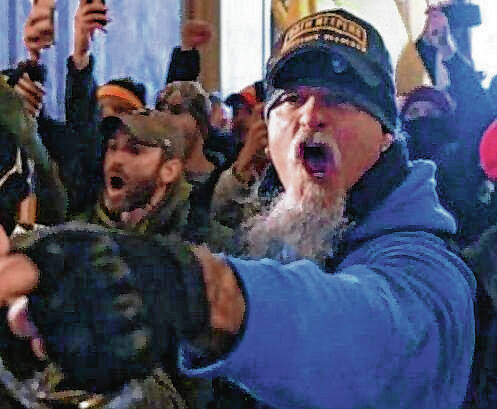
Photo provided Jon Schaffer is facing six federal crimes for his alleged involvement in the Jan. 6 U.S. Capitol insurrection and has filed a motion to dismiss a civil case filed against him by Washington D.C. officials.
WASHINGTON — A federal judge has dismissed a civil lawsuit filed by the District of Columbia against a former Columbus resident over his role in the Jan. 6, 2021, attack on the U.S. Capitol.
U.S. District Judge Amit P. Mehta recently dismissed a lawsuit brought by the office of D.C. Attorney General Karl A. Racine, which had sought to hold former Columbus resident and heavy metal musician Jon Schaffer — along with dozens of others — financially responsible for costs associated deploying hundreds of police officers to protect the U.S. Capitol during the Jan. 6 attack.
The lawsuit, filed on Dec. 14, 2021, accused the defendants of being liable for damages tied to the unprecedented security response.
The damages and costs included transportation, coordination and overtime expenses, as well as costs associated with emergency and other medical treatment for injured officers and paid leave for officers who could not work due to their injuries, according to court records.
Schaffer, who formerly was a musician in the heavy metal band Iced Earth and member of the Oath Keepers, pleaded guilty in April 2021 to, among other things, breaching the U.S. Capitol on Jan. 6, 2021, armed with bear repellent and obstructing an official proceeding.
Just hours after returning to the White House in January, President Donald Trump pardoned, commuted or dismissed the cases of 1,500-plus people charged with crimes in the attack.
The District of Columbia had asked the judge to dismiss the lawsuit with each party bearing its own costs and fees. Schaffer consented to dismissing the case and bearing his own costs and fees, according to court records.
“The Attorney General (for the District of Columbia) has determined that, notwithstanding the virtue and propriety of this case, the District’s limited law enforcement resources must now be committed elsewhere in the service of District residents, taking into account both the growing challenges the District faces and the relatively small recoveries the District stands to obtain on its remaining common law causes of action,” the District of Columbia stated in its request to dismiss the lawsuit.
The District of Columbia also argued in court filings that the defendants’ trial preparations had been “minimal” and the burden of the lawsuit on them had been “limited.”
No trial date had been set, and discovery had not concluded. Schaffer was one of seven defendants who had given a sworn deposition in the case.
A total of 22 defendants responded to the interrogatories and just eight produced any responsive documents, while 16 defendants had default judgments entered against them for failing to participate in the litigation at all, according to court filings.
In January, Schaffer was one of three defendants who took part in mediation with the District of Columbia to potentially settle the lawsuit. The following month, the parties characterized the settlement efforts as “productive” and said they would “continue to work toward settlements.”