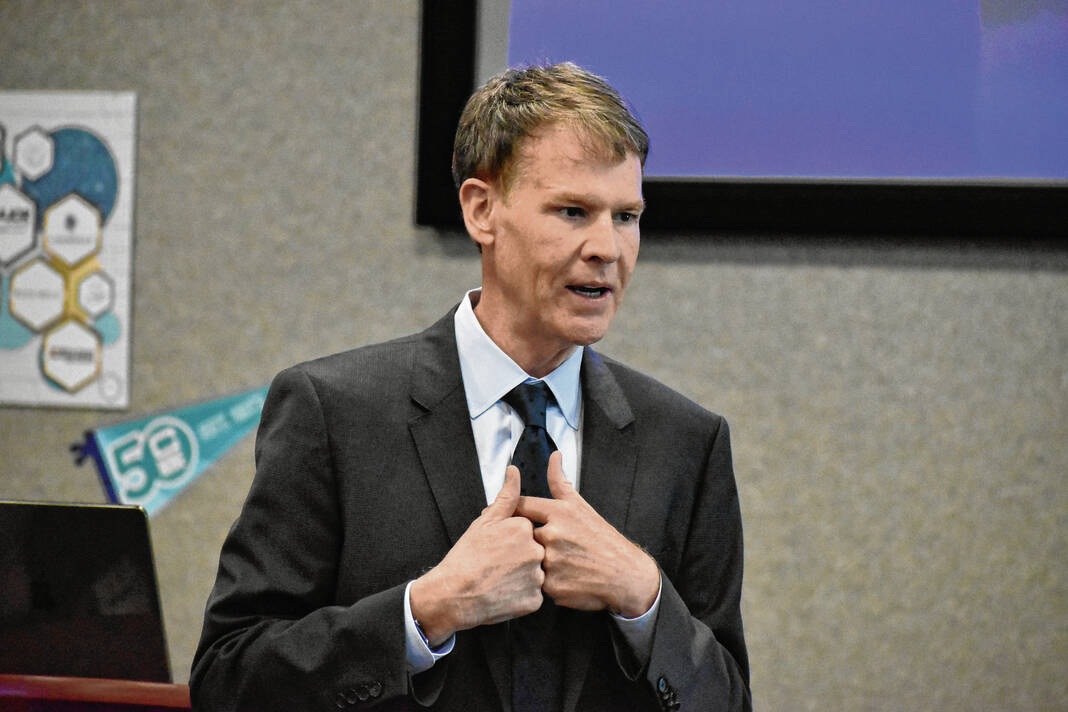
U.S. Rep. Jefferson Shreve, R-Indiana, speaks to members of the Greenwood Rotary Club on Monday at Central Nine Career Center.
Noah Crenshaw | Daily Journal
By Noah Crenshaw | Daily Journal
ncrenshaw@dailyjournal.net
For The Republic
The freshman U.S. Congressman representing Johnson County and southside of Indianapolis spoke in Greenwood about his first few months in office on Monday.
U.S. Rep. Jefferson Shreve, R-Indiana, also discussed his legislation, stock trading, constituent services and more.
The Greenwood Rotary Club invited Shreve to be their guest speaker for Monday’s meeting at Central Nine Career Center. For about a half-hour, Shreve provided updates on what was happening in Washington, D.C., and answered questions from Rotarians and guests.
Shreve told the group he appreciated being able to come to a smaller setting to provide updates, saying he was a “chamber of commerce guy.” Being in front of Rotary groups is “terrific” because anyone can attend if they want to, but it’s “less electrified” than town halls that could attract people from out of the Congressional district to attend, or those who have an agenda, he said.
“I like these opportunities to share what we’re working on,” Shreve said. “It’s your Congress, it’s your government and my aim is to give you some sense of what we are working on.”
What Shreve’s done so far
A member of the House Transportation and Infrastructure Committee, the largest committee in Congress, Shreve serves on the Highways, Aviation and Rails and Pipelines Subcommittees. Currently, lawmakers are working on highway reauthorization efforts, which occur every five years, he said.
“It’s a big piece of money. It’s very important,” Shreve said.
Indiana is a net contributor, but hasn’t gotten its fair share of federal highway fund dollars, he says. The state has gone up a little bit in the rankings, but is still too low. He cited stretches of roadway like Interstate 70 near Richmond as places where more investment was needed.
Shifting to the Aviation Subcommittee, he said the committee was in the process of deploying dollars for “big investments” in the U.S. air traffic control system. The nation has a “dated but durable” system that was suitable for 1970 and needs to be modernized. Doing so will help with hiring more air traffic controllers, as younger people don’t want to work with “such old hardware” that is prone to breakdowns, he said.
Shreve is also a member of the House Foreign Affairs Committee, which he said he worked hard to get a seat on. He became interested in foreign affairs while in college and interned for the late Sen. Richard Lugar, an Indiana Republican who famously worked across the aisle.
Describing himself as a Lugar and Mitch Daniels kind of Republican, Shreve said he believes in free trade and that the U.S. needs to keep its eye on hotspots around the world. The U.S. needs to continue to be engaged in the world.
“Yes, ‘America First,’ but not throw our walls up and cut the rest of the world off,” he said.
One of the main items facing the Foreign Affairs Committee is the reauthorization of the State Department for the first time since 2003. The department has gotten “a little wonky,” and Shreve believes it needs to be refocused on its mission, he said.
In terms of legislation, Shreve has directly authored three bills so far. The Build the Wall Act would use unspent COVID-19 relief funds to fund the construction of a border wall at the U.S./Mexico border, the Protecting Domestic Mining Act, which he says would ensure that mining of materials like coal and mineral refining like coal continues swiftly, and the Stop Scammers Act, which would give federal law enforcement the tools needed to better combat large-scale scams, according to Shreve and his office.
Shreve also highlighted other bills he voted in favor of, but did not author. This includes the One Big Beautiful Bill Act, President Donald Trump’s key budget reconciliation and tax cut legislation now before the Senate, the Laken Riley Act, which mandates the detention of non-U.S. nationals who are arrested or charged with specific crimes, the Halt Fentanyl Act which would give police more tools to address fentanyl and the Save Act, which his office says aims to ensure that only U.S citizens vote in federal elections by altering voter registration requirements. He also co-sponsored legislation to expand the use of 529 education savings plans to cover expenses for trade schools, apprenticeships and aviation-focused programs.
Shreve also offered data on his office’s constituent interactions. Since taking office Jan. 3, Shreve’s office has solved 168 constituent cases, including 16 Veterans’ Affairs cases. Ninety percent of the casework originates from visa requests from U.S. Customs and Immigration Service — specifically visa requests, Social Security, IRS, Veterans Affairs and the U.S. Postal Service. Constituents have received IRS refunds totaling $32,000, according to his office.
Shreve said he can’t fix the U.S. Postal Service, but referencing issues at the U.S. Postal Service’s distribution center on Brookville Road in Indianapolis, he’s trying to fix the issues at the center. His office has also taken several calls from constituents about Elon Musk and the Department of Government Efficiency (DOGE).
Audience questions
The first question Rotarians asked was Shreve’s thoughts on Congress after being part of it. They wanted to know if he felt more empowered or disillusioned. Describing himself as a high-information voter, Shreve thought he knew a lot about what went on in Washington before, but has learned “so much more” than he knew going in. He also knows he has “much more to learn.”
Shreve told Rotarians and guests he feels it is also more collegial on the inside than people realize.
A few moments later, Shreve discussed recent news reports regarding his stock trading. A May 13 report published by news organization NOTUS, citing his recent monthly financial disclosure on trades, said that Shreve traded between $3.44 million and $9.45 million worth of stock trades from April 7 to April 17 while markets dipped after President Donald Trump’s Liberation Day tariff announcement in early April. Some of the stocks Shreve traded in that period were in companies that fall within the jurisdiction of one of his committees, according to NOTUS.
Shreve’s office told the Indianapolis Star that he relied on a financial advisor to make the trades.
In Greenwood on Monday, Shreve told the group he had a “slew of trades” in April, but every trade was within an irrevocable charitable trust that is owned by him and his wife. The trades are not something he or his wife made a decision on.
“We just have a chunk of money that we put into the charitable trust, and I didn’t even know what we had bought and sold until after the period ended and I got the report from the firm we use,” Shreve said. “But I own some stock. Personally, I haven’t traded on anything.”
He also added that he would have more trades to disclose next month.
Other questions focused on getting federal expenses under control. Shreve discussed efforts to shrink the government, like getting rid of the Consumer Financial Protection Bureau and shrinking the U.S. Department of Education.
It’s hard work to “thoughtfully” do some of these efforts, some of which were by DOGE. Shreve thinks some mistakes were made because “you were getting into some muscle tissue in some of that,” he said.
“But time’s not on the side of change agents,” Shreve said.
The government is spending people’s money, but the government needs to be smarter about it, he said. He highlighted the budget reconciliation bill extension of tax cuts, which some have called a tax cut for the rich. But the bill also includes additional cuts, like no taxes on tips and overtime, and makes auto loan interest tax-deductible, Shreve said.
At the same time, though, Congress has to find ways to fund these cuts, which has been difficult. Now, it is in the hands of the Senate, he said.
Shreve was also asked about the need for term limits, to which he said the system is self-correcting since Republican lawmakers tend to leave office sooner than in past years, and whether he took constituent feedback into account. He said he does, telling the group that he receives a weekly summary report of calls that come into his staff, with the number of calls in the 1,500 to 1,800 range.
Shreve’s Greenwood office, 300 S. Madison Ave., Suite 300, is open 9 a.m. to 5 p.m. Monday through Friday, his office said.