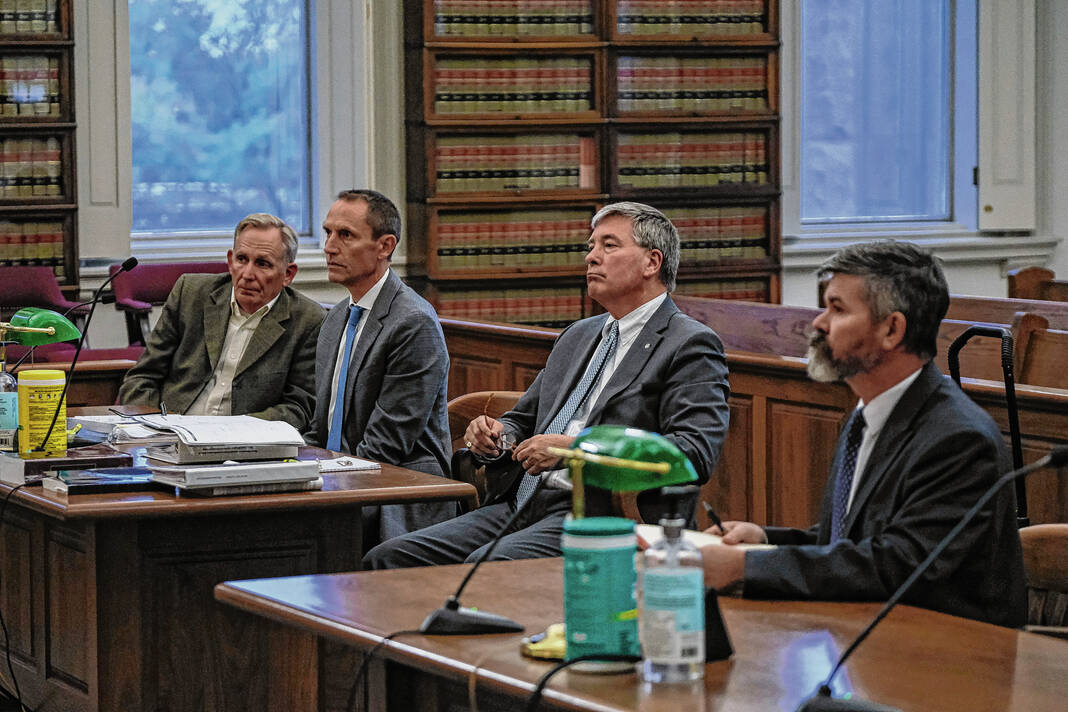
Mike Wolanin | The Republic Columbus City Council District 6 councilman Joseph Jay Foyst, from left, his attorney George “Jay” Hoffman III, attorney Peter King, representing the Bartholomew County Election Board, and attorney Ross Thomas take part in a pretrial hearing for Ross Thomas’ lawsuit against Joseph Jay Foyst and the Bartholomew County Election Board at the Bartholomew County Courthouse in Columbus, Ind., Monday, Oct. 16, 2023.
A long-running legal battle that will determine which party holds a majority on the Columbus City Council remains unresolved three months after the Indiana Supreme Court heard oral arguments — with no indication on when a decision might come.
The dispute — which revolves around the validity of Columbus City Council member Joseph “Jay” Foyst’s candidacy in the 2023 election — has been pending before the high court since August, when Foyst filed a petition asking the justices to take up the case, also known as a petition to transfer.
Foyst has urged the Indiana Supreme Court to hear the case and overturn a unanimous appellate court decision finding that he was not a valid candidate for Columbus City Council District 6 in the 2023 municipal election. The appellate decision also directed a trial court to declare his opponent, Democrat Bryan Muñoz, the winner of the election.
With Foyst on the city council, the Republicans have a 5-4 majority. If Foyst is removed, the Democrats would hold the majority.
This past week marked 90 days since the justices heard oral arguments on whether they should take the case. After about 40 minutes of arguments on March 13, the justices did not make a decision. Instead, Chief Justice Loretta Rush said, “We will be discussing the case and issuing an opinion in due course.”
“I thought the court of appeals, frankly, handled it in a pretty straightforward way and a unanimous opinion that says if you miss the deadline, you can’t be a candidate, which obviously was my position,” Bartholomew County Democratic Party Chair Ross Thomas, who is an attorney and is representing himself in the case, said. “…It would appear the Supreme Court … maybe sees it in a whole different light. But it is certainly their role to review court of appeals opinions and rules (as) they see fit, and I’m sure they will.”
Foyst’s attorney, George “Jay” Hoffman, III, said he was “happy” that the justices were taking the time they need to reach a decision on the petition.
“I’m happy that the Supreme Court is taking whatever time they need to get to the right decision, which from our perspective is to uphold the people’s will,” Hoffman said.
Foyst, for his part, continues to serve on the city council while the appellate court decision finding that he was not valid candidate remains paused as the justices consider taking the case.
Foyst said the uncertainty surrounding whether he will remain on the city council has not been nerve-racking. The high court publishes a list of decisions on transfer petitions each week, meaning that his tenure on the council could end any given week.
“Basically, I’m not thinking about the decision,” Foyst said. “I’m just doing my job. I’m driving my dump truck. I’m umpiring baseball. I’m doing my city council duties. I’m just loving my life.”
“We’re not even thinking about it,” Foyst added later, referring to the pending decision. “I’m just waiting for a phone call one of these days from my lawyer, but we’re just loving life and living life.”
Decision time frames
So far, the high court has taken longer to make a decision on Foyst’s petition to transfer than most cases this year.
This year, the court has ruled on 244 transfer petitions, with complete data available for 224 cases, according to lists of decisions on transfer petitions published by the Indiana Supreme Court that were current as of June 6.
In those 224 cases, the median amount of time elapsed between a appellate court decision and the high court’s decision on a transfer petition was around 111 days, with just 11 of those petitions being granted, or around 5%.
As of June 6, a total of 325 days had elapsed since the appellate court decision in the Foyst case.
The records also suggest a correlation between how long the high court takes to make decision on a transfer petition and outcomes.
For the 11 petitions granted transfer, the median deliberation period stood at around 218 days from the appellate court decision, nearly twice as long as the 110-day median for the 213 denied petitions.
As of June 6, just five decisions on transfer petitions involved cases with a longer waiting period between decisions than in the Foyst case. The justices granted transfer in two of those cases, or 40%.
Among decisions on transfer petitions made this year, the longest wait has been 889 days. In that case, appellate court decision was issued on Sept. 29, 2022, while the decision on the transfer petition came on March 6, 2025.
“Obviously things were delayed by the request for outside briefs, which is pretty unusual in and of itself, and then oral argument, which is also a bit unusual,” Thomas said. “…I think it would be in everyone’s interest to have this decided. But you know, (the justices) obviously have their own timeframe. …So, we wait patiently for the court to rule, which is their prerogative.”
Long-running dispute
The legal dispute dates back to summer 2023 after Foyst was selected as the Republican nominee for Columbus City Council District 6 in a party caucus after nobody filed to run for the seat in the GOP primary, leaving a vacancy on the general election ballot.
Thomas challenged Foyst’s candidacy, arguing that local GOP officials failed to file a required notice of the party caucus with the Bartholomew County Clerk’s Office before the state-imposed deadline. The bipartisan Bartholomew County Election Board upheld Thomas’ challenge and removed Foyst from the ballot.
However, the Bartholomew County Republican Party held another caucus and selected Foyst again to fill the vacancy, pointing to a section in the Indiana Code that GOP officials said allowed them to fill a vacancy following “the successful challenge of a candidate.”
Thomas attempted to challenge Foyst’s candidacy again, but his request was denied by Bartholomew County Clerk Shari Lentz because the deadline had passed to file a challenge, prompting Thomas to file a lawsuit. While the lawsuit was pending, Foyst won the 2023 general election, defeating Munoz with 59.5% of the vote.
The lawsuit largely centers on the interpretation of the statute that the local GOP used to nominate Foyst during the second party caucus. The law states that a political party may take action to fill a ballot vacancy within 30 days following “the successful challenge of a candidate.”
Thomas contends that the statute does not apply to Foyst, arguing that because the party missed the filing deadline, he was “never a valid candidate.”
Foyst’s attorneys have argued that a ballot vacancy — no matter the cause — may be filled under the statute. Foyst’s attorney have further argued that Thomas lacks standing to bring the lawsuit and that removing Foyst from office would disenfranchise voters. Legal standing refers to the legal right to bring a lawsuit.
While a trial court judge sided with Foyst, upholding his candidacy, a panel of appellate judges unanimously sided with Thomas and directed a trial court to declare Muñoz the winner of the election. In August, Foyst filed the petition asking the Indiana Supreme Court to take up the case.
If the Indiana Supreme Court grants Foyst’s petition, that means that the justices have agreed to hear his appeal and examine the legal issues in that case. It does not necessarily mean that they will decide the case in his favor.
If the high court denies Foyst’s petition, that means the appellate court ruling would be final.