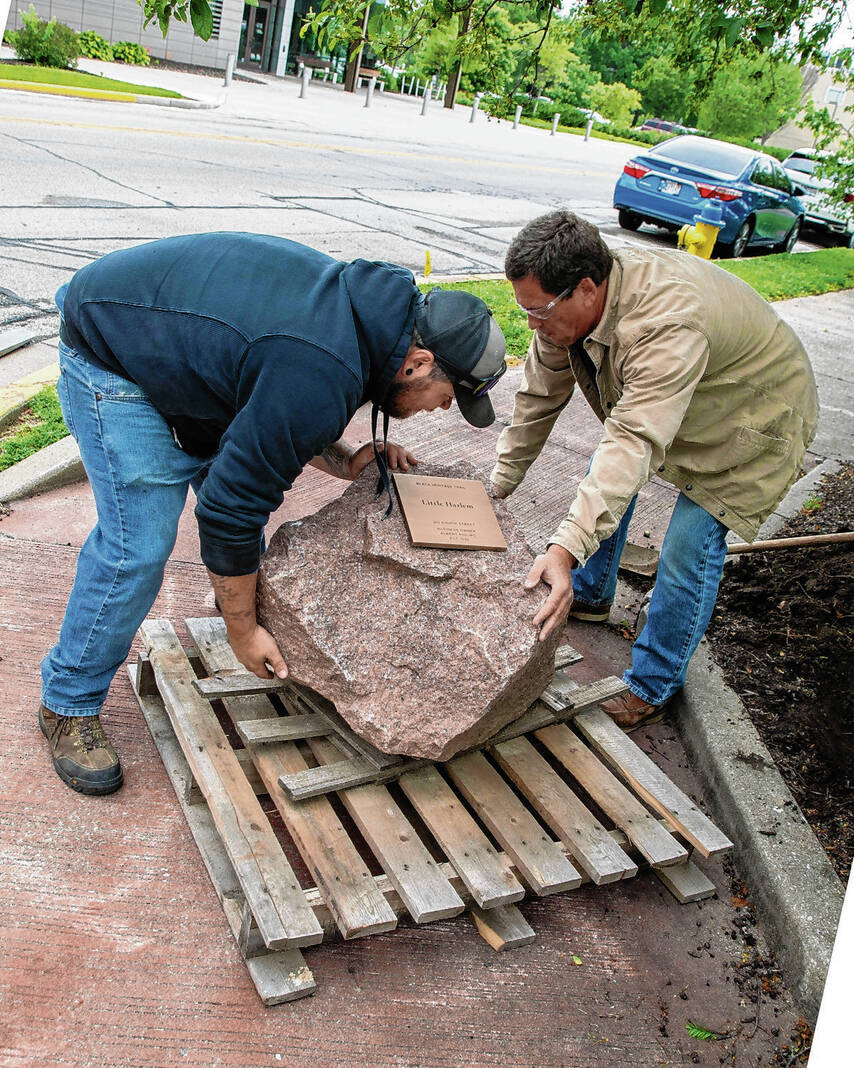
Photo by Hadley Fruits A marker on Eighth Street is placed on a boulder and is shown being installed.
Downtown Columbus welcomes you to take a trip through history with the opening of the new Black Heritage Trail. Created by Columbus resident Paulette Roberts, this walking tour features 10 bronze markers placed in the sidewalk paying tribute to historic Black-owned businesses.
According to Roberts, during trips she took with her family around the country, she saw flyers and tours for historical places around cities. Knowing that Columbus had some history to highlight, she started researching and found these historic Columbus locations from the late 1800s and mid-1900s. She began the trail then in 2005 with a flyer and tours, which continued to evolve into the new markers.
The markers, created by Garland Brook Cemetery and installed by Taylor Brothers Construction, each display the name of the business, its location, owner and establishment date. One marker, located on Eighth Street, is placed on a granite boulder rather than on the sidewalk, Roberts said.
“It looks wonderful because it stands out,” Roberts said.
Sites chosen include the Noah Roberts Barbershop, established in 1915 by Noah Roberts, the Imes and Washington Barbershop, established in 1899 by Harry Imes and James Washington, and the Goins Hotel, established in 1928 by Elmer and Lydia Goins. Another business Goins operated, a shoe-shining parlor named Yellow Front, is also featured on the trail.
“He operated that for over 53 years, and I thought one thing (that) was unique about this shoe-shine parlor was that he had shined shoes for William Jennings Bryan and also President William McKinley,” Roberts said. “So there’s a marker for that on Washington Street.”
Other historic businesses include Art Beauty Shop, established by Cora Stewart in 1916 and one of the first beauty shops in Columbus, the Hammond’s Cafe, established by Elijah Hammond in 1903, and the Annex Barber and Beauty Shop, established by Grant Smith in 1908.
In addition to businesses, the site where Frederick Douglass delivered a speech in 1873 is also included on the trail. Located at the former Crump Opera House, Douglass had delivered a speech centered on anti-slavery and the future of the country, Roberts said.
“So that happened back in January of 1873 and when I found out that during the research, I was just amazed that he had put his footprint here in Columbus,” Roberts said.
The Black Heritage Trail will open with a ribbon cutting ceremony from 5 to 7 p.m. Thursday in the 6th Street Arts Alley, hosted by Landmark Columbus Foundation and the African American Foundation. The ceremony will feature speeches from Roberts, historian Brenda Pitts and Mayor Mary Ferdon, in addition to remarks from living relatives of Albert Philips and Wayne Handley, two business owners whose businesses are included in the trail.
Handley established the Postal Shining Parlor in 1913, while Philips established Little Harlem, which Roberts described as a bar. She said it was known for its activity from World War II veterans and the local community.
“The soldiers didn’t have a place to, I guess, burn off some energy. So it was opened as a gathering place, the Atterbury guys that look like me didn’t have a place to go. So the bar was opened up in 1942 to 1954, and then someone else bought it and renamed it,” Roberts said. “But my father was honorably discharged from Atterbury and I can see in my mind that he probably frequented Little Harlem when he was here at Atterbury.”
Roberts said she loves how the markers came out and she looks forward to the ribbon cutting ceremony. When people walk by and see these markers, she believes that they take away that Black people have been here for a long time and are a prominent part of Columbus heritage, both then and now.
“We have been working on the markers for just about a year or so and we’re just so excited that it has come to light. We wanted to preserve this history because we had nothing in Columbus that showed the amount of time and effort that had been put into our culture from the late 1800s to now,” Roberts said. “So that’s what we decided that we need markers so that the young people would have something to refer to about the heritage that we are sharing with the community.”