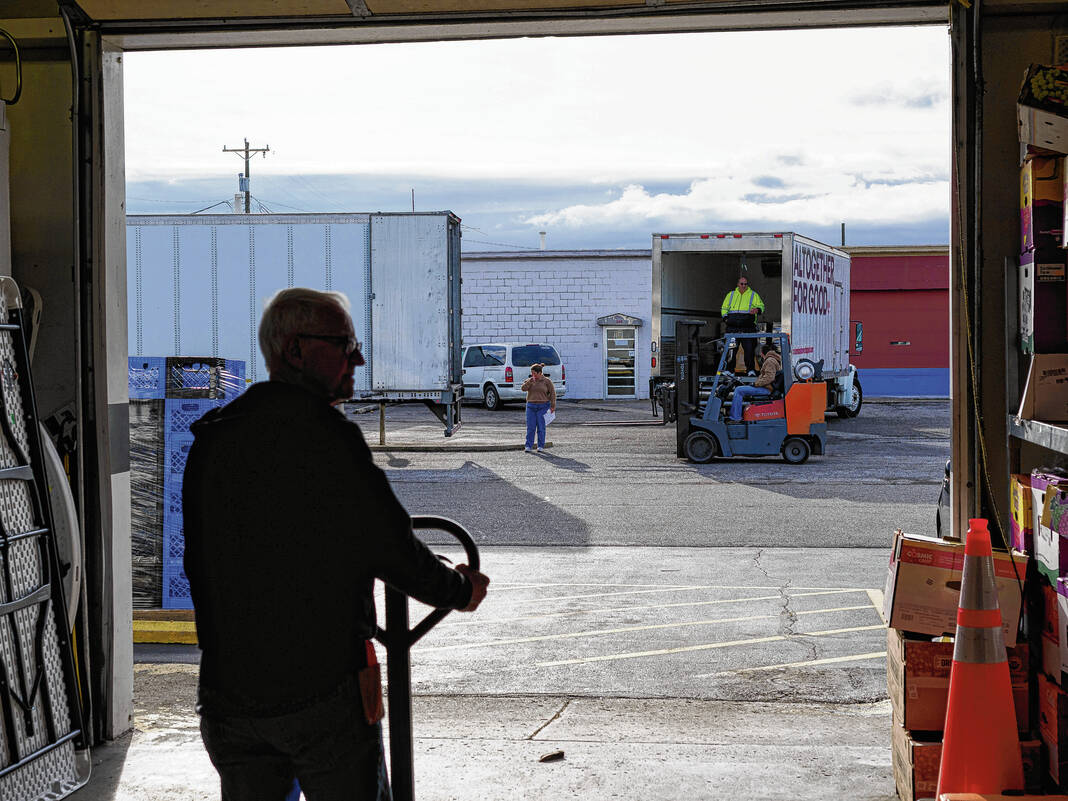
Mike Wolanin | The Republic Volunteers unload a food delivery to the Love Chapel Food Pantry from the Church of Jesus Christ of Latter-day Saints at the Love Chapel Food Pantry in Columbus, Ind., Monday, March 31, 2025.
Food pantries in Bartholomew County are concerned about a potential increase in demand for food assistance due to federal funding cuts to food stamps included in President Donald Trump’s “big, beautiful bill.”
The bill includes, among other things, $4.5 trillion in tax breaks paid for, to some degree, by significant cuts to health care and nutrition programs, including the Supplemental Nutrition Assistance Program, or SNAP.
The nonpartisan Congressional Budget Office estimates that the bill will add $3.4 trillion to the federal deficit and cut nutrition funding, including SNAP, by $186 billion from fiscal years 2025 to 2034, including nearly $8 billion in fiscal year 2026, which starts in October.
Republicans and the White House have disputed the Congressional Budget Office’s findings.
Trump signed the bill into law on Friday after it cleared the House and Senate in close votes. The congressional delegation representing Columbus — Reps. Jefferson Shreve and Erin Houchin and Sens. Todd Young and Jim Banks — all voted for the measure.
“Certainly I have concerns,” said Love Chapel Executive Director Kelly Daugherty. “…In general, yes, my fear is that we will see an increase in people seeking assistance because of SNAP benefits being eliminated or reduced.”
“So much of it is the devil’s in the details, and we don’t really know how they’re going to enforce this and exactly who’s going to get hurt, who’s not going to get hurt,” Daugherty added later in the interview.“…We’re worried about it, but we don’t know exactly how much to worry yet.”
In May, nearly 5,700 Bartholomew County residents — 2,855 households — relied on food stamps, with benefits totaling just over $1 million that month alone, according to the latest data from the Indiana Family and Social Services Administration.
That comes out to nearly 7% of all Bartholomew County residents and 9% of all households in the county, according to U.S. Census Bureau population estimates. On average, each local recipient received $191.27 in SNAP benefits in May.
Last year, Bartholomew County residents collectively received nearly $13.7 million in food stamp benefits, according to FSSA.
A total of 1,208 households — around 4,900 people — turned to Love Chapel, 292 Center St., for help with food last month, Daugherty said. While that was a decrease from 1,320 families the month before, it is up from the average of 750 families per month in 2022.
Daugherty said he is worried that changes to SNAP benefits in the bill may reverse the progress made so far this year in reducing the number of local residents needing help with groceries.
“Any progress is good, but we’re worried about what’s going to happen with the ‘big, beautiful bill,’” Daugherty said.
For its part, the Salvation Army, 2525 Illinois St., served nearly 500 families during the first 21 days of June, which was an increase compared to the full-month total in May.
“We’re definitely already seeing an increase,” said Nancy Johnson, social services manager at Salvation Army. “…We’re averaging over 10 new families a week. And that’s really quite a few when you think about it. …We’re seeing a lot of Hispanics. We’re seeing a lot of Haitians.”
Johnson said she believes the increase in demand is being driven by, in part, Indiana’s decision to opt out of a summer program for hungry school children through direct payments to families.
“That benefit has not happened this summer,” Johnson said. “I know that (the families) can still get some free lunches and breakfast, but here again, parents have to drive to them. ‘Do I drive to school and take my kids to eat there for breakfast? And then, ‘Oh, wait a minute, we’ve got to go back in two or three hours for (the children) to be able to do the same thing for lunch.’ So, you’ve got to weigh the cost of gas and time as to the free meals they can get.”
Feeding America, the nation’s largest hunger-relief network, also expressed concerns about the funding cuts in the bill, characterizing them as a “significant setback for people and communities facing barriers to accessing the food and resources they need to thrive.”
“At a time when food insecurity is rising nationwide, this legislation threatens to worsen the crisis, taking away access to food and health care from millions of people, including children, seniors, veterans and people with disabilities,” Feeding America CEO Claire Babineaux-Fontenot said in a statement last week as the bill was passed.
Gleaners Food Bank of Indiana, which is one of Love Chapel’s sources for food, is part of the Feeding America network. Gleaners did not respond to a request for comment on the legislation.
However, Gleaners CEO Fred Glass characterized the then-proposed cuts to SNAP in May as a “needless, self-inflicted humanitarian and economic disaster for Indiana and the country.”
“These cuts would be primarily achieved by purportedly ‘shifting,’ in Indiana’s case, 25% of SNAP costs from the federal government to state taxpayers,” Glass said in a statement in May.”
Congressional Republicans have argued they are trying to right-size safety net programs for the population they were initially designed to serve, mainly pregnant women, the disabled and children, and root out what they describe as waste, fraud and abuse, The Associated Press reported.
The bill includes new 80-hour-a-month work requirements for many adults receiving Medicaid and food stamps, including older people up to age 65, according to wire reports. Parents of children 14 and older would have to meet the program’s work requirements.
Around 40 million people use SNAP, though most of them already work, according to analysts.
Republicans are also looking to have states pick up some of the cost for SNAP benefits, according to wire reports. Currently, the federal government funds all benefit costs. Under the bill, states beginning in 2028 will be required to contribute a set percentage of those costs if their payment error rate exceeds 6%. Payment errors include both underpayments and overpayments.
Indiana’s error rate was 9.5% during fiscal year 2024, according to the most recent figures from the U.S. Department of Agriculture.
“Indiana’s state government couldn’t absorb these costs even if it wanted to,” Glass said. “…If this proposed federal legislation becomes law, the responsibility to provide $356 million in SNAP benefits will shift from the federal government to Indiana state government. Assuming the state is unable to take this action, Hoosiers in need will lose access to 133 million meals.”
Shreve has touted language he authored on funding for a border along the U.S.-Mexico border that was included in the final version of the bill, as well as tax cuts, emphasizing in a statement last week that the measure “provides tax relief for ALL Americans.”
“The bill’s removal of the tax burden on tips, on Social Security and on overtime will leave more money in the pockets of hardworking Hoosiers,” Shreve said in a statement Thursday following the bill’s passage. “We’re delivering meaningful results for Hoosier families, workers and employers alike.”
Houchin described the bill in a statement as the “most conservative legislation we’ve passed in a generation.”
“This bill makes the Trump tax cuts permanent, ends taxes on tips and overtime, slashes wasteful spending, secures our border, unleashes American energy and restores accountability across the federal government,” Houchin said in a statement following the bill’s passage on Thursday. “For families in southern Indiana, it means more money in their pockets, fewer burdens from Washington and greater opportunity.”
Under the bill, the wealthiest households would see a $12,000 increase from the legislation, and the bill would cost the poorest people $1,600 a year, mainly due to reductions in Medicaid and food aid, according to an analysis by the Congressional Budget Office.
Locally, most of the people who go to Love Chapel for help with food are already getting food stamps, Daugherty said.
“Unfortunately, the SNAP benefit system has never been that robust,” Daugherty said. “Otherwise, they wouldn’t have to come to the food pantry if they got SNAP benefits. I met a lady we had at one of our food insecurity screening coalition meetings … and she had a family with five children, and she was getting $300 a month.”
“It’s already an inadequate system that does not provide good nutrition,” Daugherty added. “Any studies you ever read, the No. 1 thing is if you can get money for food, it reduces health costs, it reduces all kinds of different problems within our society. And so, it’s sad.”