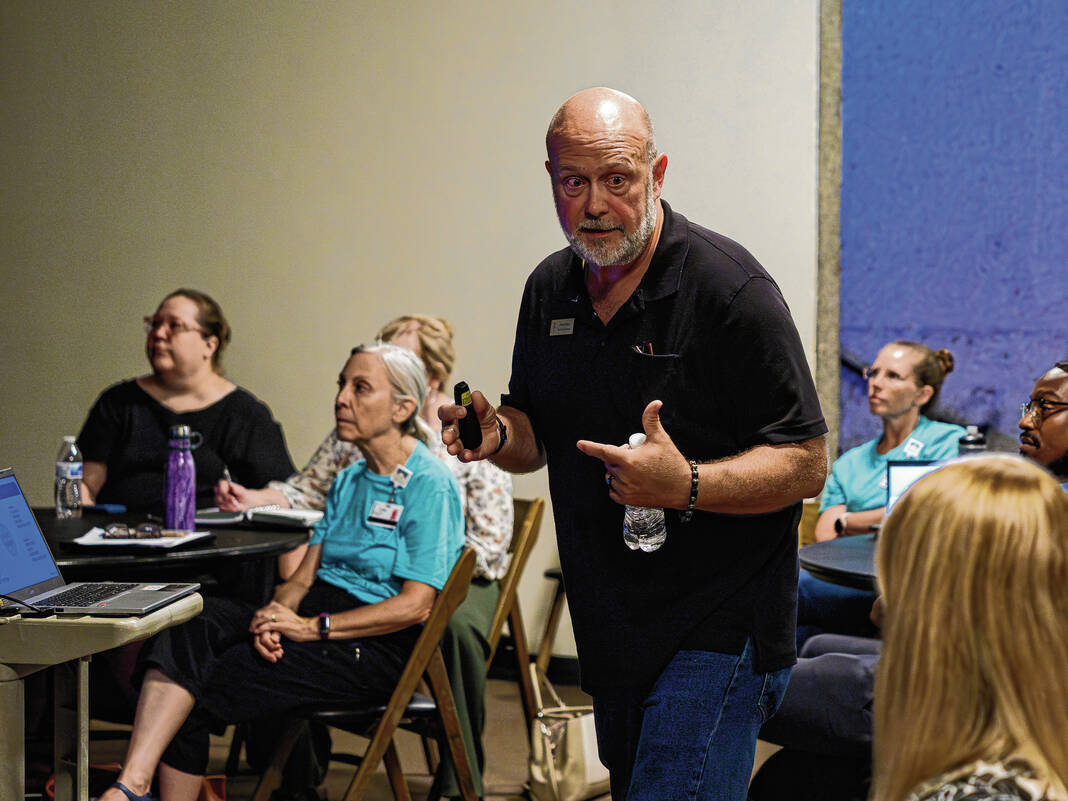
Mike Wolanin | The Republic Chuck Kime, executive director of Foundation for Youth, gives a presentation on Adverse Childhood Experiences during a Health Equity Ambassador open meeting at The Lex in Columbus, Ind., Tuesday, July 22, 2025.
Ambassadors of the Health Equity Ambassador program met at The LEX Tuesday night to discuss the future of Mental Health Matters and its next community-wide initiative focusing on self-healing communities.
Following a brief introduction from Project Manager Vachel Hudson, Healthy Communities Director Lisa Crane opened by discussing the rebrand Mental Health Matters will be undergoing from “A Bartholomew County Initiative” to “A Healthy Communities Initiative,” to reflect Mental Health Matters becoming a Healthy Communities Action Team.
The Ambassador Group will remain as well as the Five Elements of Mental Well-Being and the teams created from that. Leaders within Mental Health Matters will become the Action Team. This year also marked the end of Mental Health Matters’ three-year cycle and their transition into the next one.
“So now we’re in 2025,” Crane said. “We’re continuing to implement strategies and work towards sustainability.”
Crane also delivered feedback on a survey ambassadors took during their previous meeting, which asked what a shift from solely mental health to health equity would look like to them.
Points raised from the survey include more in-depth assessments of health care assets and gaps, embracing the SAMHSA model to expand beyond just mental health and strengthening partnerships with local businesses, schools and churches.
“We will continue to support and to grow the ambassador network, we will continue to have an ambassador coordinator. We are going to define the recruitment strategy and the ambassador onboarding process,” Crane said. “We did hear pretty loud and clear that you would really like to really define how do we determine, how do we choose, how do we pick an ambassador.”
Foundation for Youth Executive Director Chuck Kime also led a discussion Tuesday night on ACEs, or Adverse Childhood Experiences. These are defined as potentially traumatic events, such as experiencing abuse, witnessing violence in the home or community and substance use problems, that occur in childhood, according to the CDC.
ACEs can be counteracted by treating children positively, building strong relationships with others and building a caring and supportive community, Kime said. The meeting concluded with ambassadors asking what the community can do to help counteract ACEs, such as a greater sense of understanding of what a child may be going through.
“I think what would be the greatest of all outcomes would just be to spread this information around so that not only practitioners but families know and employers know, and then we can begin to talk about next steps,” Kime said following the meeting.
To learn more about ACEs, contact Kime at chuck@foundationforyouth.com. If anyone is interested in joining Mental Health Matters, visit mhmbc.org.