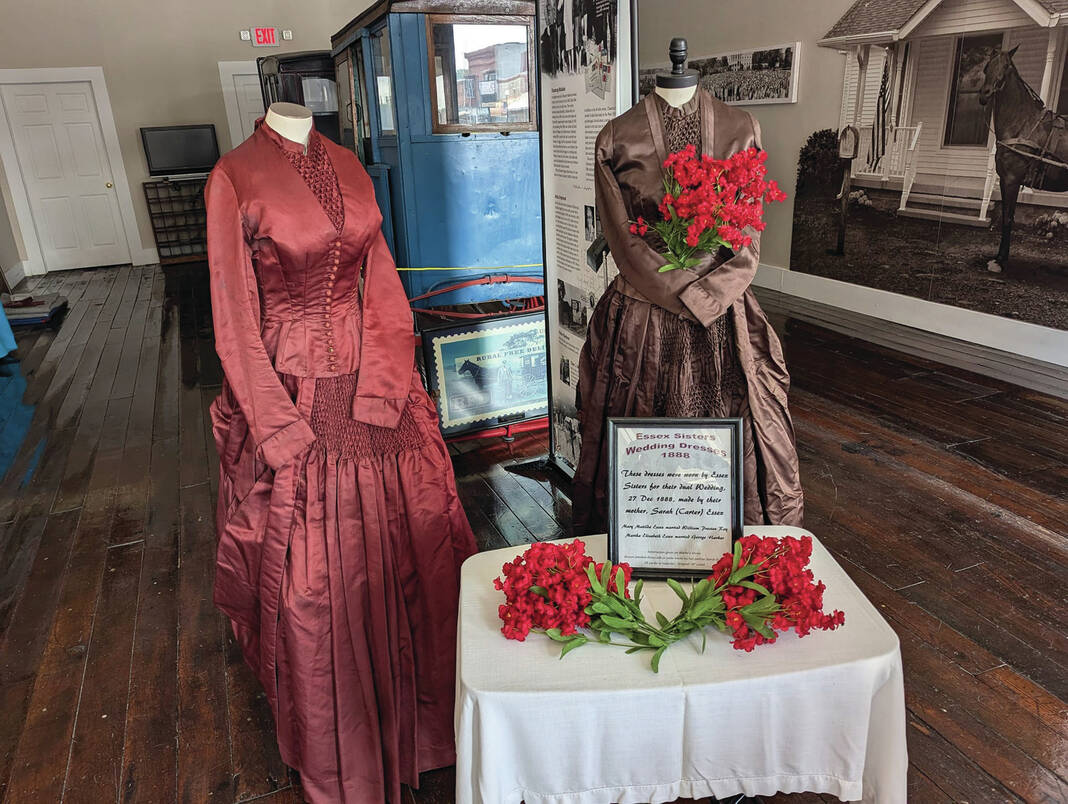
Family talks often involved a variety of family artifacts. One of the largest family talks, the Essex family, featured the gorgeous, handmade gowns of the Essex sisters. The sisters had a double wedding on December 27, 1888. Picture Provided
Photo Provided
For an anniversary as golden as 50, Kim Ray knew she wanted to create something special for the Yellow Trail Research Center. Reviving an idea she had five years ago, called First Families of Hope, Kim knew that the Bartholomew County Genealogical Society would be perfect to take on a massive project.
The Yellow Trail Research Center and Bartholomew County Genealogical Society began their planning in January 2024 and launched their First Families of Hope talks just a month later. They wanted the project to recognize and honor the pioneer families of Hawcreek and Flat Rock townships.
They planned to host the talks every first Saturday for the next 19 months. While they didn’t have a complete direction, definition or criteria for the project, they hoped going ahead and launching the project to the public would help with data collection and give the project the life it needed.
“Eventually, we were able to define a First Family: a husband, wife and children; a married couple or a single adult,” says Kim Ray, who leads the project. “There is only one criteria for a First Family: at least one of the adults in the First Family was in Hawcreek or Flat Rock Township by 1840.”
The project was divided into three groups, with the first two groups being the surnames for the First Family talks. The first group of names included seven families who met for the first Moravian Church service in 1830. This included Martin Hauser, the founder of Hope. For the second round of Founding Family talks, the Research center chose 12 families from the pioneers who purchased an original land tract in Hawcreek or Flat Rock township by 1840.
The First Families of Hope Talks were designed as information gathering events, and the public participated in many ways. Talks are laid back and very informal, allowing the conversation to flow with the group’s interests. The public has been encouraged to bring photos, documents or any other items from their families to share with the group.
“Hope is a unique setting for genealogy,” says Kim. “When someone donates photos of their great-grandmother, it benefits half of Hope, due to the close relationships. With strong family ties over so many generations, there is a connection to a First Family of Hope in everyone’s family.”
The First Family of Hope Talks were also live streamed for anyone who was unable to attend in-person. They were then posted on the Yellow Trail Museum’s Facebook page, “with views continuing long after the talk is over,” says Kim. The live streams are taken down after a month, but the stats have way surpassed those working on the project’s expectations. “We have averaged 130 viewers per Talk and have had as many as 1,400 viewers during the month following the First Family Talk,” she says.
The First Families of Hope Talks didn’t just have Indiana residents in attendance, according to Kim, with people attending from all over Indiana and from as far as California.
“We had two Spaugh cousins, one from Arizona and one from Michigan, that were so excited about the project, they planned a week-long vacation around the Spaugh Family Talk.” The Spaugh’s vacation included a tour of the Moravian church, Norman’s (Spaugh) Cabin and God’s Acre, the historic, northern section of the Moravian Church’s cemetery.
Descendants of the Wilson and Rominger families came all the way from Florida and California, respectively, to facilitate their families’ talks. According to Kim, “With the Carter Family Talk, we found out there are at least seven totally separate, unrelated Carter families in Bartholomew County.”
The First Family of Hope Talk’s largest gathering was for the Essex Family. Where there were 30 people present and over 1,400 live stream views before the live stream was taken down. The Research Center displayed two wedding dresses that were in the museum’s collection. They belonged to two Essex sisters, Mary Matilda (Essex) Ray and Martha Elizabeth (Essex) Harker.
“The sisters had a double wedding just after Christmas, December 27, 1888,” explains Kim. “The dresses, one brown and one burgundy, were handmade by their mother, Sarah Pence (Carter) Essex.”
The remaining 31 families made up a third group, completing 50 surnames for the 50th anniversary of the Yellow Trail Research Center. Unfortunately, this group would not be announced or have talks as time did not allow. However, biographical sketches of these 31 surnames, as well as the other 19 from the earlier groups, will be posted to the Research Center’s website.
The biographical sketches are a page long including photos. In addition to the talks and biographical sketches, the Research Center has been updating Find a Grave with information they have found during their research. They are also creating decks filled with informational cards.
These cards will provide a basic amount of information to help families and researchers find more information on their relatives. Included on the cards will be the names of husbands, wives and children, birth and death years, and the year they came to Hawcreek or Flat Rock township. Symbols will also be present that indicate where researchers can find more information. For example, there is a symbol that tells you if they are buried in God’s Acre.
Each deck will include 52 cards, one card for each of the 50 First Families, a card explaining symbols you may see throughout the deck, and a card explaining the Bartholomew County Genealogical Society’s project along with a short history of the Yellow Trail Museum. The Bartholomew County Genealogical Society plans to purchase several decks of cards that will be given to the Yellow Trail Research Center for fundraising purposes.
The Yellow Trail Research Center will also be displaying the 50 First Families of Hope biographies during the Hope Heritage Days, September 26-28. The Yellow Trail Museum Board, led by President Bill Johnson, is planning a 50th birthday party that will highlight the First Families of Hope on Saturday, September 27, during the Hope Heritage Days. The Museum Board has been selected to Grand Marshall for the Heritage Days parade, which is on Sunday, September 28.
The final family in the First Families of Hope Talks series is the Reed family and will take place on Saturday, August 2 from 10 a.m. to noon at the Yellow Trail Research Center located at 644 Main St. in Hope. For more information about the First Families of Hope project, visit theyellowtrailmuseum.org or check out their Facebook page, The Yellow Trail Museum & Visitors Center.